Education Overview
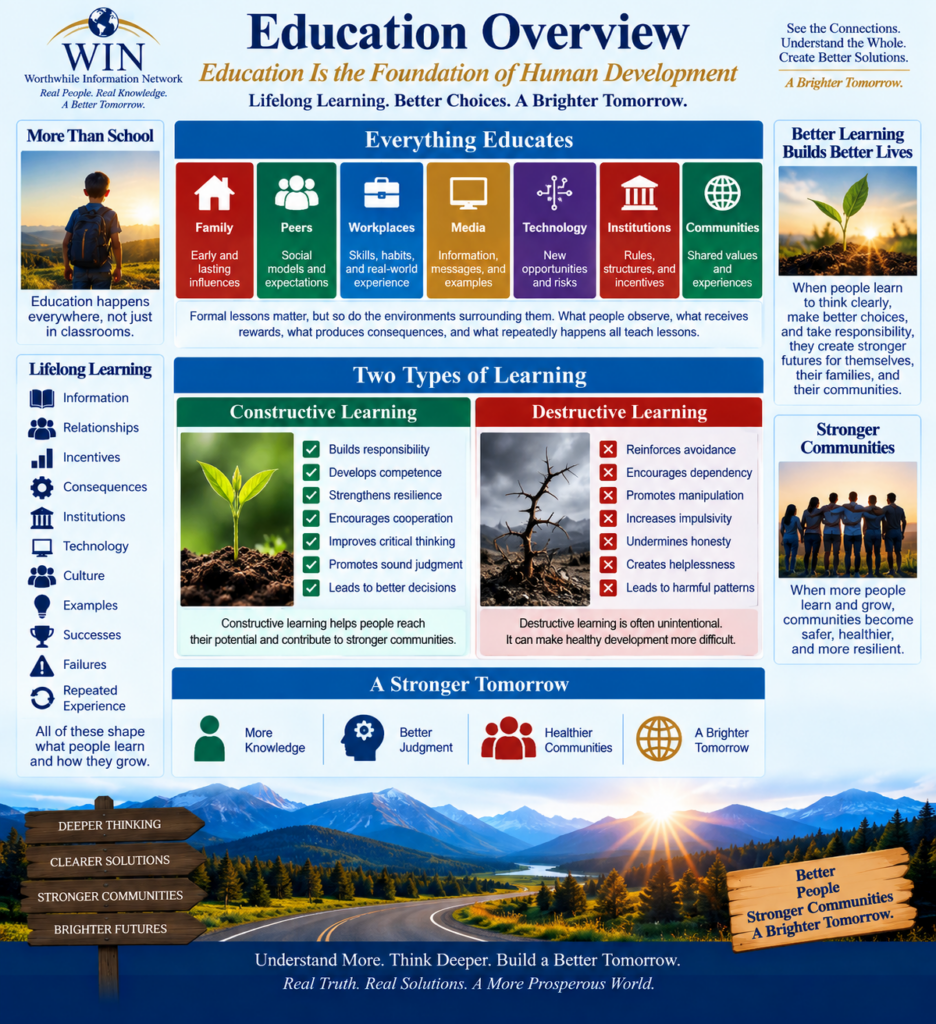
Education Overview
Education Is the Foundation of Human Development
Worthwhile Information Network (WIN) approaches education as a lifelong developmental process rather than something that occurs only in schools.
People continually learn from:
information;
relationships;
experiences;
incentives;
consequences;
institutions;
technology;
culture;
examples;
successes;
failures;
and repeated patterns in everyday life.
Some education is intentional.
Much of it is not.
WIN’s educational objective is therefore broader than delivering information.
It is to help people develop the knowledge, reasoning, judgment, habits, capabilities, and responsibility needed to make better-informed decisions and continue improving throughout life.
Education, in this broader sense, is part of the infrastructure through which human beings develop.
Education Is More Than Schooling
Schooling is one important form of education.
But education begins before formal schooling and continues long after it.
A child learns from how adults respond to questions.
An employee learns from what a workplace rewards.
A consumer learns from repeated advertising.
A citizen learns from institutions.
A person learns from success and failure.
Communities transmit expectations and norms.
Technology shapes what information people encounter and how they interact with it.
Consequences teach.
Examples teach.
Environments teach.
This is why WIN distinguishes education from the narrower concept of formal instruction.
WIN explores this larger role through Education as Infrastructure.
Everything Educates
One of WIN’s foundational educational concepts is:
Everything Educates.
This does not mean every influence teaches equally or intentionally.
It means human beings are continually exposed to experiences from which learning can occur.
What people observe can teach.
What receives rewards can teach.
What repeatedly produces consequences can teach.
What authority tolerates can teach.
What families model can teach.
What peers normalize can teach.
What technology repeatedly presents can teach.
Families, schools, peers, workplaces, media, technology, institutions, communities, and culture all contribute to learning environments.
Understanding this broader educational environment helps explain why information alone does not always change behavior.
WIN examines this concept more fully through Everything Educates.
Constructive and Destructive Learning
Education is not automatically beneficial merely because learning occurs.
Some experiences can strengthen:
responsibility;
competence;
resilience;
cooperation;
curiosity;
critical thinking;
self-control;
sound judgment;
and constructive independence.
Other experiences may unintentionally reinforce:
avoidance;
dependency;
manipulation;
impulsivity;
dishonesty;
helplessness;
poor reasoning;
or other harmful patterns.
WIN refers to this possibility as Destructive Education.
The term is not an accusation against teachers, parents, schools, or any particular institution.
It is a framework for asking:
What is the person actually learning from this experience?
That question can reveal a difference between what an environment intends to teach and what repeated experience may actually be teaching.
Human Development Is the Larger Context
Education does not occur in isolation.
People differ in:
biology;
development;
prior knowledge;
experiences;
relationships;
abilities;
opportunities;
environments;
expectations;
and learned responses.
The same educational experience can therefore affect different people differently.
WIN’s Human Development work examines these interacting influences across a person’s lifetime.
Its Human Developmental Framework provides a more detailed way to consider how knowledge, beliefs, assumptions, experiences, habits, expectations, values, relationships, social influences, and feedback can interact with biological and developmental characteristics.
This matters educationally because effective teaching begins with a basic reality:
learners do not all arrive at the same starting point.
Development Occurs Through Loops
Human development is rarely a single event.
Experiences influence expectations and habits.
Expectations and habits influence choices.
Choices produce consequences.
Consequences influence later expectations and behavior.
Those later choices create additional experiences.
WIN describes these recurring processes as Developmental Loops.
Constructive loops can gradually strengthen capability and responsibility.
Destructive loops can make unhealthy patterns increasingly difficult to change.
For example:
Practice
↓
greater competence
↓
greater confidence
↓
more willingness to practice
↓
still greater competence
But another loop might become:
Repeated failure
↓
lower confidence
↓
avoidance
↓
less practice
↓
slower improvement
↓
additional failure
Understanding the loop can reveal why a problem continues even after its immediate symptoms have been addressed.
It can also reveal where a constructive intervention might alter the trajectory.
Education Should Develop Capability
The purpose of education should not be reduced to remembering information.
Information matters.
But a capable person also needs to know how to use information.
WIN’s educational direction therefore emphasizes development of capabilities such as:
finding relevant information;
evaluating evidence;
distinguishing evidence from assumption;
recognizing uncertainty;
asking useful questions;
comparing explanations;
reasoning about causes;
identifying incentives;
considering consequences;
recognizing manipulation;
understanding systems;
learning from mistakes;
communicating constructively;
and revising conclusions when stronger evidence becomes available.
The larger objective is not simply knowing more.
It is becoming increasingly capable of understanding, deciding, acting, learning, and correcting responsibly.
Education Should Improve Decision-Making
Knowledge becomes particularly important when it influences decisions.
Knowing facts is valuable, but people also need ways to:
evaluate claims;
compare alternatives;
recognize uncertainty;
understand consequences;
identify assumptions;
consider probabilities;
detect manipulation;
reconsider beliefs;
and learn from outcomes.
WIN’s Foundations of Responsible Decision-Making develops these capabilities in greater detail.
The goal is not to tell people what to think about every issue.
It is to strengthen the processes by which people determine:
what deserves to be believed;
what remains uncertain;
and
what actions are reasonably likely to produce better outcomes.
Education Should Not Become Indoctrination
Education becomes dangerous when it teaches conclusions while disabling the learner’s ability to question them.
WIN’s educational objective is not to produce people who simply repeat WIN’s terminology or conclusions.
Learners should be encouraged to ask:
What is the evidence?
How strong is it?
What assumptions are being made?
What alternative explanations exist?
What would weaken this conclusion?
What would cause WIN to change its position?
Could WIN itself be wrong?
A strong educational system should develop people capable of questioning the educational system itself.
That principle applies to WIN.
Real Truth and Intellectual Humility
WIN uses the phrase Real Truth to emphasize that reality does not change merely because a belief is:
popular;
emotionally appealing;
politically convenient;
profitable;
traditional;
or institutionally established.
At the same time, human understanding is imperfect.
Educational material should therefore distinguish:
evidence from interpretation;
observation from inference;
confidence from certainty;
and established knowledge from provisional explanation.
It should acknowledge uncertainty, compare competing explanations, and remain correctable when stronger evidence becomes available.
Teaching confidence without the ability to reconsider can be as dangerous as teaching people nothing at all.
Evidence Is Part of Education
People increasingly encounter information from many sources.
Some is accurate.
Some is incomplete.
Some is misleading.
Some is deliberately manipulative.
Some is technically true but presented without essential context.
Some comes from credible experts.
Some merely looks authoritative.
Education should therefore include the ability to evaluate evidence rather than merely consume information.
WIN’s How We Evaluate Evidence framework introduces questions about:
source quality;
independence;
replication;
measurement;
population and context;
competing explanations;
causal inference;
uncertainty;
and practical significance.
The objective is not universal skepticism.
It is disciplined judgment about what the available evidence actually supports.
Real Root Cause
Many recurring problems are addressed primarily at the level of visible symptoms.
WIN uses the concept of Real Root Cause to encourage deeper examination of conditions that allow a problem to:
begin;
persist;
return;
or change form.
This does not assume that every problem has one simple cause.
Human outcomes frequently involve interacting:
developmental;
environmental;
institutional;
informational;
economic;
social;
and personal factors.
Education should help learners distinguish a convenient explanation from a sufficiently supported causal explanation.
Systems Thinking
Actions occur within systems.
A change in one part of a system can alter:
incentives;
behavior;
resources;
expectations;
relationships;
and outcomes elsewhere.
WIN therefore introduces Systems Thinking to help learners examine:
feedback loops;
unintended consequences;
delayed effects;
tradeoffs;
adaptation;
system boundaries;
and the difference between short-term improvement and durable improvement.
One useful systems-thinking question is remarkably simple:
And then what?
From Information to Understanding
Memorizing information is not the same as understanding it.
A learner may be able to repeat a definition without recognizing the concept in a real situation.
A person may memorize a rule without understanding why it exists.
Someone may remember an example but be unable to apply the principle to a new problem.
Educational material should therefore help learners:
connect facts;
recognize patterns;
explain relationships;
test explanations;
apply concepts;
identify exceptions;
and explain why a conclusion follows from the evidence.
Understanding becomes more visible when knowledge can be transferred to situations that were not memorized in advance.
Application Reveals Understanding
Suppose someone memorizes:
Correlation does not necessarily establish causation.
That is useful.
But deeper understanding appears when the learner encounters a new claim and asks:
Could another variable explain both observations?
Could the direction of causation be reversed?
Is there evidence of a plausible mechanism?
What comparison would help distinguish among explanations?
Application turns a remembered sentence into a reasoning capability.
For this reason, future WIN education should increasingly use:
examples;
questions;
scenarios;
comparisons;
case analysis;
reflection;
application;
and assessment.
Mistakes Should Become Educational Information
Errors can reveal where understanding is incomplete.
If a learner gives the wrong answer, the educational question should not end with:
Wrong.
A more useful question is:
Why did that answer appear reasonable?
Perhaps the learner:
misunderstood a concept;
missed relevant information;
used an incorrect assumption;
applied the right rule in the wrong context;
or understood the material but made a simple mistake.
Different causes require different educational responses.
This principle connects education with WIN’s Learning From Failure framework.
Feedback Should Help Learners Improve
Assessment is most useful when it does more than classify performance.
Good feedback can help a learner understand:
what was correct;
what was incorrect;
why;
what remains uncertain;
what concept needs additional work;
and what to try next.
A score can summarize performance.
It does not necessarily explain it.
WIN’s future educational systems should therefore treat assessment as part of the learning process, not merely as a gate at the end of it.
Learning Should Be Developmental
Advanced material should build on foundations rather than assuming every learner begins with the same knowledge or skills.
WIN’s future learning architecture is intended to organize material into understandable progressions.
Learners should be able to strengthen foundational capabilities before moving into more complex subjects.
Where appropriate, progress should reflect demonstrated understanding, not simply:
time spent on a page;
attendance;
completion of a checklist;
or exposure to material.
This does not require every learner to move at exactly the same pace.
Developmental education should recognize different starting points while preserving meaningful standards.
Accessibility Is Part of Educational Design
Information that people cannot reasonably access is less useful educationally.
Future WIN education should therefore consider accessibility from the beginning rather than treating it merely as a later technical addition.
That can include attention to:
clear language;
readable structure;
visual accessibility;
device compatibility;
alternative text;
navigation;
captioning where applicable;
and reasonable accommodation of different ways people access information.
Accessibility does not require eliminating intellectual difficulty.
It means avoiding unnecessary barriers to learning.
Education and Personal Responsibility
Understanding the influences on human behavior does not eliminate personal responsibility.
People can learn.
They can reconsider.
They can make choices.
They can change direction.
At the same time, people’s knowledge, capabilities, opportunities, and developmental conditions differ.
WIN’s educational approach therefore seeks to combine:
realistic understanding of developmental and environmental influences
with
increasing individual capability, judgment, and responsibility.
Greater understanding should expand the ability to make informed choices.
With that capability can come greater responsibility for what a person chooses to do next.
Education Should Help People Recognize Manipulation
Modern information environments can expose people to:
selective information;
emotional appeals;
misleading statistics;
false dilemmas;
repetition;
social pressure;
authority cues;
algorithmic amplification;
advertising;
propaganda;
and persuasive content designed to influence behavior.
The objective should not be to teach people that everything is manipulation.
That would create another distortion.
The educational objective is to develop enough reasoning capability that people can ask:
What am I being asked to believe or do?
What evidence supports it?
What information may be missing?
Who benefits if I accept this claim?
What alternative explanation should I consider?
Education Should Help People Cooperate
Independent reasoning does not require isolation.
Many human problems require people to work together.
Education should therefore also help develop:
constructive disagreement;
clear communication;
listening;
evidence-based discussion;
intellectual humility;
appropriate compromise;
responsibility;
and the ability to cooperate without requiring complete agreement.
A person who can reason independently but cannot work constructively with other people may still have difficulty contributing to complex collective problems.
Technology Can Expand Education—but It Does Not Automatically Improve It
Technology can potentially make education:
more accessible;
more personalized;
more interactive;
more measurable;
more scalable;
and easier to update.
Artificial intelligence may eventually assist with:
explanations;
practice;
feedback;
adaptive learning;
knowledge retrieval;
content organization;
and identifying areas where a learner may need additional help.
But technology also creates risks.
Systems can provide incorrect information.
Automation can scale mistakes.
Personalization can become manipulation.
Data collection can threaten privacy.
Convenience can encourage overreliance.
Technology should therefore support educational objectives rather than determine them.
The question is not merely what technology can do. It is what educational purpose it should responsibly serve.
Human Judgment Remains Important
Technology can assist education, but educational systems involve judgments about:
accuracy;
development;
ethics;
appropriate boundaries;
learner needs;
privacy;
assessment;
and consequences.
WIN should not assume that automated systems can responsibly replace every human role.
Future educational architecture should determine where automation improves learning and where qualified human judgment, review, or accountability remains necessary.
The Future Active Citizen Educational Pathway
WIN anticipates developing a future educational pathway associated with the concept of an Active Citizen.
Early stages would focus on:
learning;
judgment;
conduct;
evidence;
responsibility;
appropriate boundaries;
and continuing development.
Participation in education would not automatically confer:
organizational authority;
investigative authority;
law-enforcement powers;
or access to sensitive activities.
More advanced responsibilities, if developed, would require separate qualifications, safeguards, accountability, and continuing standards.
The long-term purpose is educational and cultural:
helping people become increasingly informed, responsible, constructive examples within their own communities.
Education Before Expansion
WIN’s long-term educational plans are intentionally larger than the capabilities of the current website.
The present WordPress site is primarily an informational and public-education foundation.
More advanced learning may eventually require a dedicated platform supporting:
structured courses;
learner accounts;
assessments;
progress tracking;
accessibility;
privacy controls;
security;
educational records;
instructor or reviewer functions;
and appropriate administration.
Those capabilities should be developed only when WIN has sufficient:
technical;
educational;
governance;
security;
privacy;
financial;
and operational capacity
to support them responsibly.
A Future Learning Platform Should Serve the Educational Architecture
A sophisticated platform is not the objective.
Learning is the objective.
Technology should therefore be selected only after educational requirements are sufficiently clear.
Questions should include:
What must learners understand?
What capabilities should they demonstrate?
What feedback will help them improve?
What information must be protected?
What should be automated?
What requires human judgment?
How will educational effectiveness be measured?
How will incorrect material be corrected?
How will the system evolve without losing institutional knowledge?
WIN’s Future Learning Platform page introduces this longer-term direction.
Evidence, Review, and Correction
Educational material should not become insulated from criticism merely because it has been published.
WIN intends for important claims and frameworks to remain open to:
evidence;
professional review;
academic criticism;
practical testing;
and revision.
Where material is found to be inaccurate or misleading, correction is part of the educational process.
An educational institution that teaches others to correct their mistakes should be willing to correct its own.
Measure Learning, Not Merely Activity
Educational systems can easily measure what is convenient:
pages viewed;
courses completed;
time logged in;
videos watched;
questions answered;
certificates awarded.
Those measures may be useful.
But they are not automatically evidence that meaningful learning occurred.
Where practical, evaluation should ask whether learners can:
explain concepts accurately;
apply them in unfamiliar situations;
distinguish stronger from weaker evidence;
identify assumptions;
recognize important consequences;
solve relevant problems;
and retain useful capability over time.
Activity is not the same as learning.
Education Should Be Evaluated Too
Educational programs should not be exempt from the standards they teach.
If a course is intended to improve decision-making, WIN should eventually ask whether relevant decision-making capabilities actually improve.
If an educational approach is intended to strengthen evidence evaluation, its effectiveness should be tested.
If learners consistently misunderstand a concept, the problem may not be entirely with the learners.
The instructional design itself may need correction.
This connects education to WIN’s Measurable Outcomes and continuous-improvement principles.
Education Across Generations
WIN’s long horizon makes preservation important.
Educational systems should be designed so future administrators and learners can understand not only current conclusions but also:
the reasoning;
evidence;
definitions;
assumptions;
limitations;
and history
behind them.
Otherwise, future generations may inherit conclusions without understanding why they were reached.
The strongest educational legacy is not a fixed set of answers.
It is a durable capacity to:
learn;
test;
correct;
improve;
and
transmit worthwhile knowledge across generations.
Education Should Preserve the Ability to Improve
Preservation does not mean freezing educational material permanently.
Knowledge changes.
Evidence improves.
Technology changes.
Learners change.
New problems emerge.
Old explanations may become incomplete.
WIN should therefore preserve both:
institutional memory
and
the ability to revise what that memory contains.
Future educators should be able to understand why earlier decisions were made without being forced to preserve them when better evidence becomes available.
Where the Educational Work Is Going
The current website introduces the concepts and architecture.
Future development can progressively add:
structured educational material;
learning pathways;
assessments;
specialized courses;
interactive exercises;
case studies;
professional review;
and other capabilities
as resources and expertise become available.
WIN’s Future Educational Opportunities page describes some of these possibilities.
WIN’s objective is to build that system deliberately rather than prematurely presenting unfinished infrastructure as a completed educational institution.
The Larger Educational Objective
WIN’s educational goal is not simply to transfer WIN’s existing knowledge to other people.
A more durable objective is to help people become increasingly capable of learning for themselves.
That means developing people who can:
find information;
evaluate it;
question it;
connect it;
apply it;
test it;
communicate about it;
learn from mistakes;
and revise their understanding when reality requires it.
If successful, education should eventually make learners less dependent on being told what to think, not more dependent.
The long-term objective is therefore not merely an educated population in the conventional sense.
It is a population increasingly capable of continuing its own responsible development.
Continue Exploring
These pages extend WIN’s educational architecture into human development, learning environments, decision-making, evidence, systems, and future educational development.
The Human Developmental Framework
Foundations of Responsible Decision-Making