Developmental Loops
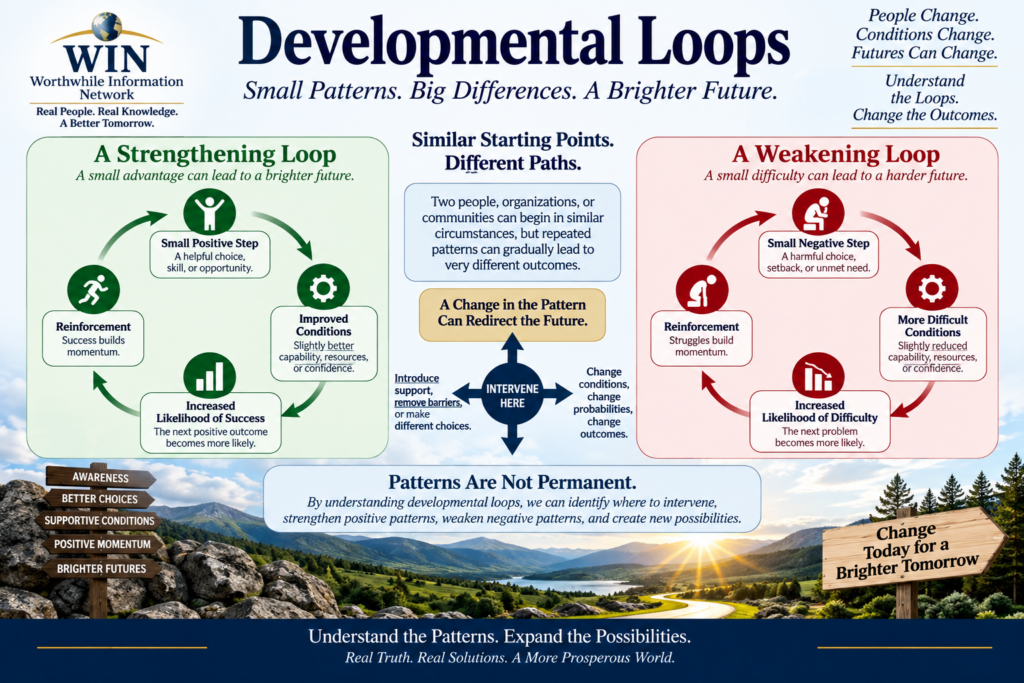
Small Patterns Can Strengthen Over Time
Development rarely occurs through one event alone.
People, habits, organizations, relationships, and institutions are often shaped by repeated interactions in which one result changes the conditions influencing what happens next.
WIN refers to these recurring patterns as developmental loops.
A small advantage can make the next success slightly more likely.
A small difficulty can make the next difficulty more likely.
Repeated over time, those differences can accumulate.
The important idea is not simply repetition.
It is feedback:
What happens now changes some of the conditions affecting what is likely to happen next.
A Simple Real-Life Example
Imagine two children beginning to read at approximately the same level.
One child happens to find a book that captures her interest.
She reads a little longer.
The extra practice makes reading slightly easier.
Because reading becomes easier, she enjoys it more and chooses to read again.
Additional practice improves her skill further.
The pattern can become:
Interest → Practice → Greater Skill → More Confidence → More Reading → Still Greater Skill
Now imagine another child who initially finds reading frustrating.
Frustration leads to avoidance.
Avoidance reduces practice.
Less practice allows the skill gap to grow.
Reading then becomes even more difficult relative to classmates, increasing embarrassment or frustration and making avoidance still more attractive.
The pattern can become:
Difficulty → Frustration → Avoidance → Less Practice → Greater Difficulty → More Frustration
Neither child was necessarily destined for either outcome.
A relatively small early difference may have entered a feedback loop.
Similar Starting Points Can Produce Different Trajectories
Developmental loops help explain why people with apparently similar starting conditions can eventually experience very different outcomes.
The difference may not have begun with a major difference in intelligence, character, motivation, or opportunity.
Sometimes a modest initial event changes behavior slightly.
That behavior changes the next experience.
Repeated feedback gradually enlarges the difference.
This is one reason snapshots can be misleading.
Looking only at where two people are today may reveal very little about the sequence of experiences that helped produce the difference.
This connects directly with WIN’s Human Development approach.
Loops Can Strengthen Capability
Constructive loops appear throughout ordinary life.
A person exercises and feels slightly better.
Feeling better makes another workout easier to attempt.
Repeated exercise improves physical capacity.
Greater capacity makes exercise less difficult.
The person becomes increasingly capable of maintaining the behavior.
Similar patterns can occur with learning, saving money, building relationships, practicing a skill, solving problems, developing professional competence, and gaining confidence through successful experience.
Small improvements can create conditions that make additional improvement easier.
Loops Can Also Work Against Development
The same feedback mechanism can move in the opposite direction.
A student performs poorly and loses confidence.
Lower confidence creates anxiety or avoidance.
Avoidance reduces practice.
Reduced practice contributes to another poor result.
The next poor result appears to confirm the belief:
“I am bad at this.”
What began as difficulty with a task can gradually become a belief about identity.
This does not mean the loop automatically produces destiny.
It means failure can become self-reinforcing when surrounding conditions support avoidance, discouragement, or repeated unsuccessful experiences.
A Workplace Example
Suppose employees in an organization discover that reporting problems produces criticism rather than constructive investigation.
Employees gradually report fewer problems.
Management then receives less accurate information.
With less information, management makes poorer decisions.
Those decisions create additional problems.
Because management does not hear about many of them early, the problems become more serious before they are discovered.
Leadership may then conclude that employees are unreliable and impose tighter controls.
Employees become still less willing to communicate openly.
The organization has created a developmental loop:
Punitive Response → Less Reporting → Worse Information → Poorer Decisions → More Problems → More Punitive Control
The individual actions may appear rational when viewed separately.
The combined system produces an increasingly harmful result.
An Institutional Example
Developmental loops can also operate between institutions and the people they serve.
Suppose people believe an institution will ignore their legitimate concerns.
They become less likely to participate.
Lower participation gives the institution less information about what people actually need.
Decisions become less responsive.
People observe the poor response and become even more convinced that participation is pointless.
The resulting loop can become:
Low Trust → Less Participation → Poorer Information → Less Responsive Decisions → Still Lower Trust
Simply telling people to “trust the institution” would not repair the mechanism.
Changing the loop requires changing the experiences that keep reinforcing distrust.
Positive and Negative Do Not Mean Good and Bad
In feedback analysis, a reinforcing or “positive” loop is one that amplifies change.
It is not necessarily beneficial.
A destructive pattern can reinforce itself just as a constructive one can.
Likewise, a balancing or “negative” loop counteracts change.
It may stabilize something useful or prevent needed improvement.
The important questions are:
What behavior does the loop strengthen?
What conditions weaken it?
What keeps the pattern continuing?
What could alter its direction?
This distinction is important when applying Systems Thinking.
Developmental Loops in Individuals
Human development contains many interacting loops involving knowledge, skill, confidence, expectations, habits, relationships, health, opportunity, consequences, and self-control.
Improvement in one area can sometimes make improvement elsewhere easier.
Better decision-making may reduce avoidable problems.
Fewer avoidable problems can preserve time and resources.
Those resources can support learning, healthier relationships, financial stability, or additional opportunities.
Each improvement can increase the probability of another constructive outcome.
The reverse can also occur.
One difficulty can consume resources needed to address another, producing a sequence in which several problems begin reinforcing one another.
Developmental Loops in Families
Family patterns can also become self-reinforcing.
Consider conflict.
One person expects criticism and therefore becomes defensive before a conversation begins.
The defensive response sounds hostile to the other person.
The other person responds more aggressively.
That aggression confirms the original expectation that the conversation was unsafe.
Both people may leave believing the other person caused the failure.
Repeated often enough, the expectation itself becomes part of the mechanism recreating the conflict.
Changing the loop may require changing not only what is said but the sequence of expectations, reactions, and consequences surrounding the conversation.
Developmental Loops in Institutions
Organizations develop through loops as well.
Accurate information can improve decisions.
Better decisions can improve results.
Better results can increase trust and participation.
Greater participation can provide still better information.
That is a potentially strengthening loop.
Institutional decline can also become self-reinforcing.
Poor information can produce poor decisions.
Poor decisions can reduce trust.
Reduced trust can cause people to withhold information or disengage.
The institution then receives even poorer information.
A system can therefore deteriorate without any individual deliberately attempting to make it worse.
Environment Changes the Loop
Behavior does not develop independently of surroundings.
Incentives, examples, expectations, relationships, access to information, available choices, consequences, institutional rules, and chance events can make entering or escaping a loop easier or harder.
This does not eliminate individual agency.
People make choices.
But choices occur within conditions that can repeatedly make some behaviors easier, safer, more rewarding, more costly, or more difficult.
Understanding development requires examining both.
WIN’s Human Developmental Framework provides the broader structure for examining how these influences can interact with human development.
Early Differences Can Become Large Differences
When a loop repeats many times, small differences can accumulate.
An early advantage in reading, emotional regulation, reliable support, technical skill, access to accurate information, or practice opportunities may create additional opportunities for development.
An early disadvantage may create additional obstacles that compound.
This does not mean early conditions determine destiny.
It means timing can matter because consequences can accumulate.
A modest correction made before a harmful pattern has repeated hundreds of times may require far less effort than repairing the accumulated consequences later.
Timing Can Change the Cost of Correction
Consider a small misunderstanding between two people.
Corrected immediately, it may require a five-minute conversation.
Left unresolved, it may affect later interactions.
Each person begins interpreting new events through the previous misunderstanding.
Resentment develops.
Communication declines.
Additional misunderstandings appear.
Months later, repairing the relationship may require far more than correcting the original error.
The original problem did not merely remain.
It participated in producing additional problems.
This is why early correction can sometimes have disproportionate value.
Developmental Loops Can Interact
Real human development rarely involves only one loop.
Health can affect employment.
Employment can affect financial stability.
Financial stability can affect stress.
Stress can affect relationships.
Relationships can affect emotional well-being.
Emotional well-being can affect decision-making.
Decision-making can affect health.
The loops interact.
This is one reason complex problems often resist single-variable explanations.
What appears to be one problem may be maintained by several mutually reinforcing processes.
A Loop Can Change Direction
Developmental loops are not permanent.
A new relationship, better information, a different environment, successful treatment, education, opportunity, changed incentives, improved skills, a corrected policy, or a single meaningful success can sometimes interrupt an established pattern.
Imagine the struggling reader receiving material matched to the child’s actual reading level and interests.
For the first time, reading becomes manageable.
The child finishes a book.
That success creates a small increase in confidence.
Confidence makes another attempt more likely.
Additional practice begins improving skill.
The original weakening loop can start becoming a strengthening loop.
The important point is not that one success magically solves the problem.
It is that:
Changing one part of a feedback process can sometimes change what the process produces next.
Breaking a Harmful Loop
A recurring problem is rarely changed permanently merely by naming its undesirable outcome.
The mechanism sustaining the pattern must be understood.
Useful questions include:
- What repeatedly happens before the problem?
- What happens immediately afterward?
- What behavior is being rewarded or discouraged?
- What information is missing?
- What expectations have formed?
- What resources are being depleted?
- What incentives maintain the pattern?
- What conditions make a different response difficult?
- What part of the sequence could realistically be changed?
The objective is to identify a leverage point where changing one condition alters what is likely to happen during the next cycle.
Do Not Confuse the Symptom With the Loop
A visible problem may be only one stage of a much larger process.
Low performance, for example, might be treated simply as a motivation problem.
But suppose:
Low Performance → Criticism → Reduced Confidence → Avoidance → Less Practice → Still Lower Performance
Telling the person to “try harder” addresses the visible symptom without necessarily changing the process maintaining it.
WIN’s Real Root Cause approach therefore asks what recurring conditions continually reproduce the outcome.
Constructive Loops Can Be Designed
The same logic applies to improvement.
Clear information can support better choices.
Better choices can produce better outcomes.
Visible success can strengthen confidence in effective behavior.
Greater confidence can encourage continued learning and refinement.
A constructive system does not depend on one moment of inspiration.
It makes useful learning, correction, practice, feedback, and responsible behavior easier to repeat until improvement becomes increasingly self-supporting.
Beware of Loops That Look Successful
Not every self-reinforcing process is desirable.
A system can generate impressive short-term measurements while quietly weakening the conditions necessary for long-term success.
For example, an organization may increase productivity by placing extreme pressure on employees.
Higher output appears successful.
Management therefore increases the pressure.
Output rises again temporarily.
But exhaustion, turnover, hidden errors, poor communication, and declining institutional knowledge gradually accumulate.
The apparent success becomes part of the mechanism creating eventual failure.
This is why WIN distinguishes measurable activity from meaningful outcomes.
It is also why Long-Horizon Thinking matters.
Measurement Should Follow the Loop
If an intervention is intended to change a developmental loop, measurement should examine more than the final outcome.
It should also examine the intermediate mechanism.
If a program is intended to improve learning by increasing confidence and practice, useful measurements might include:
- whether confidence changed;
- whether practice actually increased;
- whether skill improved;
- whether the improvement persisted;
- and whether unintended consequences appeared.
If the intermediate mechanism does not change, improvement in the final outcome may have another explanation.
Understanding the loop therefore helps determine what should be measured.
See Measurable Outcomes.
Why This Matters to WIN
WIN’s long-term educational work is concerned not only with what people know at one moment, but with the processes through which knowledge, judgment, habits, capability, and responsibility develop.
Developmental loops provide a way to examine those processes without assuming that a single lesson, rule, program, punishment, incentive, or intervention will permanently change behavior.
They also connect individual development with Systems Thinking and Real Root Cause analysis.
Persistent outcomes often continue because the conditions producing them are repeatedly recreated.
Understanding the loop helps reveal where those conditions come from and what evidence would show that the pattern has actually changed.
The Practical Benefit
Developmental-loop analysis encourages a longer view.
Instead of asking only whether an intervention produced an immediate result, it asks whether the result changes the probability of better or worse outcomes in the next cycle.
That distinction matters.
An action can produce an attractive immediate result while strengthening a destructive long-term loop.
Another action may produce only modest immediate improvement while changing the conditions so that improvement becomes easier to reproduce.
The practical standard is therefore not simply:
“Did something change?”
It is:
“What happens next because it changed?”
That question is central to understanding development over time.
Continue Exploring
Developmental loops become clearer when viewed together with systems thinking, human development, learning from failure, long-horizon evaluation, and WIN’s broader Human Developmental Framework.
Systems Thinking
Human Development
The Human Developmental Framework
Learning From Failure
Long-Horizon Thinking
Real Root Cause
Measurable Outcomes