Future Learning Platform
Future Learning Platform
From an Informational Website to a True Learning Environment
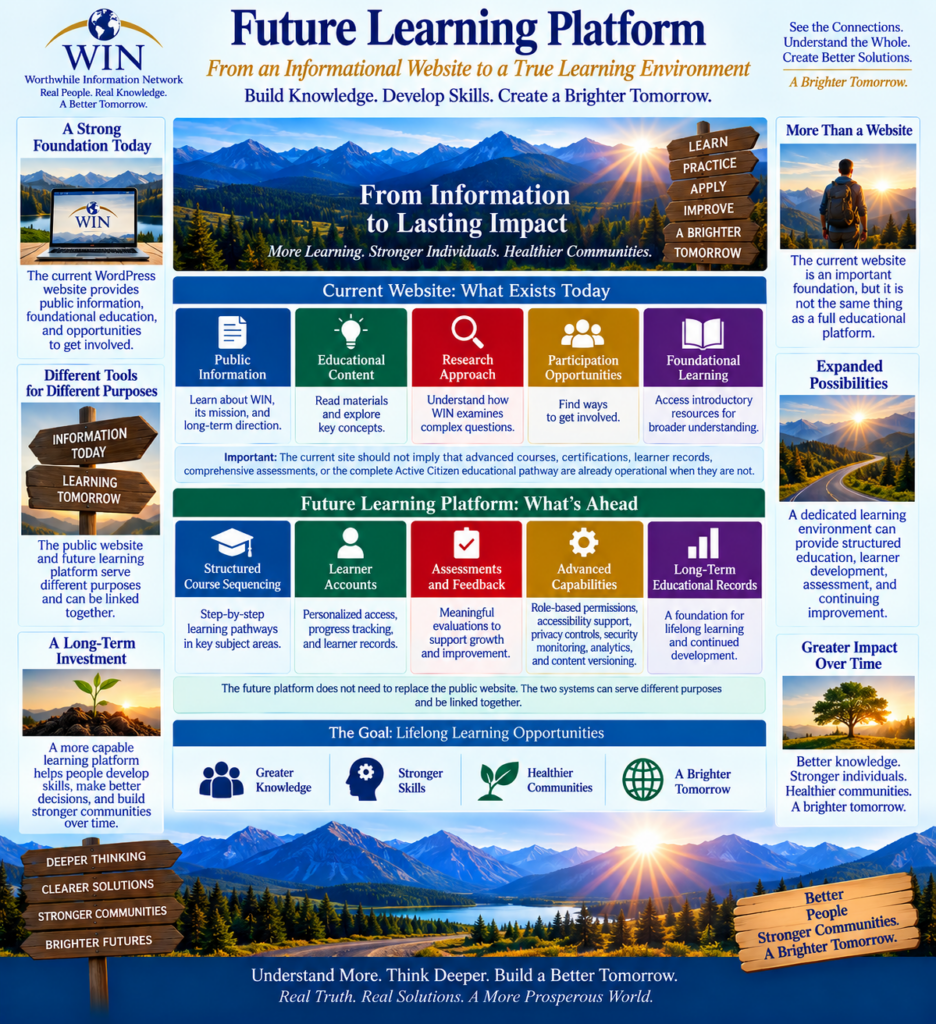
WIN’s current website is primarily a public information and communication site.
It explains the organization, introduces research and educational concepts, provides pathways for participation, and makes WIN’s developing work easier to examine.
WIN’s longer-term plans include something substantially more capable:
a structured learning environment that could support organized educational pathways, assessments, progress tracking, accessibility, continuing education, and other functions that an ordinary informational website is not designed to provide.
That future platform is planned and under development conceptually. It is not currently an operational WIN learning platform.
This distinction is important.
WIN should not describe future technical capabilities as though they already exist.
What Exists Today
WIN currently has a public WordPress website containing:
organizational information;
research explanations;
educational concepts;
frameworks;
participation opportunities;
policies;
graphics;
forms;
and other public resources.
WIN is also developing the educational architecture that could eventually support more structured learning.
Visitors should therefore distinguish between:
educational material available on the current website
and
the more sophisticated learning environment described on this page as a future capability.
WIN’s Education Overview explains the larger educational architecture.
Education Comes Before Technology
The most important design principle for the future platform is simple:
WIN should determine what education requires before deciding what technology to build or purchase.
Technology should answer educational requirements—not create them.
Before selecting a future platform, WIN should understand questions such as:
What should learners understand?
What capabilities should they develop?
How should learning be sequenced?
What requires practice?
What should be assessed?
What kind of feedback is useful?
What information genuinely needs to be recorded?
What requires human judgment?
What privacy and security obligations follow from those requirements?
Only then should WIN determine which technologies are appropriate.
WIN’s Future Educational Opportunities page describes the staged educational system that the technology may eventually support.
Why WordPress Alone May Not Be Enough
WordPress is well suited to WIN’s present public-information needs.
It can:
publish pages;
organize content;
provide forms;
display graphics;
support navigation;
and provide ordinary website administration.
A mature educational environment could eventually require capabilities beyond those needed by the present website, including:
structured learning pathways;
assessments;
learner progress records;
role-based access;
continuing education;
qualification records;
reporting;
privacy controls;
administrative workflows;
and other educational functions.
WIN does not need to build all of those capabilities immediately.
Technology should be added when educational and operational requirements justify it.
A Separate Educational Architecture
WIN’s long-term architecture can separate the public informational website from more consequential future educational systems where practical.
This separation can allow the public website to remain relatively simple while future learning systems receive stronger:
identity controls;
privacy protections;
security;
accessibility;
recordkeeping;
administrative controls;
and technical safeguards
appropriate to their functions.
The final architecture should depend on:
verified requirements;
available resources;
professional review;
security considerations;
privacy requirements;
maintainability;
cost;
and what WIN learns during development and testing.
Separation Can Reduce Risk
A public informational website and a system containing learner identities, assessment records, qualifications, or restricted administrative functions have different risk profiles.
Keeping every capability in one technical environment can create unnecessary complexity and increase the consequences of a failure.
Appropriate separation can help reduce:
unnecessary data exposure;
permission complexity;
security risk;
maintenance problems;
and accidental interaction between public and sensitive systems.
The appropriate degree of separation should be determined from actual technical requirements rather than assumed in advance.
Learning Pathways
Future WIN education may use structured learning pathways rather than treating education as an unrelated collection of pages or courses.
A pathway can organize:
prerequisite concepts;
learning objectives;
educational sequences;
lessons;
exercises;
assessments;
feedback;
and continuing development
so learners encounter material in an intelligible order.
Different pathways may eventually serve different educational purposes or levels of responsibility.
A pathway should exist because the learning sequence benefits from structure—not merely because software makes pathways easy to create.
Courses and Learning Modules
Future educational material may be organized into:
courses;
modules;
lessons;
exercises;
reference material;
case examples;
simulations;
assessments;
and other appropriate formats.
Modular organization can make it easier to revise material without rebuilding an entire curriculum.
It can also help identify which concepts are prerequisites for later learning.
But modularity should serve learning.
The curriculum should not be forced into arbitrary units merely because a software platform expects every educational experience to fit the same template.
Assessment
Assessment can help determine whether learners understand important concepts rather than merely whether they viewed a page or completed a course.
Future assessments may use different methods depending on what is being evaluated.
Knowledge recall, reasoning, application, judgment, communication, and responsible decision-making may require different forms of assessment.
Possible approaches could include:
questions;
written explanations;
case analysis;
scenarios;
projects;
demonstrations;
or supervised application.
Assessment methods themselves require evaluation.
A test is useful only to the extent that it measures something meaningful with acceptable reliability, validity, proportionality, and fairness.
Completion Is Not Competence
A technical platform can easily record:
pages viewed;
videos watched;
modules opened;
time logged in;
and courses marked complete.
Those measurements may be administratively useful.
They do not automatically demonstrate competence.
Where meaningful capability matters, WIN should distinguish between:
participation;
completion;
understanding;
and
demonstrated competence.
The platform should not create an illusion of educational success merely because it can generate impressive completion statistics.
Progress Tracking
A future learning platform may allow authorized learners and administrators to understand progress through applicable educational pathways.
Progress records could eventually identify:
completed material;
assessment results;
continuing-education requirements;
qualifications;
or areas requiring additional work.
Such records would introduce privacy, security, accuracy, retention, and access-control responsibilities substantially different from those of WIN’s current informational website.
Educational Records Need Context
Data can become misleading when separated from what it actually measures.
A score should not be treated as a complete description of a learner.
A failed assessment does not prove permanent inability.
Course completion does not prove competence outside the scope of the course.
A qualification does not make a person correct about every subject.
The platform should preserve enough context to prevent educational records from implying more than the underlying evidence supports.
Accessibility From the Beginning
Accessibility should be part of the architecture, not an optional feature added after a learning system is completed.
Future educational systems should consider:
clear navigation;
readable content;
keyboard access;
assistive technologies;
captions or transcripts where applicable;
alternative text;
visual accessibility;
understandable instructions;
device compatibility;
and other relevant accessibility requirements.
Accessibility testing and qualified review should become more extensive as the complexity and consequence of the platform increase.
Accessibility does not mean reducing intellectual standards.
It means reducing barriers unrelated to the capability being developed or evaluated.
Privacy and Data Minimization
A future learning system could process substantially more personal information than WIN’s present public website.
WIN should therefore limit future data collection to information reasonably necessary for legitimate:
educational;
administrative;
security;
or legal purposes.
The fact that data can be collected does not mean it should be collected.
Before materially different data practices are introduced, WIN should establish appropriate:
privacy disclosures;
access controls;
retention practices;
security safeguards;
deletion or archival procedures where appropriate;
and professional review
for the information involved.
Purpose Limitation Matters
Information collected for one legitimate purpose should not automatically be repurposed for unrelated uses simply because WIN possesses it.
For example, information needed to:
administer a course;
verify completion;
provide accessibility support;
or maintain security
may have different appropriate uses and retention requirements.
Data practices should remain connected to defined purposes.
This reduces unnecessary accumulation and helps prevent future administrators from treating every available piece of information as organizational property that may be used without limitation.
Data Accuracy Matters
Learner records, qualifications, assessment results, and administrative records can affect people.
Future systems therefore need reasonable methods for identifying and correcting material errors.
A sophisticated database containing inaccurate information is not a reliable information system.
Accuracy is part of data governance.
Cybersecurity
More capable systems create more consequential security responsibilities.
A future platform may require:
stronger authentication;
role separation;
logging;
backups;
recovery procedures;
vulnerability management;
software maintenance;
security updates;
incident response;
and other safeguards appropriate to its actual architecture and risk.
Security requirements should develop alongside the system rather than being treated solely as a final step before deployment.
Security Should Be Proportionate to Consequence
Not every component requires identical security.
A public educational page and a system containing:
personal information;
assessment records;
administrative privileges;
or qualification data
have different consequences if compromised.
Security controls should therefore correspond to:
the sensitivity of information;
the authority associated with an account;
the consequences of unauthorized access;
and the importance of the affected system.
Role-Based Access
Not every participant requires access to every function or record.
Future systems may use role-based permissions so:
learners;
instructors;
administrators;
reviewers;
technical personnel;
and other authorized participants
receive access appropriate to legitimate responsibilities.
Sensitive permissions should be limited and documented rather than granted merely for convenience.
Least Necessary Access
A useful principle is:
People should receive the access reasonably necessary to perform their legitimate responsibilities—not every permission they might someday find useful.
This reduces the consequences of:
mistakes;
compromised accounts;
misunderstanding;
and misuse.
Administrative convenience should not automatically override appropriate access boundaries.
Important Actions Should Be Auditable
More consequential systems may need records showing important administrative actions such as:
changes to qualifications;
changes to permissions;
significant content revisions;
administrative overrides;
or other sensitive actions.
The objective is not unlimited surveillance.
It is sufficient accountability to determine what happened when consequential system changes require review.
Audit information itself should also have appropriate privacy, access, and retention controls.
Professional and Academic Review
WIN’s educational platform is not intended to depend solely on software development.
Educational design, subject-matter accuracy, measurement, accessibility, privacy, security, governance, and other consequential areas may require appropriately qualified review.
As the system develops, WIN should seek relevant expertise according to the significance and risk of the capability being considered.
WIN’s Academic Collaboration page describes ways qualified researchers, educators, and subject-matter experts may contribute.
Content Versioning and Correction
Educational material changes as:
errors are discovered;
evidence improves;
explanations become clearer;
standards change;
and instructional experience reveals weaknesses.
Future systems therefore need practical methods to:
identify authoritative material;
preserve appropriate revision history;
correct substantive errors;
and prevent outdated content from being mistaken for current instruction.
The level of version control should be proportionate to the importance and consequence of the material.
Versioning Should Preserve the Reason for Important Changes
Knowing that a document changed is useful.
Knowing why it changed can be more important.
For consequential educational material, future administrators may need to understand:
what changed;
when it changed;
why it changed;
what evidence justified the change;
and which version was authoritative at a particular time.
This supports accountability without requiring every minor wording improvement to become an elaborate bureaucratic process.
Evidence Behind the Education
WIN’s educational content is intended to remain connected to evidence and reasoning rather than becoming doctrine learners are expected to accept without examination.
Important educational claims should remain open to:
stronger evidence;
competing explanations;
qualified criticism;
and correction.
Learners should increasingly understand not only a conclusion but also:
the reasoning;
evidence;
limitations;
assumptions;
and uncertainty
relevant to it.
WIN’s How We Evaluate Evidence page explains the broader evidence principles supporting this approach.
Artificial Intelligence May Become Part of the Platform
Artificial intelligence may eventually assist with educational functions such as:
explaining concepts;
answering questions;
providing practice;
generating examples;
supporting accessibility;
helping learners locate relevant material;
providing preliminary feedback;
or assisting administrators and educators.
AI could substantially increase educational capability.
It can also introduce new risks.
AI systems can:
produce incorrect information;
express unjustified confidence;
misinterpret context;
create inconsistent explanations;
reflect weaknesses in underlying data or instructions;
and encourage excessive dependence if used poorly.
AI capability should therefore be evaluated according to the educational purpose and consequence of the task.
AI Should Not Quietly Become the Authority
A learner should not be expected to accept an AI-generated answer merely because a system produced it.
For consequential educational functions, WIN may need methods for:
source grounding;
uncertainty disclosure;
human review;
escalation;
quality testing;
correction;
and monitoring recurring errors.
Some uses of AI may require little oversight.
Others may require substantial human judgment.
The relevant question is not:
Can AI perform this task?
It is:
Can AI perform this task reliably enough for the consequence involved, with appropriate safeguards and correction mechanisms?
Human Judgment Remains Important
Automation can improve efficiency.
It can also create the appearance that difficult judgments have become objective merely because software makes them quickly.
Future WIN systems should identify decisions that require meaningful human review.
Examples may eventually include:
high-consequence qualification decisions;
appeals;
serious misconduct findings;
unusual accessibility situations;
sensitive record corrections;
or decisions for which automated evidence is incomplete or uncertain.
Human oversight should be substantive rather than ceremonial.
The Future Active Citizen Pathway
One possible use of the future learning architecture is structured education associated with WIN’s developing Active Citizen Pathway.
That pathway requires more than reading informational pages.
More consequential participation may eventually require:
defined educational standards;
qualification requirements;
ethical boundaries;
accountability;
continuing education;
and appropriate evaluation.
Active Citizen education does not create:
police powers;
detention authority;
enforcement authority;
or permission to violate applicable law, privacy, property rights, or safety boundaries.
Any future higher-responsibility participation should depend on applicable:
training;
qualification;
authorization;
safeguards;
and organizational capacity
being in place.
Continuing Education
Learning does not necessarily end when an initial educational pathway is completed.
Future programs may require continuing education when:
knowledge changes;
standards are revised;
responsibilities evolve;
technology changes;
or maintaining a qualification requires participants to demonstrate current understanding.
Continuing-education requirements should depend on the nature and consequence of the role involved.
Administrative Capability
A mature educational system may eventually require administrative functions such as:
enrollment management;
learner records;
qualification status;
instructor administration;
support workflows;
reporting;
appeals or review procedures where appropriate;
and other operational functions.
These capabilities should be introduced only when WIN has the organizational capacity and safeguards necessary to operate them responsibly.
Software can automate administration.
It cannot eliminate the need for accountable administration.
Analytics With Boundaries
Educational analytics can help identify:
where learners struggle;
where material is confusing;
whether educational methods appear to be working;
and where additional support may be useful.
Analytics do not justify unlimited data collection.
WIN should balance legitimate measurement needs against:
privacy;
security;
data minimization;
proportionality;
and the risk of drawing conclusions that the available data cannot support.
WIN’s Measurable Outcomes framework provides a broader basis for distinguishing meaningful outcomes from convenient activity measures.
Technical Architecture Should Follow Requirements
WIN has not committed itself permanently to a particular future learning-platform technology or vendor.
Technical decisions should follow verified educational and operational requirements.
Relevant considerations may include:
security;
privacy;
accessibility;
maintainability;
interoperability;
documentation;
cost;
backup and recovery;
data portability;
vendor stability;
administrative complexity;
and long-term sustainability.
This reduces the risk of designing WIN’s educational system around software simply because the software happens to be available.
Avoid Unnecessary Vendor Lock-In
A platform can become difficult to replace when:
important data cannot be exported;
content exists only in proprietary formats;
critical integrations depend on one provider;
administrators do not understand the architecture;
or migration becomes prohibitively expensive.
WIN should consider portability and replacement before dependence becomes difficult to reverse.
Avoiding vendor lock-in does not require avoiding commercial software.
It means understanding the consequences of dependence before creating it.
Data Portability Supports Institutional Independence
Where practical and appropriate, WIN should be able to retrieve important organizational and educational information in usable formats.
This can support:
migration;
backup;
independent analysis;
continuity;
and recovery from vendor failure.
A platform should not become the only place from which WIN can understand its own educational system.
Backup Is Not the Same as Recovery
A system can have backups and still be unable to recover effectively.
Future planning should consider:
what is backed up;
how frequently;
where copies are stored;
who can restore them;
how restoration is tested;
what dependencies are required;
and how long acceptable recovery may take.
Recovery procedures should eventually be tested rather than assumed.
Disaster Recovery and Continuity
A consequential learning system may eventually need plans for disruptions such as:
technical failures;
data corruption;
cybersecurity incidents;
vendor outages;
administrator loss;
configuration errors;
or other events that interrupt service.
Not every failure requires elaborate disaster infrastructure.
But the greater the platform’s importance, the less reasonable it becomes to rely entirely on improvisation after failure occurs.
Development, Testing, and Production Should Be Distinguished
As the future platform becomes more consequential, WIN may benefit from separating environments used for:
development;
testing;
and live operation.
Changes can then be evaluated before being introduced into the system people actually depend on.
The appropriate technical implementation should be determined by qualified professionals and actual system complexity.
The underlying principle is simple:
important changes should be tested before they are allowed to affect consequential live systems.
Build in Stages
WIN does not need every possible feature before meaningful educational development can begin.
Development can proceed in stages:
clarify educational requirements;
develop and review content;
test learning methods;
establish safeguards;
pilot appropriate components;
measure results;
correct weaknesses;
and
add technical capability when justified.
This allows evidence from earlier stages to influence later investments.
Pilot Before Scaling
A system that functions with a small controlled group may behave differently when:
more learners participate;
more instructors become involved;
larger quantities of data accumulate;
administrative workload increases;
or technical integrations multiply.
Pilot testing can expose:
confusing workflows;
weak assessments;
permission problems;
support burdens;
accessibility barriers;
security weaknesses;
and unexpected administrative demands.
Successful operation at one scale should not automatically be assumed to prove readiness for a much larger one.
Do Not Build Faster Than WIN Can Govern
Technical capability is not the same as organizational readiness.
WIN should not intentionally expand a consequential learning system faster than it can responsibly support its:
governance;
educational quality;
administration;
accessibility;
privacy;
cybersecurity;
recordkeeping;
evaluation;
financial obligations;
and user support.
Delaying a feature can be preferable to deploying one without adequate safeguards or operational capacity.
Cost Is Part of Technical Sustainability
A platform can be technically impressive and financially unsustainable.
Future decisions should consider not only acquisition or development costs but also:
hosting;
maintenance;
security;
support;
licenses;
professional services;
updates;
training;
data storage;
backup;
migration;
and eventual replacement.
The least expensive initial option is not necessarily the least expensive long-term option.
Likewise, the most expensive system is not automatically the most appropriate.
The relevant question is:
What level of technology can WIN responsibly sustain for the educational value it provides?
Long-Term Durability
A future learning platform must be maintainable beyond its original developers or administrators.
Important:
architecture;
configurations;
procedures;
dependencies;
data practices;
recovery methods;
credentials-management procedures;
and administrative responsibilities
will require sufficient documentation to support continuity.
WIN should also seek to avoid unnecessary dependence on:
undocumented knowledge held by one individual;
obsolete technology;
unsupported software;
or systems that cannot reasonably be maintained or replaced.
Succession Is a Technical Requirement Too
A system is fragile when only one person knows:
how it works;
how to administer it;
how to recover it;
where important documentation exists;
or why critical technical decisions were made.
Technical succession should therefore be treated as part of continuity planning.
Knowledge should be transferable before an emergency makes transfer impossible.
Technology Eventually Needs Retirement
Technology does not remain suitable forever.
A future platform may eventually become:
obsolete;
unsupported;
too expensive;
insecure;
incompatible;
or inferior to a better alternative.
Responsible technology governance therefore includes the ability to retire or replace systems.
Migration planning should preserve, as appropriate:
important content;
necessary records;
institutional knowledge;
privacy obligations;
and historical accountability.
A durable institution is not one that uses the same technology forever.
It is one that can change technology without losing itself.
What the Future Platform Is Not
The future learning platform is not intended to be merely:
a larger website;
a collection of online quizzes;
a mechanism for issuing impressive-looking credentials;
or a technology showcase.
Its value will depend on whether it helps people develop meaningful understanding and capability while operating within appropriate:
educational;
ethical;
technical;
privacy;
security;
accessibility;
and governance standards.
Technology is infrastructure for the educational mission—not the mission itself.
A Platform That Can Improve With Its Learners
WIN’s long-term objective is to create an educational environment capable of improving as:
evidence;
instructional experience;
technology;
professional knowledge;
and human understanding
improve.
Feedback, assessment results, accessibility findings, technical experience, pilot results, professional review, and learner outcomes can reveal where changes are needed.
A durable learning system therefore requires the ability to revise itself without losing accountability for what changed and why.
Current Status
The advanced learning platform described on this page is a future capability and is not currently operational.
WIN’s present public website provides informational and introductory educational material.
WIN is developing the:
concepts;
curriculum architecture;
governance requirements;
safeguards;
and technical requirements
that could support more structured educational capabilities in the future.
Development should proceed according to:
demonstrated need;
organizational capacity;
available resources;
professional review;
testing;
and evidence of readiness
rather than according to a predetermined launch date.
Continue Exploring
These pages explain the educational architecture, technology planning, measurement, professional collaboration, and future pathways that may eventually connect to the learning platform.