Measurable Outcomes
Improvement Should Be Observable
WIN’s long-term objectives concern real human and institutional improvement. Those objectives become meaningful only when they can eventually be connected to observable evidence.
Aspirations such as better reasoning, stronger education, fewer destructive behaviors, more capable institutions, and greater human development are important—but the words alone do not demonstrate progress.
WIN therefore asks:
What would be different in the real world if meaningful improvement were actually occurring?
Outcomes Are Different From Activity
Activity describes what was done. Outcomes describe what changed.
A website can receive more visitors. A course can enroll more learners. An organization can hold more meetings, recruit more volunteers, publish more material, raise more money, or create more programs.
Those activities may be necessary and useful, but they do not by themselves establish that anyone became more capable or that a problem improved.
WIN therefore distinguishes organizational activity from evidence of meaningful outcomes.
What Should Be Measured?
The appropriate outcome depends on the objective being examined.
Depending on the program, question, or research objective, relevant outcomes might include:
Understanding — Can people explain important concepts accurately rather than merely recognize familiar words?
Reasoning — Can people examine evidence, identify assumptions, compare explanations, and revise conclusions when warranted?
Application — Can knowledge be used appropriately in realistic situations rather than only repeated on a test?
Retention — Does important learning persist after the immediate educational experience ends?
Transfer — Can useful knowledge be applied to new circumstances rather than only the example originally taught?
Decision quality — Do decisions become better informed, more consistent with relevant evidence, and less vulnerable to avoidable reasoning errors?
Behavioral outcomes — When behavior change is actually an objective, does relevant behavior change in the intended direction?
Error reduction — Are important mistakes, preventable failures, or recurring misunderstandings becoming less common?
Problem reduction — Is the underlying problem becoming meaningfully less severe rather than merely moving somewhere else?
Institutional capability — Can an organization perform an important function more reliably, transparently, safely, or sustainably?
Durability — Do improvements persist after novelty, intensive supervision, unusual funding, or other temporary conditions disappear?
Unintended consequences — Did improvement in one area create unacceptable costs or problems somewhere else?
The objective determines the outcome. The easiest available number does not.
Establish the Starting Point
Improvement requires some understanding of the condition before the intervention.
When practical, WIN establishes a relevant baseline so later observations can be compared with the starting condition.
A baseline might describe knowledge, reasoning performance, existing behavior, error rates, institutional capability, current outcomes, or another condition relevant to the objective.
Without a meaningful starting point, it can be difficult to determine whether apparent progress represents actual improvement.
Measure Understanding, Not Mere Exposure
Seeing information is not the same as understanding it.
For educational objectives, WIN distinguishes progressively stronger forms of learning:
Exposure — A person encountered the information.
Recognition — The person recognizes the concept or terminology.
Comprehension — The person can explain the idea accurately.
Application — The person can use the knowledge appropriately.
Retention — The knowledge or capability remains available over time.
Transfer — The person can apply the underlying principle in a new or unfamiliar situation.
These levels are not interchangeable.
A completed lesson demonstrates exposure and perhaps participation. It does not automatically demonstrate comprehension, retention, application, or transfer.
Better Reasoning Is an Outcome
WIN’s educational objectives extend beyond memorizing WIN terminology or agreeing with WIN conclusions.
Meaningful improvement may include greater ability to distinguish evidence from assertion, identify assumptions, recognize uncertainty, compare competing explanations, detect contradictions, separate correlation from causation, examine incentives, identify possible Real Root Causes, and revise conclusions when stronger evidence appears.
A learner who can challenge a weak WIN argument using sound evidence and reasoning may demonstrate more educational development than a learner who simply repeats WIN’s conclusion.
Better Decisions Are an Outcome
Knowledge becomes more valuable when it improves decisions.
Depending on the context, better decision-making may involve identifying relevant evidence, considering alternatives, recognizing important risks, anticipating unintended consequences, distinguishing short-term benefits from long-term effects, and correcting a decision when new information changes the situation.
WIN does not assume every good decision produces a good outcome. Chance and uncontrollable conditions also matter.
Decision quality therefore requires examining both the reasoning process and the resulting evidence where appropriate.
Short-Term and Long-Term Outcomes
Some improvements appear quickly. Others require time.
A learner may demonstrate immediate comprehension after instruction but fail to retain or apply the knowledge months later. A program may produce an encouraging short-term result while creating dependency, rising costs, declining participation, or unintended consequences over time.
WIN therefore distinguishes immediate outputs and short-term outcomes from longer-term durability and impact.
The correct time horizon depends on the objective.
Problem Reduction Must Be Real
A problem has not necessarily improved merely because it became less visible.
An intervention can move a problem to another group, institution, location, measurement category, or period of time. It can suppress a symptom while leaving the conditions that regenerate the problem intact.
WIN therefore examines whether the underlying problem actually declined and whether the apparent improvement remains when broader system effects are considered.
Correlation Is Not Automatically Causation
An outcome can improve after an intervention without the intervention necessarily causing the improvement.
Other conditions may have changed at the same time. Participants may differ from nonparticipants. Measurement may change. Selection effects, outside events, natural variation, or other variables may influence the result.
WIN therefore keeps causal conclusions proportionate to the strength of the evidence.
An encouraging outcome can justify further investigation without automatically proving causation.
Include Unintended Consequences
An intervention should not be judged solely by the outcome it was designed to improve.
WIN also asks:
What else changed?
Who benefited?
Who experienced costs or burdens?
Did incentives change?
Did the improvement create new risks?
Did another part of the system become weaker?
Did the result remain acceptable when broader consequences were considered?
An outcome is more meaningful when improvement survives this wider examination.
Do Not Design Metrics Merely to Produce Success
Measurement loses value when indicators are selected primarily because they make a program appear successful.
WIN avoids defining success around whichever numbers happen to improve.
Important outcomes and evaluation criteria are identified as clearly as practical before final results are known. When measurements need to change, the reason for the change should be understandable rather than concealed.
The objective is accurate learning, not favorable statistics.
Failure Is Information
A pilot or educational program that does not produce the expected outcome is not automatically wasted effort.
A disappointing result may reveal:
a weak underlying explanation;
an ineffective teaching method;
an implementation problem;
inadequate measurement;
an important missing variable;
an unintended consequence;
a population or context difference; or
an expectation that was unrealistic.
The outcome becomes useful when it changes what WIN understands or does next.
Evidence Should Change the Program
Measurement has little purpose if results cannot influence future decisions.
When credible evidence shows that a framework, educational method, policy, technology, measurement system, or operational process is ineffective or harmful, WIN’s response is to investigate the cause and make appropriate corrections.
Depending on the evidence, that may mean revising content, changing implementation, strengthening safeguards, improving measurement, conducting another pilot, delaying expansion, or discontinuing an approach.
Evidence matters because it can change the next decision.
Success Exists at Different Levels
“Success” is not one thing.
Individual-level success may involve improved understanding, reasoning, application, retention, transfer, or decision quality.
Educational-level success may involve learners reliably developing the intended capabilities without unacceptable burdens or unintended harm.
Program-level success may involve producing meaningful outcomes consistently enough to justify continued operation or further testing.
Institutional-level success may involve WIN becoming more accurate, transparent, maintainable, secure, accountable, and capable of correcting itself.
Long-term success may involve worthwhile knowledge and capabilities remaining understandable, transferable, testable, and improvable across future administrators and generations.
A strong result at one level does not automatically establish success at every other level.
What Success Does Not Mean
Success does not mean everyone agrees with WIN.
It does not mean every participant likes the program.
It does not mean WIN becomes large, wealthy, famous, or institutionally powerful.
It does not mean WIN avoids criticism, correction, or failure.
And it does not mean WIN should preserve a program simply because substantial time, money, reputation, or effort has already been invested in it.
Those conditions may matter for other reasons, but none alone demonstrates that the work produced its intended outcome.
Evidence of Capability Matters More Than Labels
WIN’s future educational and qualification systems may eventually use completion records, assessments, credentials, certifications, or other indicators of progress.
Such labels have value only when they correspond to meaningful underlying capability.
A certificate cannot substitute for competence. A title cannot substitute for demonstrated judgment. Completion cannot substitute for understanding.
As WIN develops future educational systems, evidence of capability will remain more important than the label attached to it.
Improvement Should Survive Real Conditions
An outcome demonstrated only under unusually favorable conditions may not remain useful when conditions change.
WIN therefore examines, where appropriate, whether improvements survive differences in people, instructors, settings, resources, technology, time, workload, incentives, and other relevant real-world conditions.
The stronger the claim of general effectiveness, the more important it becomes to understand where the outcome does and does not persist.
Durability Matters
A temporary improvement can still be useful, but it should not be mistaken for permanent development.
WIN distinguishes immediate change from durable change.
Where long-term capability matters, follow-up evidence may be needed to determine whether knowledge was retained, behavior persisted, institutional capability remained functional, or the original problem returned.
Durable improvement is generally more consequential than a brief improvement that disappears when special conditions end.
Measurable Does Not Mean Everything Important Is Easily Counted
Not every meaningful human outcome can be reduced to a single number.
Judgment, reasoning quality, institutional trustworthiness, resilience, ethical decision-making, and other complex outcomes may require multiple forms of evidence.
Quantitative measures can be valuable. Qualitative evidence can also reveal understanding, context, failure modes, and consequences that numerical indicators miss.
WIN therefore seeks evidence appropriate to the outcome rather than assuming that only easily counted information is real.
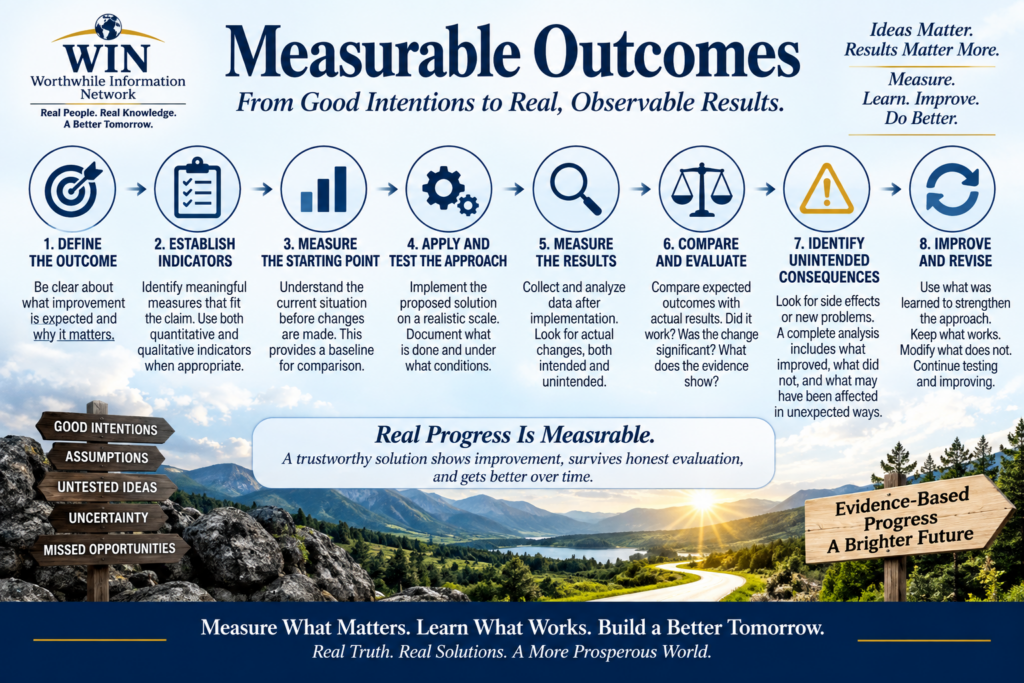
A Continuing Evaluation Loop
WIN treats evaluation as a recurring process:
Define the Outcome → Establish the Baseline → Apply the Intervention → Observe What Happened → Measure and Compare → Examine Unintended Consequences → Interpret the Evidence → Correct → Test Again
This process allows programs to improve through evidence rather than remain fixed simply because they were once approved.
Evaluation continues as long as consequential claims or programs continue to require examination.
The Standard
The central question is not:
“Did WIN complete the program?”
It is:
“Did the program produce meaningful improvement, how do we know, what else happened, how durable was the improvement, and what should change because of what we learned?”
That is the standard by which measurable outcomes become useful rather than merely impressive.