Destructive Education
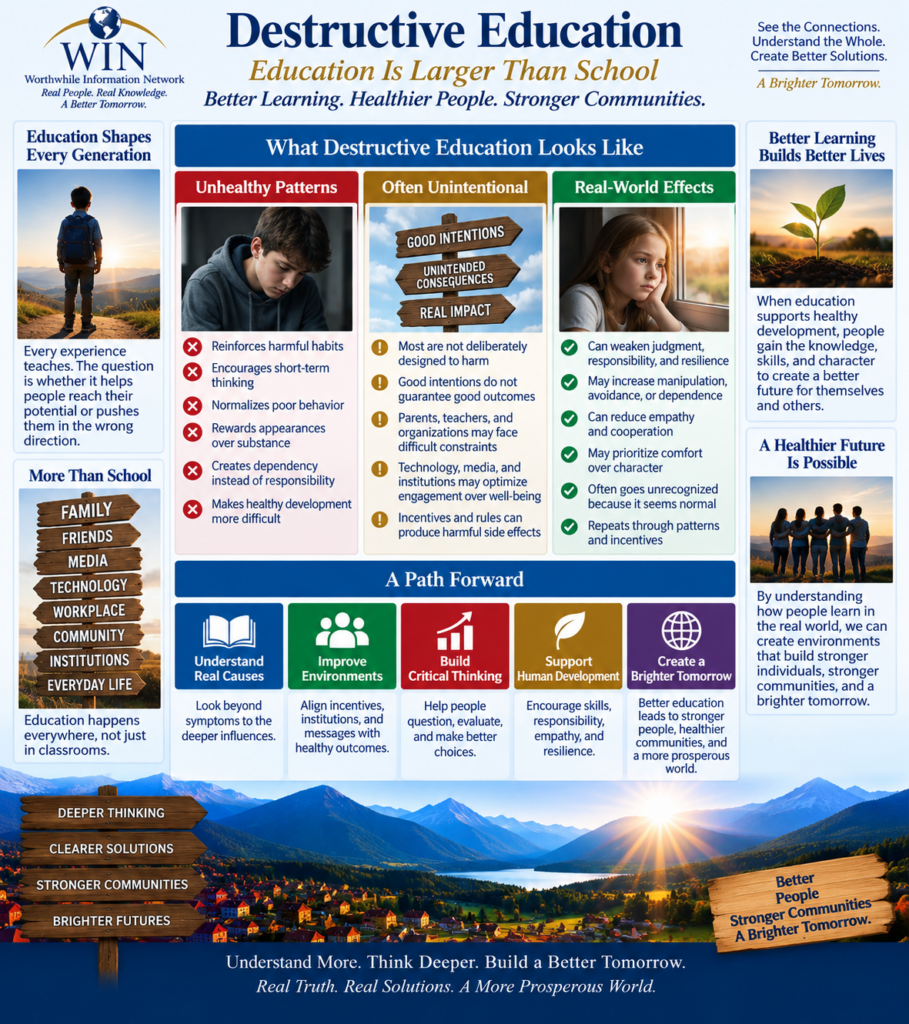
Education Is Larger Than School
WIN uses the term Destructive Education to describe learning experiences that can produce harmful beliefs, habits, expectations, decision patterns, or developmental outcomes.
This does not mean that every harmful outcome was deliberately taught. Much of what people learn comes from repeated experience rather than formal instruction.
Human beings continually learn from what they observe, what happens to them, what behavior is rewarded or punished, what other people model, and what appears to work in the environments around them.
Understanding destructive education therefore requires looking beyond schools and classrooms.
Destructive Education Is Often Unintentional
Most harmful learning does not begin with someone deciding to teach another person something destructive.
A family may unintentionally reinforce dishonesty by punishing admission of mistakes more severely than successful concealment. A workplace may unintentionally reward cutting corners if employees who ignore procedures consistently outperform those who follow them. An institution may unintentionally teach passivity when people repeatedly discover that legitimate concerns are ignored.
Nobody necessarily designed those lessons.
But lessons can still be learned.
This distinction matters because preventing destructive education requires examining what an environment actually teaches, not merely what the people running it intended to teach.
Words Are Only One Teacher
People learn from instructions, explanations, rules, and advice, but they also learn from examples and consequences.
A parent may tell a child that honesty matters while repeatedly lying when dishonesty is convenient.
An organization may publish an ethics policy while rewarding people who violate it to produce better short-term results.
A school may teach students to think independently while rewarding only answers that reproduce expected conclusions.
In each case, the formal message and the experienced lesson conflict.
When that happens repeatedly, experience can become the stronger teacher.
What Behavior Is Actually Being Reinforced?
One useful question is simple:
What behavior is this environment making more rewarding, easier, safer, or more successful?
Suppose an employee discovers a serious mistake. Reporting it immediately could allow the organization to correct the problem. But if employees who disclose mistakes are humiliated while employees who conceal mistakes usually avoid consequences, the system may unintentionally teach concealment.
The official policy may say, “Report problems immediately.”
The experienced lesson may become, “Do not admit a mistake unless you have to.”
That is destructive education created by incentives rather than by a formal lesson.
Repeated Experiences Can Become Developmental Loops
Learning can accumulate through feedback.
An experience influences expectations. Expectations influence choices. Choices produce new experiences. Those experiences can then reinforce the original expectation.
For example:
A person repeatedly encounters hostility when asking legitimate questions.
They begin expecting hostility.
They ask fewer questions.
They receive less information.
Their uncertainty increases.
They become even less willing to question authority.
A temporary experience can therefore become a self-reinforcing developmental loop.
Understanding these loops is important because changing the visible behavior alone may not correct the expectations that produced it.
Environments Matter, but They Do Not Determine People
Recognizing environmental influence does not eliminate individual responsibility or personal choice.
People exposed to similar environments can respond differently. Human beings possess different temperaments, experiences, relationships, knowledge, opportunities, abilities, and capacities for reflection.
Environment affects probability. It does not automatically determine destiny.
This distinction prevents two opposite errors: pretending environments do not matter and pretending individuals have no agency.
A useful developmental model must account for both.
Children Are Especially Sensitive to Repeated Lessons
Children enter the world without a completed model of how people, institutions, relationships, authority, risk, cooperation, and consequences work.
They build those models from experience.
Repeated experiences can therefore influence expectations such as:
Are adults trustworthy?
Does telling the truth help or hurt?
Are mistakes opportunities to learn or reasons to hide?
Does effort matter?
Can disagreements be handled safely?
Are rules applied consistently?
Do people cooperate or exploit one another?
No single experience necessarily determines a child’s development. But repeated patterns can become increasingly influential as expectations accumulate.
Adults Continue to Learn Too
Development does not stop at childhood.
Workplaces, relationships, institutions, economic conditions, media environments, technology, laws, incentives, and repeated social experiences continue influencing expectations and behavior throughout adulthood.
A person who repeatedly sees responsible behavior ignored while manipulation succeeds may gradually become more cynical.
Someone who repeatedly experiences fair treatment and meaningful accountability may become more willing to cooperate.
People continue learning from the systems around them whether those systems were designed as educational environments or not.
Families Educate Continuously
Families teach through far more than deliberate instruction.
Children observe how adults handle disagreement, responsibility, money, promises, frustration, affection, mistakes, authority, honesty, and conflict.
A household can verbally teach one principle while repeatedly demonstrating another.
For example, adults may tell children to admit mistakes while reacting so harshly to every mistake that concealment becomes emotionally safer than honesty.
The intended lesson is responsibility.
The experienced lesson may become concealment.
Improvement requires understanding both.
Peers and Communities Educate
Peer groups influence what behavior earns approval, rejection, status, ridicule, belonging, or exclusion.
Communities also establish informal expectations about cooperation, trust, responsibility, conflict, achievement, authority, and acceptable behavior.
These influences are not automatically beneficial or harmful. Their effects depend on what behaviors and expectations they reinforce.
Workplaces Educate
Every workplace creates a learning environment.
Employees learn what actually happens when they report problems, question decisions, admit mistakes, help coworkers, protect customers, follow procedures, or challenge unethical behavior.
Consider two organizations that display the same statement:
“Safety comes first.”
At one organization, workers who stop production because of a legitimate safety concern are thanked and the problem is investigated.
At the other, workers who stop production are criticized for reducing output.
The written policy is identical.
The educational environment is not.
Institutions Educate Through Their Rules and Incentives
Schools, governments, businesses, nonprofits, courts, regulatory systems, and other institutions continually generate incentives and consequences.
Those systems can teach people whether honesty is worthwhile, whether rules are fairly applied, whether cooperation is rewarded, whether reporting problems produces correction, and whether responsible behavior carries unnecessary costs.
A policy can therefore produce an educational effect even when education was never its stated purpose.
Understanding those effects is part of systems thinking.
Incentives Can Teach More Powerfully Than Instructions
People respond not only to what they are told but also to what repeatedly happens.
If a system says one thing while consistently rewarding the opposite behavior, the incentive structure may eventually become the more credible teacher.
This does not mean people mechanically follow incentives. It means incentives alter the relative costs and benefits surrounding choices and therefore can influence patterns of behavior over time.
A responsible system examines both its stated rules and the lessons produced by its actual consequences.
Media and Technology Are Educational Environments
Modern information systems expose people to enormous quantities of content.
Algorithms, notifications, entertainment, advertising, online communities, games, search systems, recommendation engines, and social platforms can influence what people repeatedly encounter and what receives attention.
These systems can provide extraordinary educational opportunities.
They can also amplify misinformation, outrage, compulsive behavior, distorted comparisons, shallow reasoning, or social hostility.
The important question is not whether technology is inherently beneficial or harmful.
The question is what patterns particular systems repeatedly encourage under particular conditions.
Our Own Choices Educate Us
People also participate in creating their own learning environments.
What someone repeatedly reads, watches, practices, avoids, tolerates, investigates, questions, and discusses can influence future expectations and behavior.
Choices therefore can become educational inputs into later choices.
This is another reason developmental loops matter: people are not merely shaped by environments; their decisions can also help shape the environments and experiences that influence them next.
Conflicting Lessons Matter
People frequently receive contradictory lessons.
A child may hear that honesty matters at home but observe dishonesty rewarded elsewhere.
An employee may receive ethics training while seeing unethical behavior rewarded by management.
A citizen may be told that responsible participation matters while repeatedly experiencing institutions that appear unresponsive.
These contradictions can produce confusion, cynicism, selective trust, or context-dependent behavior.
Understanding development therefore requires examining the combination of lessons people experience rather than assuming one message operates in isolation.
Education Can Accumulate
A single event may have little lasting effect.
Repeated experiences can be different.
When similar lessons are encountered through families, peers, institutions, media, workplaces, technology, and personal experience, their effects may accumulate.
This helps explain why some beliefs or behavioral patterns can become difficult to change. They may not have resulted from one lesson at all. They may have been reinforced by hundreds or thousands of experiences.
Changing the pattern may therefore require more than providing new information. It may require creating sufficiently credible new experiences.
Timing Matters
The same lesson can have different effects depending on when it occurs.
Early experiences can be particularly influential because fewer previous experiences exist against which they can be evaluated. Later experiences may reinforce, weaken, or overturn earlier expectations.
Timing also matters during periods of transition, uncertainty, stress, social isolation, or rapid change.
A complete developmental analysis therefore asks not only what happened, but when, how often, under what conditions, and what previous learning already existed.
Destructive Education Does Not Mean Everything Determines Us
The concept should not be interpreted fatalistically.
Human beings can reconsider beliefs, encounter better evidence, form healthier relationships, enter different environments, learn new skills, and revise expectations.
People can recover from harmful developmental experiences.
Institutions can also change.
The purpose of identifying destructive education is not to declare people permanently damaged. It is to understand preventable developmental pressures well enough to improve them.
Avoiding Blame
The concept of destructive education is most useful when it helps diagnose systems and learning patterns rather than merely identify villains.
Families, educators, organizations, governments, businesses, and individuals can transmit harmful lessons without intending to do so.
That does not eliminate accountability when genuine misconduct occurs.
It does mean that explanation and blame are different questions.
A productive analysis asks:
What happened?
What was learned?
Why was that lesson credible?
What reinforced it?
What could change the conditions producing it?
What responsibility belongs to the individual?
What responsibility belongs to the surrounding system?
Those questions provide more information than blame alone.
Short-Term Success Can Conceal Long-Term Harm
A system can appear successful while creating conditions that eventually undermine its own goals.
A workplace might increase output by creating intense fear of failure. Productivity may rise temporarily while reporting deteriorates, mistakes are hidden, experienced employees leave, and organizational learning declines.
A school might improve a narrow performance measure by teaching heavily to that measure while reducing curiosity or broader understanding.
A family might obtain immediate obedience through intimidation while damaging trust and independent judgment.
Short-term measurements therefore cannot automatically establish long-term developmental success.
From Destructive to Constructive Education
Identifying destructive education is only useful if it helps reveal better alternatives.
Constructive education seeks environments in which beneficial behavior is understandable, practicable, and reinforced.
That may involve aligning:
- stated values with actual incentives;
- responsibility with fair accountability;
- honesty with psychologically safe correction;
- effort with meaningful opportunity;
- rules with consistent enforcement;
- learning with useful feedback;
- authority with appropriate review; and
- mistakes with opportunities for correction when circumstances permit.
The objective is not to create a perfect environment.
It is to reduce unnecessary contradictions between what a system claims to value and what the system actually teaches through experience.
Claims Must Still Be Tested
Not every undesirable outcome can be attributed to education or environmental influence.
Human behavior has multiple causes. Genetics, temperament, health, chance, economic conditions, relationships, personal decisions, historical circumstances, and many other variables may contribute.
Claims about destructive education therefore require evidence.
Researchers should ask whether the proposed learning mechanism actually occurred, whether competing explanations fit the evidence better, whether the pattern appears across appropriate comparisons, and what evidence would weaken or overturn the explanation.
The concept becomes useful only when it remains testable.
The Larger WIN Perspective
WIN’s broader educational approach begins with the premise that human development occurs throughout life and through many environments.
Understanding destructive education therefore means examining not merely what people are formally taught but what their experiences repeatedly make credible.
That principle also applies to WIN itself.
If WIN eventually develops educational programs, Active Citizen pathways, technology systems, partnerships, or other institutional structures, it will not be enough for WIN to state good principles.
The organization must examine what its own incentives, procedures, leadership behavior, technologies, and consequences actually teach.
The Standard
The practical question is not simply:
“What did we intend to teach?”
It is:
“What are people actually learning from the environment we created, and what evidence tells us whether those lessons are helping or harming human development?”
That distinction turns education from something that happens only in classrooms into something that can be examined throughout human life.
Continue Exploring
Everything Educates
Education Overview
Frameworks Explained
Foundations of Responsible Decision-Making