Education as Infrastructure
Education as Infrastructure
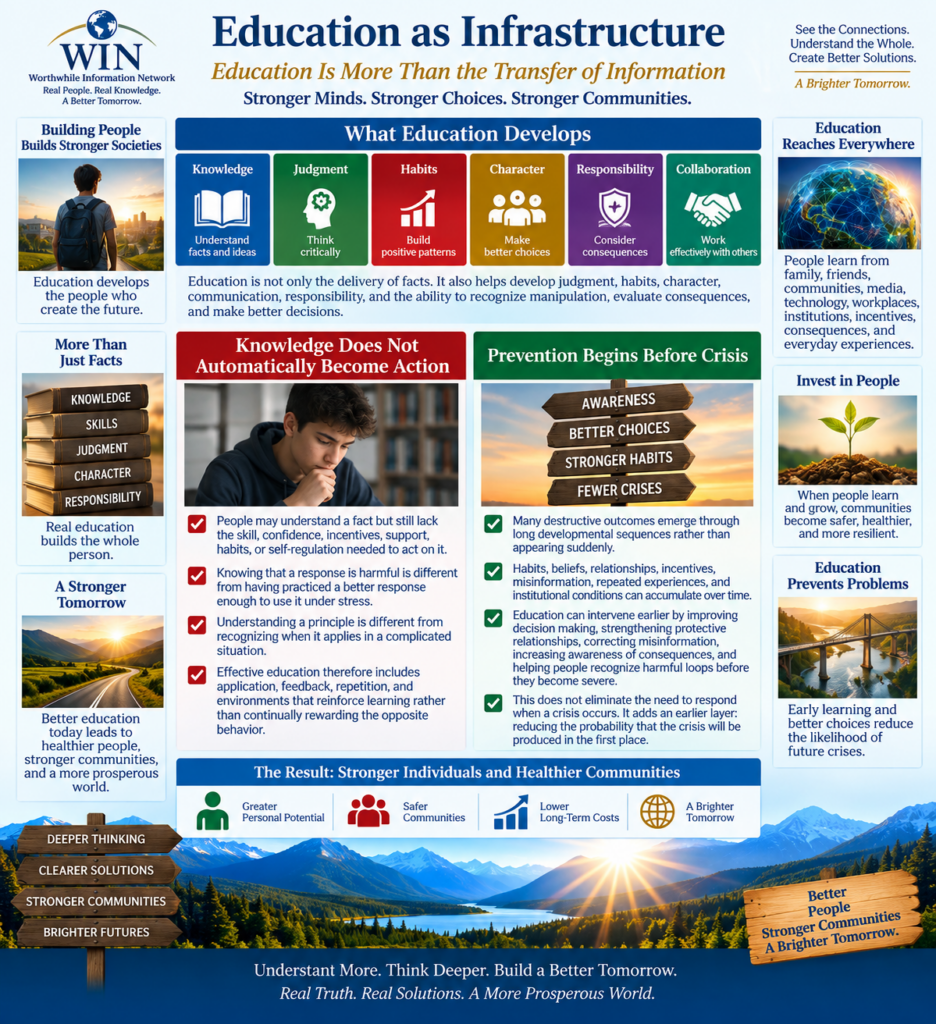
Education Is More Than the Transfer of Information
Education is often described as the transfer of knowledge.
That is important, but incomplete.
Education can also influence:
judgment;
habits;
skills;
expectations;
communication;
responsibility;
self-regulation;
cooperation;
problem-solving;
and the ability to evaluate information and make decisions.
A person can memorize information without learning how to apply it.
A person can understand a principle in a calm environment but fail to recognize or use it under pressure.
A person can know what should be done without possessing the skills, habits, confidence, opportunity, or self-regulation needed to do it.
Durable learning therefore involves more than exposure to information.
It can require:
understanding;
application;
practice;
feedback;
reflection;
correction;
and
opportunities to use knowledge under realistic conditions.
For WIN, education is therefore part of the infrastructure supporting human development.
It affects not only what people know, but how they reason, respond to pressure, cooperate with others, solve problems, learn from mistakes, and continue developing when conditions change.
What Does “Education as Infrastructure” Mean?
We usually think of infrastructure as the underlying systems that allow other activities to function.
Roads support transportation.
Electrical systems support homes, businesses, communication, and industry.
Water systems support health and communities.
Digital networks support modern information exchange.
Education can be understood in a similar foundational sense.
Human institutions ultimately depend on people.
People operate:
businesses;
governments;
schools;
nonprofits;
families;
technology;
health systems;
financial systems;
and communities.
Their knowledge, judgment, skills, habits, and decisions influence how well those systems function.
Education therefore helps build part of the human infrastructure on which other forms of infrastructure depend.
This does not mean education controls every outcome.
Resources matter.
Technology matters.
Law matters.
Institutions matter.
Biology and environment matter.
Chance matters.
But all of those systems ultimately interact with human beings who must understand, operate, maintain, improve, and sometimes redesign them.
Human Capability Is Infrastructure
A sophisticated system can still fail when the people operating it:
do not understand it;
misinterpret information;
hide errors;
ignore warning signs;
lack appropriate training;
respond poorly to incentives;
or cannot adapt when circumstances change.
Conversely, capable people can sometimes compensate for imperfect systems—at least temporarily.
This means human capability itself has infrastructural value.
Education can help develop that capability.
The larger objective is not simply producing people who possess information.
It is developing people increasingly capable of:
understanding;
reasoning;
deciding;
cooperating;
acting responsibly;
learning;
and
correcting mistakes.
Education Begins Long Before Formal Instruction
Human development begins before a person enters a classroom.
Children learn from:
relationships;
language;
examples;
responses;
attention;
boundaries;
consequences;
expectations;
and repeated experiences.
Learning continues through school, work, relationships, media, technology, institutions, successes, failures, and everyday life.
This is why WIN’s Everything Educates concept is central to its educational architecture.
Formal education is one part of a much larger learning environment.
If the surrounding environment continually teaches lessons that contradict formal instruction, those competing lessons matter.
Knowledge Does Not Automatically Become Action
People may understand a fact but still lack the:
skill;
confidence;
incentives;
support;
habits;
practice;
opportunity;
or self-regulation
needed to act on it.
That gap matters.
Knowing that a response is harmful is different from having practiced a better response enough to use it under stress.
Understanding a principle is different from recognizing when it applies in a complicated situation.
Knowing how to perform a skill is different from reliably performing it when tired, frightened, distracted, pressured, or uncertain.
Effective education therefore includes application, feedback, repetition, and environments that reinforce learning rather than continually rewarding the opposite behavior.
Knowing, Understanding, and Doing Are Different
Educational systems can mistakenly treat these three stages as equivalent.
They are not.
A learner may know a definition.
The learner may then understand why the concept matters and how its parts relate.
A still deeper level appears when the learner can apply that understanding appropriately in a new situation.
For example, someone may memorize:
Correlation does not necessarily establish causation.
Understanding requires knowing why.
Application requires recognizing the problem when encountering a new claim in the real world.
Education becomes more useful as knowledge increasingly becomes transferable capability.
Education Helps Build Decision Infrastructure
Every day, people make decisions involving:
health;
money;
relationships;
employment;
technology;
information;
risk;
responsibility;
and other people.
Institutions make decisions with even wider consequences.
The quality of those decisions depends partly on the capabilities of the people making them.
Education can help people learn to:
identify the actual problem;
find relevant information;
evaluate evidence;
recognize assumptions;
compare alternatives;
consider probabilities;
anticipate consequences;
identify incentives;
recognize uncertainty;
and correct course when evidence changes.
WIN develops these capabilities more fully through Foundations of Responsible Decision-Making.
Decision-making is therefore not merely an educational subject.
It is one of the practical outputs that makes education infrastructurally important.
Prevention Begins Before Crisis
Many destructive outcomes emerge through long developmental sequences rather than appearing suddenly.
Habits, beliefs, relationships, incentives, misinformation, repeated experiences, opportunities, and institutional conditions can accumulate over time.
By the time a serious problem becomes visible, part of its developmental history may already extend across months or years.
Education can sometimes intervene earlier by:
improving decision-making;
strengthening useful capabilities;
correcting misinformation;
increasing awareness of consequences;
helping people recognize manipulation;
strengthening protective relationships;
and helping people recognize harmful developmental patterns before they become severe.
This does not eliminate the need to respond when a crisis occurs.
People experiencing immediate problems may need immediate help.
Education adds another layer:
reducing the probability that some preventable problems will be produced or repeatedly reproduced in the first place.
Prevention Is Not a Guarantee
Education should not be presented as a universal preventive solution.
Well-educated people can make poor decisions.
People can understand risks and still take them.
Some problems arise from circumstances education cannot control.
Some outcomes involve illness, biological factors, accidents, coercion, economic conditions, institutional failures, or other forces that cannot reasonably be reduced to education.
The responsible claim is narrower:
better education can improve some of the capabilities and conditions that influence some outcomes.
Whether a particular educational intervention actually produces the intended improvement should be measured rather than assumed.
Developmental Loops Can Strengthen or Weaken Capability
Learning can become self-reinforcing.
Practice can improve competence.
Greater competence can increase confidence.
Greater confidence can increase willingness to practice.
That additional practice can produce further improvement.
But destructive patterns can also reinforce themselves.
Repeated failure can reduce confidence.
Reduced confidence can encourage avoidance.
Avoidance can reduce practice.
Reduced practice can slow improvement.
That slower improvement can contribute to additional failure.
WIN examines these processes through Developmental Loops.
Thinking in loops changes an important educational question.
Instead of asking only:
What lesson should we teach?
we can also ask:
What continuing pattern of experience will reinforce—or undermine—the lesson afterward?
Institutions Educate Through Design
Education happens outside classrooms as well as inside them.
Rules, incentives, interfaces, media, workplaces, schools, families, and public systems continually teach people what behavior is:
expected;
rewarded;
ignored;
discouraged;
safe;
risky;
easy;
or difficult.
An institution may formally teach one principle while its actual incentives teach another.
A workplace can praise honesty while rewarding concealment of bad results.
A school can encourage curiosity while punishing reasonable questions.
An organization can ask people to report problems while making the person who reports them suffer for doing so.
A public system can encourage responsibility while making responsible action unnecessarily difficult.
Institutional design is therefore an educational force whether or not it is labeled education.
The Hidden Curriculum of Systems
Every institution has formal rules.
But people also learn from what actually happens.
They observe:
Who is rewarded?
Who is ignored?
What happens when someone admits a mistake?
Are questions welcomed?
Does leadership follow the standards it expects from everyone else?
Are bad results hidden or examined?
Does honesty create unnecessary punishment?
Do shortcuts succeed?
Does competence matter?
Does manipulation work?
These experiences form a kind of hidden curriculum.
People learn what the system actually rewards even when official documents say something different.
This is one reason education and Systems Thinking cannot be completely separated.
A system is always communicating something through its structure and consequences.
Incentives Can Educate More Powerfully Than Instructions
Suppose an organization tells employees:
Quality comes first.
But promotions depend almost entirely on speed.
Employees are then receiving two educational messages.
The written message says:
Prioritize quality.
The incentive system says:
Prioritize speed.
Repeated experience may teach the second lesson more powerfully than the first.
This is why educational design cannot be separated from incentive design.
If institutions want to encourage particular capabilities or standards, they should examine whether their actual incentives reinforce or undermine them.
Culture Is Part of Educational Infrastructure
Culture influences what people regard as:
normal;
admirable;
embarrassing;
acceptable;
expected;
or unacceptable.
A culture can encourage:
curiosity;
responsibility;
honesty;
learning;
constructive disagreement;
and correction.
It can also discourage those behaviors.
Culture is not created by slogans alone.
It develops through repeated examples, stories, incentives, consequences, leadership behavior, peer expectations, and institutional practices.
Education therefore includes not only what an institution formally teaches, but what its culture repeatedly demonstrates.
Education Should Strengthen Agency
People are influenced by their environments.
But influence is not destiny.
Education should increase people’s capacity to examine those influences rather than simply submit to them.
That includes learning to:
compare evidence;
recognize persuasion and manipulation;
anticipate consequences;
communicate disagreements constructively;
resist harmful social pressure;
reconsider assumptions;
recognize uncertainty;
and accept responsibility for choices.
The purpose is not to tell people what to think about every issue.
It is to strengthen the tools needed to think more carefully, learn from error, and make increasingly informed decisions.
Education Should Reduce Unnecessary Dependence
A strong educational system should not make people permanently dependent on the educator for every answer.
As learners develop, they should become increasingly capable of:
finding information;
evaluating sources;
asking better questions;
checking claims;
recognizing their own limitations;
seeking appropriate expertise;
and continuing to learn independently.
This creates an important test:
Does the educational process increase the learner’s capability—or merely increase dependence on the source of instruction?
WIN’s long-term educational objective favors increasing capability.
Education and Freedom Are Connected
A choice made without relevant knowledge may technically be a choice, but it is not necessarily an equally informed choice.
Understanding:
consequences;
alternatives;
risks;
probabilities;
manipulation;
and relevant evidence
can expand a person’s practical ability to choose intelligently.
Education does not guarantee wise choices.
It can increase the range of choices a person is capable of evaluating meaningfully.
In that sense, education can strengthen practical agency without eliminating personal responsibility.
Education and Responsibility Grow Together
Greater capability can create greater responsibility.
A person who has never encountered important information may make a mistake partly because of ignorance.
Once that person understands the consequences more clearly, continuing the same behavior can involve a different degree of informed choice.
Education therefore should not merely expand knowledge.
It should also help people understand:
responsibility;
consequences;
obligations;
boundaries;
and the effects their choices have on others.
WIN’s educational direction seeks to combine greater understanding with greater responsibility.
Education Can Strengthen Institutional Resilience
Institutions sometimes become dangerously dependent on a small number of people.
One person knows how the system works.
One employee knows why an old decision was made.
One administrator understands the records.
One technician knows how to recover from a failure.
When that person leaves, capability disappears.
Education, documentation, cross-training, succession planning, and institutional memory can reduce that vulnerability.
A resilient institution should be able to:
teach new people;
transfer important knowledge;
preserve reasoning;
update procedures;
recover from mistakes;
and continue functioning through leadership changes.
Education therefore supports not only individual development but organizational continuity.
Education Can Preserve Institutional Memory
Documentation preserves information.
Education helps people understand and use it.
An archive can contain thousands of documents and still fail as institutional memory if future people cannot determine:
which material remains current;
why important decisions were made;
what evidence supported them;
what assumptions were involved;
what failed;
what changed;
and what should be reconsidered.
Education converts stored information into usable institutional knowledge.
For a long-horizon organization such as WIN, that distinction is particularly important.
Education Should Make Correction Normal
People will make mistakes.
Institutions will make mistakes.
Educational material will contain weaknesses.
Evidence will change.
Better explanations will emerge.
A mature educational culture should therefore treat correction as part of learning rather than automatically treating it as embarrassment or defeat.
Learners should be able to say:
I was wrong.
Researchers should be able to say:
The evidence changed.
Organizations should be able to say:
This did not work as expected.
Educators should be able to say:
We need to teach this differently.
WIN’s Learning From Failure approach treats errors and unexpected outcomes as potential sources of information rather than things that must always be hidden or rationalized.
Education Should Remain Correctable
An educational system becomes dangerous if its conclusions become immune to evidence.
WIN’s educational materials should therefore remain open to:
criticism;
professional review;
new evidence;
better explanations;
measurement;
and revision.
Teaching a concept does not make it permanently correct.
Publishing a course does not transform a hypothesis into a fact.
Institutional adoption does not make an idea immune to reconsideration.
The educational infrastructure should preserve both:
knowledge worth keeping
and
the ability to correct what should no longer be kept.
Lifelong Public Education
A society facing rapid technological, economic, institutional, and informational change needs continuing opportunities for adults to update knowledge, evaluate claims, adapt responsibly, and guide younger generations.
Formal schooling cannot anticipate every challenge a person will encounter decades later.
New technologies emerge.
New forms of manipulation appear.
Institutions change.
Scientific understanding improves.
Occupations change.
Information environments evolve.
People take on new responsibilities throughout life.
WIN’s long-term educational vision therefore extends beyond childhood and beyond a single course.
Public explanations, future structured learning, continuing education, and opportunities for review can contribute to a system in which learning remains available throughout life.
Education Must Adapt Without Chasing Every Trend
Lifelong education requires updating.
But constant change is not automatically improvement.
Educational systems should distinguish between:
new information that materially changes understanding;
temporary fashions;
new terminology for old ideas;
technological novelty;
and genuinely better methods.
The objective should be neither resistance to change nor fascination with change.
It should be disciplined improvement.
Technology Is Part of the Educational Environment
Digital systems increasingly influence:
what information people encounter;
how quickly they encounter it;
what receives attention;
how information is personalized;
how people communicate;
and how people learn.
Artificial intelligence may expand access to explanations, practice, feedback, translation, knowledge retrieval, and individualized learning assistance.
But technology can also:
spread incorrect information;
amplify manipulation;
create dependency;
reduce privacy;
scale poor educational design;
and make persuasive information appear more authoritative than it is.
Technology therefore becomes part of the educational infrastructure itself.
The relevant question is not merely:
What can the technology do?
It is:
What human capability should the technology help develop, and what safeguards are required?
Education Infrastructure Requires Maintenance
Physical infrastructure deteriorates when it is not maintained.
Educational infrastructure can deteriorate too.
Information becomes outdated.
Examples lose relevance.
Technology changes.
Skills decay.
Institutional memory disappears.
Assessments stop measuring what matters.
Incentives drift.
New evidence contradicts old material.
Programs become routine and stop being questioned.
Educational infrastructure therefore requires:
review;
measurement;
updating;
professional input;
correction;
and continuing investment.
Building educational material once is not the same as maintaining a functioning educational system.
Educational Infrastructure Should Be Measured
An educational program can be beautifully designed and still fail to produce its intended result.
WIN should therefore eventually ask:
Did learners actually understand the material?
Can they apply it?
Do relevant capabilities improve?
Do improvements persist?
What unintended consequences appeared?
Which learners benefited?
Who did not?
What parts of the program were ineffective?
Did the educational environment reinforce or undermine the formal instruction?
This connects educational infrastructure with WIN’s Measurable Outcomes framework.
The goal is not to measure everything merely because it can be measured.
It is to measure enough to determine whether important educational objectives are actually being achieved.
Educational Infrastructure Should Be Accessible
Infrastructure that large portions of its intended population cannot use has limited value.
Educational systems should therefore consider:
clear communication;
readability;
technology access;
disability accessibility;
language barriers where relevant;
device compatibility;
navigation;
and unnecessary complexity.
Accessibility does not mean removing intellectual rigor.
It means reducing barriers that are unrelated to the capability being developed.
Education Is a Long-Horizon Investment
The full effects of education may not appear immediately.
A lesson learned today may affect a decision years later.
A skill developed in adolescence may influence employment, parenting, leadership, or citizenship decades later.
Knowledge transmitted to one generation may affect the next.
Some educational benefits are therefore difficult to observe within short evaluation periods.
This does not mean long-term benefits should simply be assumed.
It means educational evaluation may need multiple time horizons.
WIN explores this broader perspective through Long-Horizon Thinking.
Education Across Generations
Every generation inherits knowledge from people it never met.
Language.
Science.
History.
Technology.
Institutions.
Methods.
Warnings.
Discoveries.
Mistakes.
Education is one of the primary mechanisms through which civilization transfers accumulated capability across time.
But transmission should include more than conclusions.
Future generations benefit from understanding:
what earlier people believed;
why they believed it;
what evidence they had;
what remained uncertain;
what failed;
and
what later evidence changed.
Otherwise, knowledge can gradually become doctrine detached from its reasons.
Education Supports Responsible Renewal
Each generation inherits systems it did not design.
Some are valuable.
Some are outdated.
Some contain both strengths and weaknesses.
Education can help future people distinguish among:
what should be preserved;
what should be repaired;
what should be replaced;
and what should be investigated further.
This is part of responsible continuity.
The objective is not to train future generations merely to preserve today’s institutions.
It is to give them enough knowledge and capability to evaluate those institutions intelligently for themselves.
Education Is Not the Only Infrastructure That Matters
Calling education infrastructure should not turn education into an explanation for every human or social outcome.
Healthy communities also depend on:
physical infrastructure;
economic opportunity;
health systems;
law;
governance;
technology;
families;
social relationships;
security;
environmental conditions;
and many other factors.
Education interacts with these systems.
It does not replace them.
The value of the infrastructure perspective is not that education explains everything.
It is that human capability affects almost everything people build, operate, maintain, and improve.
From Infrastructure to Opportunity
WIN is currently building the public foundation of a much larger educational effort.
The present website introduces concepts and makes public educational material available.
Future development may eventually include:
structured courses;
learning pathways;
assessments;
case studies;
interactive exercises;
continuing education;
specialized instruction;
and more advanced developmental pathways.
These capabilities should expand only as the curriculum, technology, professional expertise, safeguards, governance, and measurement systems become ready.
WIN’s Future Educational Opportunities page describes this staged direction.
From Education to Responsible Participation
One possible future application of WIN’s educational architecture is the Active Citizen Pathway.
The pathway begins with learning rather than authority.
Its emphasis is on:
evidence;
judgment;
responsibility;
conduct;
appropriate boundaries;
continuing development;
and constructive participation.
Completing educational material would not automatically confer organizational authority, investigative authority, law-enforcement powers, or access to sensitive activities.
More consequential responsibilities, if developed, should require stronger qualifications, safeguards, accountability, and continuing standards.
WIN’s current public description of the pathway likewise emphasizes learning and development rather than a new class of authorities.
The Larger Principle
If people are the ones who build, operate, maintain, govern, repair, and improve society’s systems, then developing human capability is not peripheral to those systems.
It is foundational to them.
Education can help people:
understand more accurately;
reason more carefully;
make better-informed decisions;
cooperate more constructively;
recognize manipulation;
learn from failure;
adapt to change;
preserve useful knowledge;
and improve what earlier generations left behind.
That is the central meaning of Education as Infrastructure.
Education is not the only foundation of human progress.
But wherever human judgment matters, the quality of human development matters too.
Continue Exploring
These pages extend the infrastructure perspective into learning environments, human development, decision-making, measurement, long-term thinking, and WIN’s future educational pathways.
Foundations of Responsible Decision-Making