Everything Educates
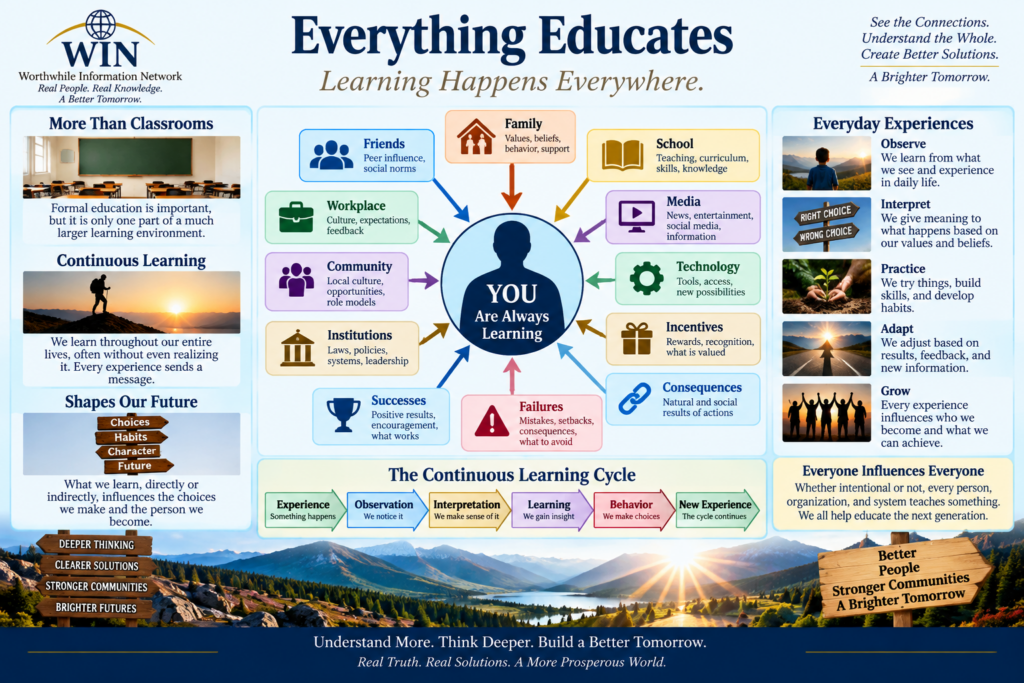
Learning Happens Everywhere
One of WIN’s foundational observations is simple:
Human beings are continually learning from experience.
Formal education is only one part of that process.
People also learn from families, peers, workplaces, institutions, incentives, consequences, examples, media, technology, success, failure, repetition, observation, and the behavior of the systems around them.
WIN uses the phrase Everything Educates to describe this broader developmental reality.
It does not mean that every experience teaches something beneficial.
It does not mean that every experience affects every person in the same way.
And it does not mean that environment determines a person’s future.
It means that experiences can influence what people learn about themselves, other people, institutions, consequences, expectations, opportunities, and how the world appears to work.
Education Is Larger Than Schooling
School is an important educational environment, but education begins before formal schooling and continues long after it.
A child learns from how adults respond to questions.
An employee learns from what behavior receives recognition.
A citizen learns from whether institutions appear fair and consistent.
A consumer learns from repeated interactions with businesses.
A person using technology learns from what the system makes easy, difficult, rewarding, visible, or invisible.
These lessons may never appear in a curriculum.
They can nevertheless influence future behavior.
Words Are Only One Teacher
What people are told matters.
What people repeatedly experience can matter just as much—and sometimes more.
An institution may say:
“Honesty matters.”
But if people repeatedly observe dishonesty being rewarded and honesty being punished, the operational lesson may conflict with the stated lesson.
A parent may tell a child to remain calm while responding to every disagreement with anger.
An organization may promote teamwork while rewarding only individual competition.
The intended message and the experienced message are not always the same.
Examples Teach
People learn partly by observing what other people do and what happens afterward.
Children observe adults.
Students observe teachers and classmates.
Employees observe supervisors and coworkers.
People observe friends, community leaders, public figures, online personalities, and strangers.
An example does not mechanically determine what another person will become.
But repeated examples can help establish expectations about what is normal, acceptable, effective, admired, tolerated, or possible.
Consequences Teach
Consequences provide information about what happens after behavior.
When constructive behavior consistently produces worthwhile results, that can reinforce the behavior.
When destructive behavior produces rewards with few meaningful costs, that can teach a very different lesson.
Consequences can also teach unintended lessons.
A system intended to discourage mistakes may instead teach people to hide them.
A system intended to encourage productivity may teach people to sacrifice quality for speed.
A punishment intended to create responsibility may sometimes teach only how to avoid detection.
The important question is not merely:
What consequence was imposed?
It is:
What did people actually learn from the consequence?
Incentives Educate
An incentive is not merely a financial reward.
Status, attention, convenience, acceptance, promotion, recognition, belonging, power, influence, reduced effort, avoidance of embarrassment, and protection from consequences can all function as incentives.
People can learn which behaviors produce desirable outcomes and which create costs.
This does not mean incentives completely control human behavior.
It means incentive structures become part of the learning environment.
Attention and Repetition Can Educate
Attention itself can become information.
Behavior that repeatedly produces attention may sometimes become more likely to occur, even when the attention was intended to discourage it.
Conversely, worthwhile behavior that receives little recognition may appear less valuable than behavior receiving immediate attention.
Repetition matters too.
Repeated experiences can create familiarity, expectations, habits, assumptions, and patterns of response.
A message heard repeatedly can become easier to remember.
A procedure practiced repeatedly can become easier to perform.
A behavior repeatedly rewarded can become habitual.
Repetition does not make a false claim true.
But repetition can affect what people remember, expect, notice, and consider normal.
Success and Failure Both Teach
Success provides information.
When a strategy produces a desired result, people may reasonably become more likely to use that strategy again.
But success can sometimes teach the wrong lesson.
An outcome may have succeeded because of luck, unusual circumstances, hidden assistance, temporary conditions, or factors unrelated to the explanation people assign to it.
The fact that something worked once does not prove that we understand why it worked.
Failure can reveal weaknesses that success hides.
A failed prediction may expose an incorrect assumption.
A failed intervention may reveal a missing variable.
A failed organization may reveal structural weaknesses.
A failed educational approach may expose misunderstanding about how people learn.
Failure becomes educational when the information it provides is examined rather than concealed, ignored, or automatically explained away.
WIN develops this principle further through Learning From Failure.
Families, Peers, and Communities Educate
Families are among the earliest and most persistent learning environments.
Children can learn communication patterns, expectations, trust, conflict resolution, responsibility, emotional responses, cooperation, boundaries, and attitudes toward other people long before those subjects are formally discussed.
No family teaches perfectly.
The important point is that family life continually creates experiences from which people may learn.
Peers and communities also matter.
People observe what others accept, admire, discourage, criticize, reward, or ignore.
Belonging can be a powerful human motivation.
Group expectations can encourage constructive behavior, but they can also normalize harmful behavior.
Communities therefore educate partly through the standards that become visible in everyday life.
Workplaces and Institutions Educate
Every workplace contains a learning environment.
Employees learn what actually matters by observing which behaviors receive recognition, promotion, authority, protection, criticism, or punishment.
A company may advertise one set of values while its internal incentives reward another.
Employees learn from both.
Schools, governments, businesses, nonprofits, courts, healthcare systems, media organizations, and other institutions likewise create experiences from which people draw conclusions.
People notice whether rules appear consistent.
They notice whether authority is accountable.
They notice whether mistakes are corrected.
They notice whether honesty matters.
They notice whether complaints receive meaningful examination.
They notice whether stated principles match actual behavior.
Those experiences can influence trust, cooperation, expectations, and future behavior.
Rules Educate Through Their Application
Rules communicate boundaries and expectations.
But the existence of a rule is only part of the educational environment.
People also learn:
- whether the rule is applied;
- whether application is consistent;
- whether exceptions are transparent;
- whether powerful people follow the same rule;
- whether compliance produces the intended benefit;
- and whether violating the rule produces meaningful consequences.
A rule on paper and a rule in practice can teach very different lessons.
Systems Teach People How to Navigate Them
People adapt to systems.
If a process consistently rewards persistence, people may learn persistence.
If it rewards manipulation, people may learn manipulation.
If it rewards superficial compliance rather than meaningful performance, people may learn how to satisfy the metric without achieving the intended result.
People do not merely operate inside systems.
They also learn from the systems they repeatedly encounter.
This is one reason Everything Educates connects closely with Systems Thinking.
Media and Technology Educate
Media and technology influence what information people encounter, what receives attention, how quickly information spreads, and which behaviors become visible or rewarded.
Digital systems can shape learning environments through interface design, notifications, recommendations, rankings, feedback, and repeated patterns of interaction.
This does not mean technology controls everyone who uses it.
It means technology creates learning environments whose effects deserve examination.
Our Own Choices Educate Us
People also learn from their own behavior.
A person makes a decision, experiences a result, interprets what happened, and may alter future behavior accordingly.
Sometimes the lesson is accurate.
Sometimes it is not.
A person may succeed for reasons they misunderstand or fail because of circumstances they incorrectly attribute to themselves.
Reflection improves the chance that experience becomes useful learning rather than merely repeated experience.
Developmental Loops
Learning often operates through loops.
Experience → interpretation → expectation → decision → behavior → consequence → new experience.
A person encounters a situation, interprets it through existing knowledge and expectations, makes a decision, experiences a consequence, and incorporates some lesson into future expectations.
The next decision is therefore not made by exactly the same person in exactly the same informational state.
Something may have been learned.
Over time, repeated developmental loops can strengthen useful capabilities—or reinforce destructive patterns.
WIN examines these processes more fully through Developmental Loops.
A Simple Example: The Workplace Metric
Imagine a workplace that says quality is its highest priority.
Employees are told to work carefully and produce accurate results.
But management evaluates employees almost entirely on how many cases they complete each day.
Workers who investigate difficult cases carefully fall behind their targets.
Workers who process cases quickly receive better evaluations.
What is the workplace teaching?
The formal lesson is:
Quality matters.
The experienced lesson may be:
Speed is what actually determines success here.
If management wants different behavior, repeating the slogan may accomplish little unless the surrounding incentives and experiences also change.
That is Everything Educates in practice.
Intended Education and Actual Education Can Differ
An educator, parent, institution, or policy can intend to teach one lesson and accidentally teach another.
A policy designed to increase accountability may teach people to hide errors.
A grading system intended to motivate learning may teach students to optimize for grades rather than understanding.
A poorly designed incentive intended to improve performance may teach people to manipulate the measurement.
The relevant question is therefore not only:
What were we trying to teach?
It is also:
What did people actually learn?
Conflicting Lessons Matter
People often receive contradictory education.
A child may be taught honesty at home while observing dishonesty rewarded elsewhere.
An employee may receive excellent ethics training while working inside a system that pressures employees to conceal mistakes.
A person may be told that participation matters while repeatedly experiencing institutions that appear unresponsive.
Different learning environments can therefore pull behavior in different directions.
Understanding development requires examining the combined learning environment, not merely one lesson in isolation.
Education Can Accumulate
One isolated experience may have little lasting effect.
Repeated experiences can accumulate.
Expectations become stronger.
Habits become easier.
Skills develop.
Interpretive frameworks become familiar.
Behavior can become increasingly automatic.
This is one reason developmental environments matter over long periods.
Small repeated influences can sometimes matter more than one dramatic lesson.
Everything Educates Does Not Mean Everything Determines
This distinction is essential.
WIN is not claiming that people are passive products of their environments.
People interpret experiences differently.
They possess different histories, capabilities, temperaments, knowledge, relationships, opportunities, constraints, and biological characteristics.
People can reject what they observe.
They can reconsider what they previously learned.
They can deliberately change habits.
They can learn from new evidence.
They can resist incentives.
They can choose differently.
The principle is therefore about influence and learning, not mechanical determinism.
Influence Is Not Destiny
A harmful developmental environment can increase risk without making an outcome inevitable.
A beneficial environment can improve opportunity without guaranteeing success.
Understanding influences should therefore improve prevention and support—not become a reason to stereotype people or assume their future behavior.
People remain capable of learning, revision, growth, and unexpected change.
Education and Accountability Can Coexist
Understanding how behavior developed does not eliminate responsibility for behavior.
Someone may have learned a destructive pattern and still be responsible for harmful actions and subject to appropriate consequences.
The deeper question is whether society can both respond appropriately to present behavior and reduce the conditions that make similar behavior more likely in the future.
Understanding development can make prevention, correction, rehabilitation, accountability, and system improvement more informed.
When Education Becomes Destructive
Education is not automatically beneficial simply because learning occurs.
People can learn prejudice.
People can learn deception.
People can learn helplessness.
People can learn aggression.
People can learn that corruption is profitable.
People can learn that mistakes must be hidden.
People can learn misinformation.
People can learn destructive habits.
WIN uses the phrase Destructive Education for learning environments or developmental processes that materially increase the likelihood of harmful beliefs, capabilities, expectations, habits, or behavior.
The purpose of identifying destructive education is not to blame every harmful outcome on education.
It is to examine whether recurring environments are repeatedly teaching lessons that contribute to recurring problems.
WIN examines this concept further on Destructive Education.
Constructive Education Requires Alignment
A strong educational environment aligns what people are told with what they repeatedly experience.
If honesty matters, honesty should not consistently produce disadvantage while dishonesty is rewarded.
If critical thinking matters, legitimate questions should not automatically be punished.
If responsibility matters, accountability should apply consistently.
If learning matters, evaluation should reward genuine understanding rather than merely superficial completion.
If correction matters, people should be able to acknowledge mistakes without every error becoming an incentive for concealment.
Alignment between stated values and experienced reality makes the educational message more credible.
Ask a Different Question
When a recurring problem appears, WIN does not ask only:
“What is wrong with these people?”
It also asks:
“What have people repeatedly been experiencing, learning, practicing, observing, and being rewarded or punished for?”
That question does not replace personal responsibility.
It expands the causal investigation.
Design Environments That Teach Better Lessons
If environments continually educate, then better systems should consider the lessons produced by their everyday operation.
A worthwhile institution should ask:
- What behavior are we rewarding?
- What behavior are we making unnecessarily difficult?
- What do people learn when they make an honest mistake?
- What do they learn when they report a problem?
- What do they learn from leadership behavior?
- What do our measurements teach people to optimize?
- Do our consequences reinforce the behavior we actually want?
- Do our stated values match people’s repeated experience?
These questions turn Everything Educates from an observation into a design principle.
Everything Educates Applies to WIN
WIN is also an educational environment.
Visitors learn from whether WIN distinguishes evidence from assumption.
Volunteers learn from how WIN responds to questions and mistakes.
Partners learn from whether WIN honors its stated standards.
Future learners will learn not only from WIN’s educational content but also from how WIN’s systems actually operate.
If WIN teaches transparency while hiding meaningful failures, WIN will be teaching two contradictory lessons.
If WIN teaches correction while resisting correction itself, its behavior will undermine its words.
Everything Educates therefore places an obligation on WIN as well:
The organization itself must increasingly demonstrate the principles it asks others to examine.
A Lifelong Educational Perspective
Everything Educates is not a claim that formal education is unimportant.
It is a reminder that human development continues across homes, schools, workplaces, institutions, communities, technologies, relationships, successes, failures, and everyday decisions.
People continually encounter information and experience from which they may learn.
The long-term objective is not to control every influence in human life. That would be neither realistic nor desirable.
The objective is to understand developmental influences well enough to create better opportunities for people to learn, reason, correct mistakes, develop worthwhile capabilities, and make increasingly informed decisions.
That is the larger meaning of Everything Educates.
Continue Exploring
Education Overview
Education as Infrastructure
Destructive Education
Developmental Loops
Systems Thinking
Frameworks Explained
The Human Developmental Framework
Foundations of Responsible Decision-Making
Learning From Failure