Real Root Cause
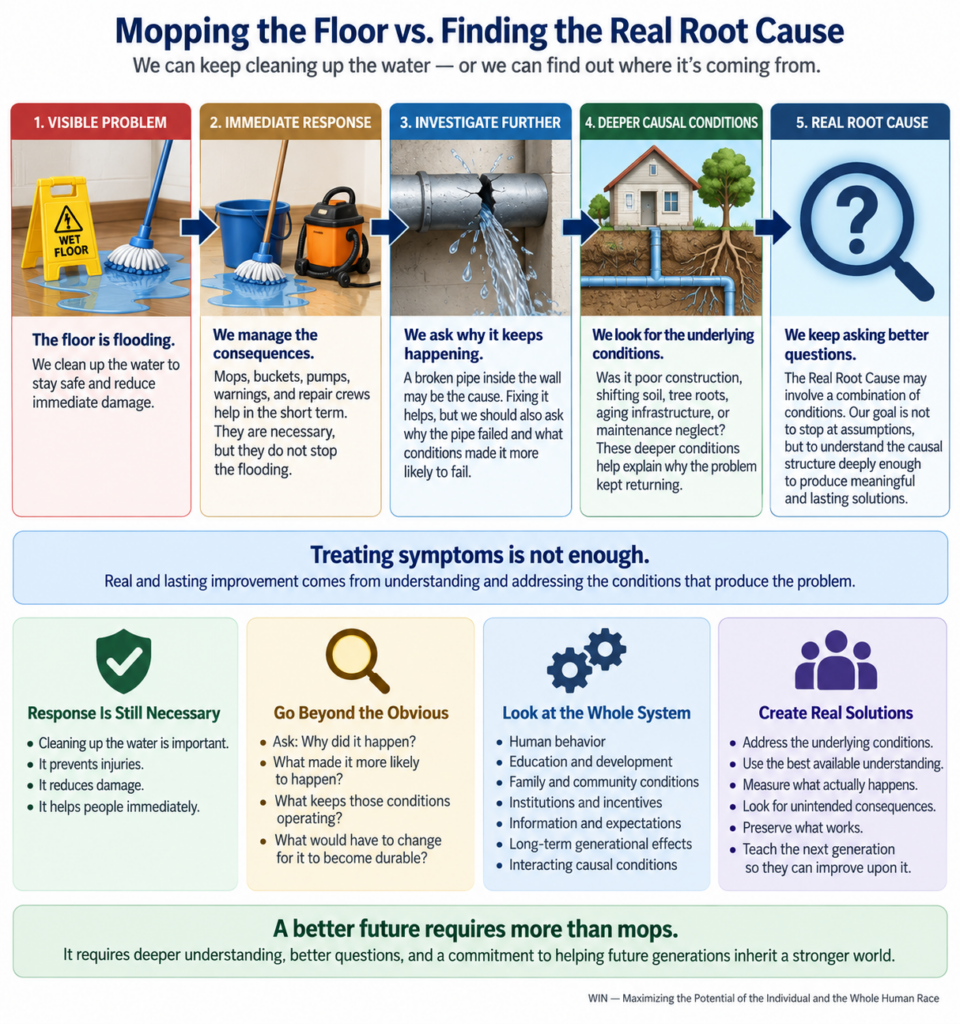
Real Root Cause: Understanding Why Problems Keep Returning
Many problems are easy to see but difficult to solve permanently.
Crime, corruption, educational failure, destructive behavior, institutional dysfunction, recurring conflict, poor decision-making, and other persistent problems can remain even after substantial effort has been devoted to fixing them.
WIN uses the term Real Root Cause (RRC) for causal understanding deep enough to explain not merely what happened, but why the important pattern keeps being produced or reproduced.
The word Real does not mean WIN has declared a cause to be unquestionably correct. A proposed Real Root Cause must earn that description through evidence, reasoning, comparison with competing explanations, and its ability to survive serious examination.
A Symptom Is Not Necessarily a Cause
The most visible part of a problem is often its outcome.
A failing student, a criminal act, an unethical decision, a dysfunctional organization, a recurring social conflict, or an unsuccessful program may be easy to observe.
But identifying the visible outcome does not necessarily explain what produced it.
Treating symptoms can sometimes be necessary and beneficial. Immediate harm may need to be stopped even when its deeper causes are not yet understood.
The mistake is assuming that controlling the symptom has necessarily removed the conditions that created it.
A Simple Example: The Wet Floor
Suppose water repeatedly appears on a floor.
Mopping it up is useful. It removes the immediate hazard and may prevent someone from falling. But if a leaking pipe is producing the water, repeated mopping manages the symptom without stopping the condition that keeps producing it.
Repairing the pipe addresses a deeper cause.
The investigation might go farther. Why did the pipe fail? Why was the leak not detected earlier? Why was the floor repeatedly mopped without the source of the water being investigated?
The appropriate stopping point depends on the problem being solved. The lesson is not that every problem has one hidden cause. It is that repeatedly managing an outcome is different from understanding what keeps producing it.
Human systems are usually far more complicated than a leaking pipe. They may involve multiple interacting causes, incentives, developmental influences, institutional conditions, and feedback loops. The example illustrates the principle, not the complexity of the real world.
Root Cause Does Not Mean One Cause
Complex human problems rarely arise from one isolated variable.
A recurring outcome may result from several interacting conditions:
Developmental influences — what people learned, experienced, practiced, normalized, or failed to learn.
Incentives — what behavior is rewarded, punished, tolerated, or made advantageous.
Information conditions — what people know, misunderstand, believe, or cannot easily verify.
Institutional structures — rules, procedures, authority, accountability, and organizational design.
Social conditions — relationships, expectations, group norms, trust, conflict, and cultural reinforcement.
Economic conditions — resources, scarcity, opportunity, costs, benefits, and financial pressures.
Technological conditions — systems that enable, amplify, constrain, or alter behavior.
Feedback loops — consequences that strengthen or weaken the conditions that produced them.
Individual differences — capabilities, experiences, motivations, limitations, and circumstances that affect how people respond.
A Real Root Cause may therefore be a causal system rather than a single causal factor.
Look for the Mechanism
Saying that two things are associated does not explain how one produces the other.
A stronger causal explanation identifies the mechanism connecting conditions to outcomes.
WIN therefore asks questions such as:
What happens first?
What changes next?
What influences the decision?
What behavior is reinforced?
What information is missing?
What incentive is operating?
What condition allows the problem to continue?
What feedback causes the pattern to repeat?
What would have to change for the outcome to change reliably?
A mechanism makes a causal explanation more testable.
Distinguish Trigger From Cause
The event immediately preceding an outcome may be a trigger without being its deepest cause.
An argument may trigger violence without explaining why violence became an available response.
A financial crisis may expose organizational weakness without having created all of that weakness.
A difficult examination may reveal educational deficiencies without having caused them.
A triggering event answers:
Why did this happen now?
A deeper causal analysis may ask:
Why was the system vulnerable to this outcome in the first place?
Both questions can matter.
Distinguish Enabling Conditions From Direct Causes
Some conditions do not directly produce an outcome but make it easier for that outcome to occur or continue.
Weak oversight may not itself commit fraud, but it may make fraud easier to conceal.
Poor information may not force a bad decision, but it can make the bad decision more likely.
A lack of accountability may not create misconduct in every person, but it can allow misconduct to persist.
These enabling conditions can be crucial parts of a Real Root Cause analysis.
Distinguish Individual Causes From System Causes
Human outcomes emerge from interactions between individuals and their environments.
It is therefore usually incomplete to assume either:
“The person caused everything.”
or:
“The system caused everything.”
Individual choices matter. So do incentives, knowledge, developmental history, opportunities, constraints, institutional rules, social influences, and consequences.
The relevant question is not which side deserves all responsibility.
The research question is:
What combination of individual and systemic conditions best explains the outcome?
Development Matters
Human behavior does not begin at the moment a problem becomes visible.
People develop patterns of reasoning, emotional responses, expectations, habits, values, skills, and decision-making strategies over time.
Families, schools, peers, institutions, media, communities, technology, rewards, punishments, opportunities, failures, successes, and lived experiences can all contribute to that development.
This does not mean every behavior can be reduced to childhood or education.
It means that serious causal analysis should examine how relevant capabilities and behavioral patterns developed rather than treating the final action as though it appeared from nowhere.
Everything Educates
WIN uses the principle Everything Educates to describe a broad developmental reality: people learn not only from formal instruction but also from repeated experience.
Rules educate.
Consequences educate.
Incentives educate.
Examples educate.
Peer behavior educates.
Institutional practices educate.
Media environments educate.
What authorities tolerate can educate.
What communities reward can educate.
What repeatedly succeeds or fails can educate.
The relevant question is not simply whether education occurred.
It is what was learned.
Incentives Can Reproduce Problems
Systems often produce the behavior they reward.
If a person or organization gains status, money, power, convenience, protection, or some other advantage from harmful behavior while bearing little cost, the surrounding incentive structure may help perpetuate that behavior.
Conversely, a system can unintentionally discourage worthwhile behavior by making it unusually costly, difficult, risky, or unrewarding.
Real Root Cause analysis therefore examines not only stated rules and intentions but also the actual incentives produced by the system.
Feedback Loops Can Make Problems Self-Reinforcing
Some outcomes create conditions that make the same outcome more likely in the future.
Poor education can reduce later opportunities, which can create conditions that make effective education harder.
Institutional distrust can reduce cooperation, which can weaken institutional performance and create still more distrust.
Corruption can weaken oversight, allowing additional corruption that further weakens oversight.
These are reinforcing feedback loops.
Finding such loops matters because changing one isolated event may have little lasting effect if the larger loop continues operating.
An Organizational Example: When the System Rewards the Wrong Result
Imagine an organization that tells employees that quality is its highest priority but evaluates them almost entirely on how many cases they complete each day.
Employees who investigate difficult cases carefully fall behind their numerical targets. Employees who process cases quickly receive better evaluations.
Management may repeatedly remind everyone to improve quality, yet the measurable incentive continues rewarding speed.
If errors increase, additional warnings or training may have little lasting effect because the organizational system continues reinforcing the behavior contributing to the problem.
The deeper question becomes:
What behavior does the system actually reward?
Changing speeches without changing the relevant incentives may leave the causal structure intact.
Some Causes Are Protective Rather Than Destructive
Causal analysis should not examine only what produces failure.
It should also identify what prevents failure.
Why do some people resist a harmful influence that affects others?
Why do some institutions remain honest under pressures that corrupt others?
Why do some students succeed under difficult conditions?
Why do some interventions work in one setting but fail in another?
These questions can reveal protective factors that are as important as risk factors.
Ask Why the Problem Keeps Returning
A particularly important clue appears when the same type of problem returns after repeated attempts to solve it.
If an intervention suppresses the outcome temporarily but the outcome later reappears, several possibilities should be examined:
The intervention may have treated only the visible symptom.
The underlying cause may remain.
Another causal pathway may be producing the same outcome.
The intervention may work only while unusually intensive resources are present.
The surrounding system may recreate the original conditions.
The intervention itself may create unintended consequences.
Or the original causal explanation may simply have been wrong.
Recurrence is information.
Repeated Failure Is Evidence
When different interventions repeatedly fail in similar ways, that pattern deserves investigation.
Failure does not automatically prove a particular root cause.
But repeated failure can reveal assumptions that deserve reconsideration.
Perhaps the wrong variable is being targeted.
Perhaps the intervention occurs too late.
Perhaps an important incentive has been ignored.
Perhaps the system compensates for the intervention.
Perhaps the measured outcome does not represent the real problem.
A Real Root Cause approach treats failed interventions as evidence rather than merely as disappointments.
Follow the Causal Chain Far Enough
Asking “Why?” once is rarely sufficient.
Suppose a program fails because participants stop attending.
Why did they stop attending?
Perhaps the program was inconvenient.
Why was it inconvenient?
Perhaps scheduling conflicted with work.
Why was that not anticipated?
Perhaps the program was designed without adequate information about participants’ actual conditions.
The useful causal stopping point is not necessarily the earliest imaginable cause.
It is the point at which the analysis becomes sufficiently explanatory and actionable to improve the outcome.
Do Not Ask “Why?” Forever
Root-cause analysis can become useless if every answer simply produces another “Why?”
Every event ultimately has an enormous causal history.
The purpose of RRC analysis is not to trace every causal chain back indefinitely.
It is to identify causes at a level where:
the explanation accounts for important evidence;
relevant competing explanations have been considered;
the mechanism is understandable;
the cause is sufficiently stable to matter;
and changing the relevant conditions could reasonably alter the outcome.
That is a practical stopping rule.
Proximity Does Not Equal Importance
The cause closest in time to an outcome is not necessarily the most important cause.
Likewise, the most distant cause is not automatically the deepest or most important one.
Causal importance depends on the structure of the problem.
A distant developmental condition may be crucial.
An immediate incentive may be crucial.
A current institutional rule may be crucial.
Often several levels interact.
RRC analysis should follow the evidence rather than assuming that either immediate or distant causes deserve priority.
Avoid the Single-Cause Fallacy
Simple explanations are attractive.
Complex problems are often described as being caused by poverty, parenting, education, greed, government, culture, technology, trauma, ideology, inequality, individual irresponsibility, or some other single factor.
Any of these may matter in a particular case.
The error is assuming that naming one plausible factor completes the explanation.
WIN’s approach asks how important variables interact and whether the proposed explanation accounts for both successes and failures.
Avoid Blame as a Substitute for Explanation
Blame and causation are different questions.
Determining moral, legal, or institutional responsibility can be necessary.
But assigning responsibility does not automatically explain why an outcome occurred or how to prevent it from recurring.
Saying “someone made a bad choice” may be true while leaving unanswered:
Why was that choice attractive?
What information did the person possess?
What alternatives were available?
What incentives were present?
What prior learning affected the decision?
What safeguards failed?
What allowed the behavior to continue?
Understanding causes does not erase responsibility.
It improves the ability to prevent recurrence.
Explanation Is Not Excuse
Explaining why destructive behavior occurred does not require approving of it.
A doctor can explain disease without endorsing disease.
An engineer can explain a structural failure without approving of the collapse.
Likewise, understanding the developmental, social, institutional, economic, or psychological conditions contributing to harmful behavior does not mean declaring the behavior acceptable.
Causal understanding and accountability can coexist.
Avoid Ideological Root Causes
A preferred worldview can become a shortcut that explains every problem in advance.
When one theory is used to explain every outcome regardless of evidence, it becomes difficult to test.
WIN therefore does not treat a political, religious, economic, cultural, or philosophical ideology as a universal causal answer.
Any proposed explanation must be evaluated against the relevant evidence and compared with credible alternatives.
Correlation Is Not Enough
If two conditions occur together, one may cause the other—but other explanations are possible.
The direction of causation may be reversed.
Both may be caused by a third factor.
Selection effects may create the appearance of a relationship.
The relationship may depend on another condition.
Or the apparent association may be coincidental.
Root-cause claims therefore require more than correlation when causal conclusions are being drawn.
Timing Matters
A proposed cause must fit the temporal structure of the outcome.
A cause generally must precede the effect it is claimed to produce, although feedback relationships can later operate in both directions.
Researchers should ask:
When did the condition appear?
When did the outcome change?
Was the proposed cause present before the outcome?
Did changes in the cause precede changes in the outcome?
Does the timing fit the proposed mechanism?
Temporal reasoning can eliminate explanations that initially appear plausible.
Compare Cases Where the Outcome Did Not Occur
Studying failure alone can hide important information.
If two people, organizations, communities, or systems face similar risks but only one experiences the outcome, the difference may reveal an important causal or protective factor.
WIN therefore values comparison between:
cases where the problem occurred;
cases where it did not;
cases where an intervention worked;
cases where it failed;
and cases where outcomes changed unexpectedly.
Variation helps reveal causation.
Counterfactual Thinking Helps Test Causes
A useful causal question is:
What would probably have happened if this condition had been different?
Counterfactual reasoning is imperfect because we cannot rerun history under perfectly controlled conditions.
But it helps clarify causal claims.
If removing a supposed cause would probably have made no meaningful difference, that factor may not be as causally important as assumed.
Where practical, experiments, natural experiments, longitudinal evidence, comparison groups, and other rigorous methods can improve this analysis.
Causes Can Change Over Time
The causes of a problem are not necessarily permanent.
Technology changes.
Institutions change.
Incentives change.
Populations change.
Knowledge changes.
Economic conditions change.
Social norms change.
A causal explanation that was useful in one period may become incomplete later.
Real Root Cause analysis must therefore remain open to changing conditions.
Causes Can Differ Across Populations and Settings
An explanation that fits one community, institution, age group, country, historical period, or population may not generalize automatically to another.
The same visible outcome can arise through different causal pathways.
WIN therefore seeks to identify the conditions under which an explanation applies rather than assuming universal applicability.
One Outcome Can Have Different Causes
Imagine two students who are both performing poorly in mathematics.
The visible outcome is the same, but the causes may be very different.
One student may never have mastered an earlier prerequisite. Another may understand the material but have difficulty reading the questions. Another may be frequently absent. Another may have received ineffective instruction. Another may be working successfully until the course reaches one particular concept.
Giving every student the same intervention simply because they have the same visible outcome can therefore fail.
The example illustrates an important RRC principle:
Similar symptoms do not necessarily imply identical causes.
Effective intervention depends on understanding the causal pathway producing the outcome in the particular situation.
Measurement Can Distort Root-Cause Analysis
If the outcome itself is measured poorly, causal analysis can become misleading.
A program may appear successful because it measures activity rather than improvement.
A social problem may appear to increase because reporting improved.
A problem may appear to decline because definitions changed.
A variable may seem causally important because both it and the outcome are measured through the same biased process.
Before explaining an outcome, researchers should ask whether the outcome has been measured accurately enough to support the explanation.
Beware of Data That Are Missing Because the System Never Collected Them
Organizations often analyze the information they possess rather than the information the problem actually requires.
Important variables may never have been measured.
People who left a program may disappear from the data.
Failed attempts may be poorly documented.
Unreported incidents may be invisible.
Historical records may reflect what institutions chose to record rather than everything that occurred.
Absence from a dataset is not always evidence of absence in reality.
Interventions Can Test Causal Explanations
A strong causal explanation should help generate predictions.
If condition A is materially contributing to outcome B, then changing A should—under appropriate conditions—produce a predictable change in B.
When an intervention based on that explanation repeatedly fails, the failure should reduce confidence in the explanation or reveal missing variables.
This is one reason WIN connects Real Root Cause analysis with measurement and pilot testing.
Solutions can become tests of causal understanding.
The Best Explanation May Still Be Incomplete
Complex systems rarely surrender every important cause at once.
An explanation may be substantially correct and still incomplete.
WIN therefore distinguishes between:
useful causal understanding
and
complete causal understanding.
Action sometimes must occur before every variable is known.
The responsible approach is to state remaining uncertainty, monitor outcomes, and revise the explanation as evidence improves.
Root Cause Analysis Must Be Falsifiable
A proposed Real Root Cause should expose itself to possible failure.
Researchers should ask:
What evidence would contradict this explanation?
What outcome would we expect if it were correct?
What would we expect if it were wrong?
What alternative explanation fits the evidence?
What evidence would cause us to revise the model?
If every possible outcome can be interpreted as confirming the proposed root cause, the explanation is not being meaningfully tested.
Root Causes Should Lead to Better Predictions
A useful causal model should improve our ability to anticipate what happens under changing conditions.
It need not predict every individual case.
Human systems contain uncertainty, variation, adaptation, and chance.
But a strong explanation should generally perform better than weaker alternatives at anticipating patterns, identifying risks, explaining differences, or predicting the consequences of interventions.
Root Causes Should Lead to Better Solutions
The practical value of causal understanding is that it changes where intervention occurs.
If a problem is repeatedly addressed only after the harmful outcome appears, society may spend enormous resources managing consequences.
When upstream causes can be identified and changed responsibly, prevention may become possible.
This is the relationship between Real Root Cause and Real Solutions:
Understand what generates the outcome before assuming what will eliminate it.
Prevention and Response Are Both Necessary
A root-cause approach should not be misunderstood as an argument against immediate response.
If someone is in danger, immediate protection matters.
If a crime occurs, lawful response matters.
If a system fails, stabilization matters.
If a child needs help, present needs matter.
Root-cause work addresses a different question:
What would have to change so fewer people reach that harmful condition in the future?
A mature system can respond to current harm while simultaneously reducing the conditions that generate future harm.
Repair Before Repetition
When evidence shows that a system repeatedly generates destructive outcomes, simply processing the consequences more efficiently is not enough.
WIN’s repair-first principle asks whether the underlying conditions can be changed so the undesirable outcome becomes less likely to occur.
Repair does not mean ignoring accountability, abandoning safeguards, or assuming every problem can be completely eliminated.
It means treating recurrence as evidence that prevention deserves serious attention.
Real Root Cause Applies to WIN Too
WIN must apply the same causal discipline to its own failures.
If a WIN program performs poorly, the explanation cannot automatically be:
participants failed;
the public did not understand;
critics interfered;
staff made mistakes;
or circumstances were unfavorable.
Any of those could matter, but they must be examined rather than assumed.
WIN should also investigate its own design, assumptions, incentives, communication, training, governance, measurement, technology, implementation, and causal model.
An organization that attributes every success to itself and every failure to outsiders cannot learn reliably.
From Real Root Cause to Real Solutions
A Real Root Cause analysis is not complete merely because it produces an interesting explanation.
Its value appears when the explanation helps identify better intervention points.
A useful causal model should help answer:
What conditions should be changed?
Which changes are realistically possible?
Which interventions address causes rather than symptoms?
What safeguards are required?
What unintended consequences could result?
How will outcomes be measured?
How quickly should change appear?
What result would show that the intervention failed?
What will we do if our causal explanation proves wrong?
These questions connect research to responsible action.
The Standard
WIN should not call something a Real Root Cause merely because it sounds fundamental.
The standard is more demanding:
Does the explanation account for the important evidence?
Does it identify a credible causal mechanism?
Does it survive comparison with competing explanations?
Does it explain important variation and recurrence?
Can it generate useful predictions?
Can it be challenged or falsified?
Does acting on it produce the expected improvement without unacceptable unintended harm?
If the answer is no, the causal model needs more work.
If stronger evidence later shows that WIN’s explanation was wrong, WIN should revise it.
That is not a failure of Real Root Cause analysis.
That is Real Root Cause analysis working.