The Human Developmental Framework
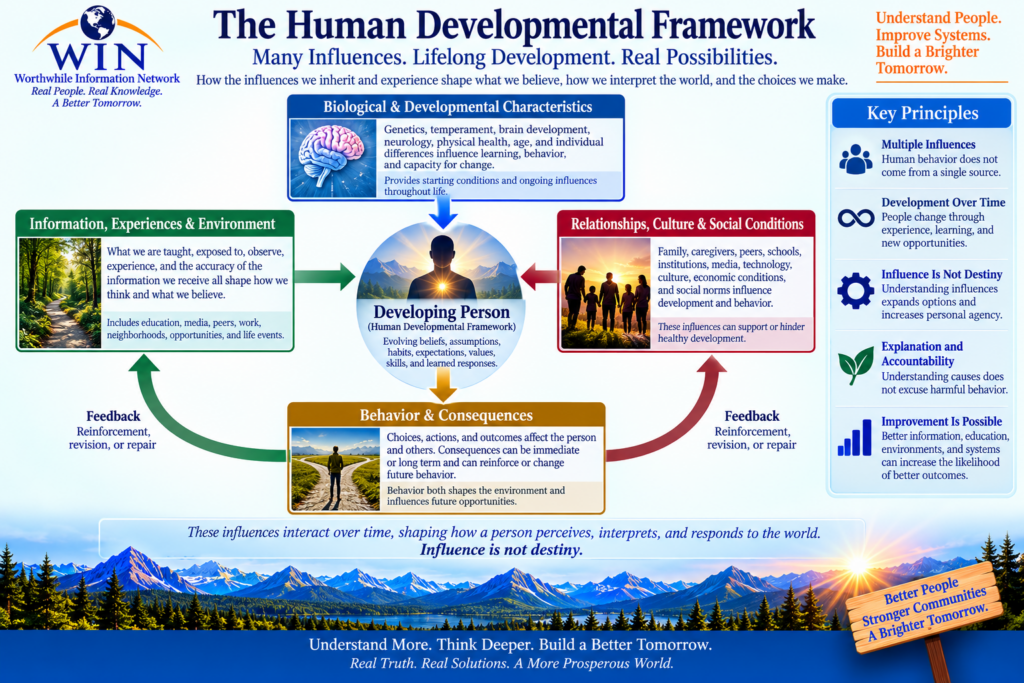
How the Influences We Inherit Can Shape What We Believe, How We Interpret the World, and the Choices We Make
The Human Developmental Framework is one of WIN’s central organizing concepts for understanding how people develop over time—and how greater understanding may create greater opportunities for responsible change.
It does not reduce human beings to their environments, excuse destructive behavior, or claim that every outcome can be explained by one model. Instead, it asks a deeper question:
What helped shape the framework through which a person now perceives, interprets, decides, and responds to the world—and what becomes possible when that framework can be examined?
1. What If Some of What You Dislike About Yourself Can Be Changed?
People sometimes look at their past and conclude:
This is just who I am.
Destructive habits, poor decisions, uncontrolled reactions, damaged relationships, addictions, fears, anger, prejudices, or repeated failures can gradually become incorporated into a person’s identity.
I did something bad can become I am bad.
I made destructive choices can become I am a destructive person.
I failed can become I am a failure.
WIN asks people to consider another possibility.
What if some of the beliefs, assumptions, habits, reactions, expectations, and behavioral patterns affecting your life are not permanent definitions of who you are?
What if some developed through a framework that began forming before you had the knowledge, maturity, independence, or ability to consciously evaluate much of what was entering it?
And what if understanding that framework could help you determine what should be preserved, questioned, repaired, or changed?
WIN calls this organizing concept the Human Developmental Framework.
Understanding it does not erase the past.
It does not eliminate responsibility.
It offers something different:
You may be capable of becoming better than some of the influences and patterns that helped shape you.
2. What Is the Human Developmental Framework?
The Human Developmental Framework (HDF) is WIN’s organizing concept for examining the evolving network of knowledge, beliefs, assumptions, experiences, learned responses, habits, expectations, values, social influences, and reinforcing feedback that can interact with biological and developmental characteristics to influence how a person perceives, interprets, decides, and behaves.
HDF is not a claim that WIN has discovered a new law of psychology.
Many fields have long studied human development, learning, cognition, behavior, biology, social influence, culture, reinforcement, relationships, and environmental conditions.
HDF provides an organizing structure for asking:
What helped shape the framework through which I now understand and respond to the world?
The framework can influence behavior.
It does not completely determine behavior.
Influence is not destiny.
3. Two Different Meanings of “Framework”
WIN uses the word framework in two different contexts.
Analytical frameworks are structured tools for examining complicated questions, evidence, systems, relationships, and decisions. These are discussed on WIN’s Frameworks Explained page.
The Human Developmental Framework refers to the developing framework through which a person perceives, interprets, evaluates, and responds to the world.
Both involve structure.
But they describe fundamentally different concepts.
4. You Did Not Choose Your Starting Framework
During early development, children do not choose many of the conditions and influences that begin shaping them, including their:
- parents or caregivers;
- genetic inheritance;
- temperament;
- family circumstances;
- neighborhood;
- language;
- culture;
- economic circumstances;
- early role models;
- school environment;
- peers;
- media environment;
- technology;
- accuracy of information provided to them;
- relationships they observe;
- behaviors society rewards or normalizes;
- or historical period.
Yet development begins immediately.
Long before children can critically evaluate the world around them, they are learning from it.
They learn what receives attention.
They learn what produces approval.
They learn what causes negative consequences.
They observe how other people handle anger, disagreement, honesty, responsibility, money, relationships, failure, authority, substances, cooperation, violence, compassion, and countless other aspects of life.
Some of this education is intentional.
Much of it is not.
But it educates nevertheless.
5. Children Are Not Blank Slates
The Human Developmental Framework does not begin with an empty human being.
Biology matters.
Genetics, temperament, neurological development, physical characteristics, developmental differences, and other individual factors can affect how people experience and respond to their environments.
Two children can experience similar circumstances and develop very differently.
HDF therefore does not replace knowledge from biology, psychology, neuroscience, medicine, or other specialized disciplines.
Nor does it claim that a particular experience will inevitably produce a particular behavior.
Instead, HDF encourages examination of the interactions among:
THE DEVELOPING PERSON
↓
BIOLOGY + DEVELOPMENT + INFORMATION + EXPERIENCES + ENVIRONMENT + RELATIONSHIPS + CULTURE + INCENTIVES
↓
HUMAN DEVELOPMENTAL FRAMEWORK
↓
PERCEPTION + INTERPRETATION + ASSUMPTIONS
↓
PERCEIVED CHOICES
↓
DECISION
↓
BEHAVIOR
↓
CONSEQUENCES TO SELF AND OTHERS
↓
FEEDBACK
↓
REINFORCEMENT, REVISION, OR REPAIR
↺
Real human development is vastly more complicated than a diagram.
This model is intended to help us ask better questions—not pretend that a human being can be reduced to a formula.
6. Everything Educates
One of WIN’s central observations is deceptively simple:
“Everything you do as a parent educates your children—and we mean everything. Everything society does also educates your children. So why would an intelligent species knowingly allow society to teach its children self-destructive behaviors?”
Children learn from what adults tell them.
But they also learn from what adults do.
They learn from contradictions between the two.
Friends educate.
Schools educate.
Entertainment educates.
Advertising educates.
Technology educates.
Institutions educate.
Rewards educate.
Consequences educate.
Success educates.
Failure educates.
What society celebrates educates.
What society tolerates educates.
What children repeatedly observe other people doing educates.
This does not mean every exposure becomes incorporated into a child’s framework. People interpret, accept, reject, forget, resist, and respond differently to what they experience.
But a society cannot reasonably assume that education occurs only when someone deliberately teaches a lesson.
Human development is occurring continuously.
Once we recognize that, an important question follows:
What are we actually teaching?
7. This Is Not About Blaming Parents
Parents have extraordinary influence over developing children.
But parents themselves also developed within frameworks they did not consciously design.
They cannot teach knowledge they never acquired.
They cannot recognize every influence they themselves were never taught to recognize.
They cannot protect children from every harmful experience.
And parents operate within larger cultures, institutions, economic circumstances, technologies, peer environments, and social systems.
Recognizing parental influence therefore should not become an excuse to condemn parents.
It creates a better question:
If humanity develops better knowledge about human development, how can we give parents, educators, communities, and children themselves better tools than previous generations possessed?
That is improvement rather than blame.
8. Feedback Loops: How Patterns Can Reinforce Themselves
The framework does not merely receive information.
It can participate in feedback loops.
Imagine that a young person gradually develops the belief:
“I will probably fail.”
That expectation may reduce effort or discourage taking reasonable opportunities.
Reduced effort can increase the probability of failure.
Failure then appears to confirm the original belief:
“See? I knew I couldn’t do it.”
The belief influenced behavior.
The behavior contributed to an outcome.
The outcome reinforced the belief.
A destructive developmental loop can begin strengthening itself.
But feedback loops can also move in another direction.
The person questions the original belief.
They try something differently.
A small success provides new information.
New information changes expectations.
Changed expectations influence future behavior.
Additional success creates additional feedback.
The mechanisms capable of reinforcing destructive patterns may also help reinforce constructive ones.
That is one reason awareness matters.
9. The Person, the Framework, and the Deed Are Not the Same Thing
This distinction is central to the Human Developmental Framework.
A human being should not automatically be reduced to the worst thing that person has ever done.
WIN distinguishes among three things.
The Person
A human being with worth, history, potential, strengths, weaknesses, individuality, agency, relationships, and capacity for development.
The Framework
The accumulated knowledge, beliefs, assumptions, experiences, habits, expectations, values, influences, learned responses, and feedback that can affect how the person interprets and responds to life.
The Deed
What the person actually does—and the real consequences that behavior creates.
The three are connected.
They are not identical.
This allows us to hold two ideas simultaneously:
You are more than the destructive elements of the framework that helped shape you.
And:
You remain responsible for what you do.
Those ideas do not have to compete.
Together they may provide a stronger foundation for genuine change.
10. Separate the Deed From the Doer—Without Separating the Doer From Responsibility
A destructive deed may deserve unequivocal criticism.
The person who committed it may have responsibilities to acknowledge what happened, accept appropriate consequences, repair harm, make appropriate amends, and change future behavior.
But that does not require declaring the entire human being worthless.
A person’s deed can be wrong without making the person’s entire existence wrong.
That distinction changes the focus of the inquiry.
Instead of only asking:
“What is wrong with this person?”
we can also ask:
“What within this person’s framework may have contributed to this behavior?”
“What other factors contributed?”
“What reinforced it?”
“What harm resulted?”
“What responsibilities now follow?”
“What could help prevent it from happening again?”
This does not weaken accountability.
It makes accountability more useful.
Confront the destructive behavior. Examine the harmful elements of the framework. Preserve the possibility that the human being can become better.
11. Understanding Is Not Excusing
Finding a cause and assigning responsibility are not the same task.
Suppose someone’s destructive behavior was influenced by misinformation, childhood experiences, unhealthy role models, social reinforcement, distorted incentives, trauma, substance-use problems, or destructive cultural norms.
Understanding those influences may help explain the behavior.
It does not make the consequences disappear.
If another person was harmed, that harm remains real.
If trust was violated, causal understanding does not automatically restore it.
If restitution is appropriate, understanding does not eliminate that responsibility.
Explanation is not exoneration.
Preserving the human worth of someone who caused harm must also never require minimizing the worth, suffering, rights, or legitimate needs of the person who was harmed.
Repair-first cannot mean ignoring victims.
The objective is to understand enough of the causal situation to respond more intelligently and reduce the probability of preventable harm recurring.
12. Self-Worth Is Not Self-Exoneration
There is a profound difference between:
“I did something terrible.”
and:
“I am fundamentally worthless.”
The first statement can leave room for responsibility.
It can lead to:
What did I do?
Whom did I hurt?
Why did I do it?
What should I repair?
What must I change?
The second can lead toward hopelessness:
If I am fundamentally worthless, why even try?
WIN rejects the idea that accepting human worth requires denying wrongdoing.
A person can simultaneously believe:
My life has value.
and:
I caused harm, I was wrong, and I have a responsibility to address it.
Those statements are compatible.
Recognizing that improvement remains possible may give a person a reason to undertake the difficult work that responsibility requires.
13. Perhaps You Are More Changeable Than You Thought
For some people, one realization may be especially important:
“Some of what is wrong in my life may have been influenced by a framework I never consciously chose—but now that I can see it, I can begin deciding what deserves to remain and what needs to change.”
That realization does not rewrite history.
It does not make harmful deeds disappear.
It does not guarantee that change will be easy.
But it changes what may be possible in the future.
Instead of:
“This is simply what I am.”
the question becomes:
“Is this something within my framework that I can examine?”
And ultimately:
You did not consciously design everything that helped shape the person you became. But becoming aware of those influences gives you an opportunity you did not have before: you can begin examining which parts truly deserve to remain part of the person you choose to become.
That is not an excuse.
It is an invitation to work.
14. Atonement Is Part of Repair
Understanding why something happened is only the beginning.
When our actions have harmed others, meaningful improvement may require atonement.
For WIN, atonement in this context means honestly confronting harm one has caused, accepting appropriate responsibility, making amends or restitution where reasonably possible, learning from what occurred, changing elements of the framework that contributed to the behavior where possible, and demonstrating that change through future conduct.
A simplified progression is:
UNDERSTAND
↓
ACKNOWLEDGE
↓
ACCEPT APPROPRIATE RESPONSIBILITY
↓
REPAIR OR MAKE AMENDS WHERE REASONABLY POSSIBLE
↓
LEARN
↓
CHANGE
↓
DEMONSTRATE CHANGE THROUGH FUTURE CONDUCT
Atonement should honor the reality of harm without requiring the permanent destruction of the person who caused it.
Some consequences cannot be reversed.
Some relationships cannot be restored.
Some harms cannot be completely repaired.
Recognizing that reality is part of responsibility.
But permanent self-condemnation does not repair the victim, undo the deed, or improve future behavior.
The purpose of understanding the past is not to manufacture an excuse for it. It is to make a better future possible.
15. The Double-Edged Sword of Understanding
Learning about your framework creates both liberation and responsibility.
Before Awareness
I may not understand what is influencing me.
After Awareness
I can begin examining what is influencing me.
With Increasing Knowledge, Capacity, and Meaningful Opportunity to Change
I become increasingly responsible for what I do with that understanding.
At first, recognizing the framework may reduce misplaced shame:
I didn’t consciously choose everything that helped shape me.
Then comes the other edge:
Now I know more than I knew before. What will I do with that knowledge?
As understanding, capacity, and meaningful opportunities to choose differently increase, the grounds for attributing behavior solely to an inherited or previously unexamined framework generally decrease.
This leads to a central HDF principle:
Understanding your framework can reduce misplaced shame while increasing your responsibility for what you do next.
Greater understanding can create greater agency.
Greater agency can create greater responsibility.
The framework is not a permanent refuge from responsibility.
It is an opportunity to become more responsible.
16. Choice, Informed Choice, and Wise Choice
Personal freedom matters.
People understandably say:
“It’s my life. I can make my own choices.”
WIN recognizes the importance of individual agency.
But three different concepts should not be confused.
Choice
The individual selects among the alternatives they perceive.
Informed Choice
The individual has sufficiently accurate information and understanding of relevant alternatives, risks, probable consequences, uncertainties, and important influences affecting the decision.
Wise Choice
The individual uses available knowledge, judgment, values, and consideration of consequences to select among those alternatives.
These are not the same thing.
Someone can have freedom without adequate information.
Someone can possess excellent information and still exercise poor judgment.
Someone can understand substantial risks and deliberately accept them.
And reasonable people can sometimes understand substantially the same facts and legitimately choose differently.
Therefore:
Having the freedom to choose is not the same as having the information necessary to make a well-informed choice—and having sufficient information does not guarantee that a person will choose wisely.
17. The Fact That You Chose Does Not Mean You Understood Everything About the Choice
This distinction is particularly important to HDF.
A decision can genuinely belong to an individual while still being influenced by a developmental framework that may improve, limit, distort, or leave incomplete that individual’s understanding of the available choices, their probable consequences, and the influences affecting the decision.
The fact that someone says:
“I chose this.”
does not necessarily establish:
“I sufficiently understood this.”
A poorly informed framework does not explain every poor decision.
People can understand substantial consequences and still make destructive choices.
But when important information is missing, inaccurate, distorted, or never critically examined, we should not confuse the existence of a choice with the existence of a fully informed choice.
That leads to a deeper question:
How well equipped was I to make the choice I made?
18. Perceived Choices Matter
There is another complication.
The choices actually available to someone and the choices that person perceives as available may not be identical.
A person may never seriously consider an alternative because their framework causes it to appear:
impossible,
unacceptable,
unrealistic,
socially forbidden,
too frightening,
not meant for someone like them,
or simply something they never realized existed.
This means education can accomplish more than helping people select among known alternatives.
Sometimes education can help people recognize alternatives they did not realize they had.
That can expand meaningful agency.
19. Greater Self-Understanding Can Increase Meaningful Autonomy
If people genuinely value making their own decisions, there is good reason for them to understand what may be influencing those decisions.
A person can ask:
Why do I want this?
Where did this belief come from?
What am I assuming?
What am I overlooking?
What information do I have?
What information might be missing?
What are the probable consequences?
What incentives are affecting me?
What social pressures are operating?
What alternatives have I considered?
The objective is not to achieve some impossible state in which a person has no influences.
Human beings do not develop in informational or social vacuums.
The objective is greater awareness of those influences.
Greater self-understanding can increase meaningful autonomy.
The better people understand what may be shaping their decisions, the better positioned they become to determine whether those decisions reflect their considered judgment.
20. Better Information Does Not Guarantee Better Choices
Better education cannot guarantee perfect behavior.
People sometimes knowingly choose short-term gratification over long-term benefit.
People take risks.
People make mistakes.
People disagree about values.
People can receive excellent information and reject it.
WIN therefore does not promise:
Better education will produce perfect people.
A more defensible proposition is:
Better education can improve the conditions under which people make decisions.
A person cannot make a genuinely well-informed decision without sufficiently accurate information about relevant consequences, alternatives, uncertainties, and influences.
Improving those conditions does not eliminate freedom.
It can make freedom more meaningful.
21. Examining Your Own Framework
The Human Developmental Framework is not intended primarily as a tool for diagnosing what is wrong with everyone else.
Its most important application may be inward.
Ask:
Why do I believe this?
Where did this belief come from?
What evidence supports it?
What evidence contradicts it?
Am I repeating something I was taught without examining it?
Which behaviors repeatedly create problems in my life?
What happens before those behaviors?
What rewards or feedback reinforce them?
Which elements of my framework have served me well?
Which may be harming me or other people?
What should I preserve?
What should I improve?
What should I reject?
And perhaps most importantly:
What might I believe today that better evidence could cause me to change tomorrow?
This standard applies to WIN itself.
22. Influence Is Not Determinism
Identifying an influence does not prove that it caused a particular person to behave in a particular way.
Similar experiences can produce different outcomes.
People possess different characteristics, capacities, relationships, opportunities, environments, and responses.
Retrospective causal explanations can also be wrong.
HDF therefore encourages investigation rather than certainty:
What may have contributed?
What evidence supports that explanation?
What alternative explanations exist?
What patterns were repeatedly reinforced?
What evidence could show our explanation to be incomplete or wrong?
The objective is not to turn people into predictable machines.
It is to improve our understanding of conditions and mechanisms that may increase or decrease the probability of particular outcomes.
23. The Framework Is Not Destiny
Your starting framework need not necessarily become your permanent framework.
People can learn.
Knowledge can improve.
Beliefs can change.
Habits can change.
Assumptions can be challenged.
Interpretations can be reconsidered.
Feedback loops can sometimes be interrupted.
New patterns can sometimes be developed.
WIN does not claim that all change is easy or always possible.
Some patterns may be deeply established.
Some circumstances may severely constrain available choices.
Some conditions require specialized professional help.
Some consequences are permanent.
Resources and opportunities differ.
Capacity differs.
Circumstances differ.
Understanding can increase the possibility of change without guaranteeing either the ability or the outcome.
And one principle deserves particular emphasis:
You are more than the framework that helped shape you, but once you can see that framework more clearly, you become increasingly responsible for what you choose to preserve, repair, reject, and pass on to others.
24. Children Give Us an Even Greater Opportunity
Adults may face the difficult task of examining patterns reinforced over decades.
Children present another possibility:
Improve developmental conditions before preventable destructive patterns become deeply established.
This does not mean protecting children from every difficulty.
It does not mean telling them what they must believe forever.
And it must not mean replacing one form of indoctrination with another.
The higher objective is to help children progressively develop the capabilities necessary to examine their own frameworks.
That can include learning to:
- evaluate evidence;
- distinguish fact from assertion;
- recognize manipulation;
- understand consequences;
- examine incentives;
- question assumptions;
- manage impulses;
- learn from failure;
- consider long-term effects;
- revise conclusions when better evidence appears;
- recognize uncertainty;
- and respect the human worth of people with whom they disagree.
The objective is not:
Teach children exactly what to think.
It is increasingly:
Help children learn how to think, question, test, learn, correct, and improve for themselves.
25. What Makes a Framework “Better”?
This question must be confronted directly.
WIN does not define a better Human Developmental Framework as:
One that agrees with WIN.
That would substitute conformity for education.
Instead, improvement can be evaluated through standards that themselves remain open to examination.
A stronger framework might increasingly support:
- factual accuracy;
- evidence evaluation;
- recognition of uncertainty;
- understanding of consequences;
- detection of misinformation and manipulation;
- self-correction;
- long-horizon reasoning;
- informed decision-making;
- learning from failure;
- respect for human worth;
- reduced preventable harm;
- and willingness to revise conclusions when better evidence warrants it.
WIN’s objective is to help people examine frameworks, not manufacture ideological conformity.
26. From Behavior Toward Deeper Causes
Imagine observing a destructive behavior.
We can stop at:
“That person did something wrong.”
Sometimes that conclusion is necessary.
But it may not be sufficient if our objective is prevention.
The Human Developmental Framework encourages progressively deeper questions:
What decision produced the behavior?
↓
What beliefs, expectations, habits, conditions, or influences affected the decision?
↓
What information was available or missing?
↓
What alternatives did the person perceive?
↓
What feedback loops reinforced the underlying patterns?
↓
Where did those developmental inputs originate?
↓
What surrounding systems repeatedly reproduce similar influences?
↓
What could change upstream to reduce the probability of recurrence?
This does not prove that we have discovered a final Real Root Cause.
It gives us a disciplined way to seek progressively deeper causal understanding.
That is an important difference.
27. Repair-First Does Not Mean Consequence-Free
When destructive outcomes repeatedly occur, condemning the final outcome alone does not tell us what keeps recreating it.
WIN therefore asks several questions simultaneously:
What happened?
Who was harmed?
Who bears responsibility?
What consequences are appropriate?
Why did it happen?
What helped produce it?
What reinforced it?
What can be repaired?
What could reduce the probability of recurrence?
Repair-first does not require abandoning accountability.
It expands accountability beyond reacting to yesterday’s damage toward preventing tomorrow’s.
28. Specialized Problems Require Specialized Knowledge
The Human Developmental Framework is an educational and analytical organizing concept.
It is not a medical diagnosis.
It is not psychological treatment.
It is not addiction treatment.
It is not a substitute for qualified professional care.
Mental-health conditions, neurological differences, trauma, substance-use disorders, developmental disabilities, acute crises, and other specialized circumstances may require knowledge and assistance far beyond what a general framework can provide.
WIN incorporates credible specialized knowledge rather than assuming that one model can explain everything.
That is part of seeking Real Truth.
29. Becoming Responsible Ancestors
Every generation inherits a world it did not design.
We inherit knowledge and ignorance.
Successful traditions and destructive traditions.
Strong institutions and weak ones.
Accurate beliefs and mistaken ones.
Problems understood by previous generations and problems they had little ability to understand.
The objective is not to condemn people in the past for failing to possess knowledge that was unavailable to them.
The more important question is:
What will we do with what we understand now?
Our children will inherit more than our money, technology, institutions, infrastructure, and environment.
They will inherit developmental conditions.
They will inherit examples.
They will inherit information.
They will inherit cultural expectations.
They will inherit many elements of our frameworks.
And future generations may reasonably ask:
Once you understood more about how human beings were being shaped, what did you do with that knowledge?
WIN believes we should strive to become Responsible Ancestors.
30. The Opportunity
Imagine people becoming progressively better able to understand:
what helped shape them;
what continues to influence them;
how feedback loops reinforce behavior;
how their framework can affect which choices they even perceive;
the difference between having a choice and having an informed choice;
how to distinguish their human worth from their mistakes;
how to accept responsibility without surrendering hope;
how to make appropriate amends for harm;
how to identify destructive patterns;
how to preserve beneficial elements of their framework;
how to challenge inaccurate or harmful elements;
and
how to provide better developmental conditions for the next generation.
That would not create perfect human beings.
No responsible educational system should promise that.
But it could help create something extraordinarily valuable:
Human beings increasingly capable of understanding and improving themselves.
Perhaps one of the greatest forms of human progress would be learning not merely how to repair the problems we inherit—
but how to become progressively better at not recreating them in the first place.
Core Human Developmental Framework Principles
The following principles summarize important boundaries and objectives of the Human Developmental Framework:
Human worth without absolution.
Causal explanation without determinism.
Responsibility without global condemnation.
Atonement without permanent self-destruction.
Education without indoctrination.
Hope without false guarantees.
Freedom without confusing choice with informed choice.
Greater understanding accompanied by greater responsibility.
And the central HDF principle remains:
You are more than the framework that helped shape you, but once you can see that framework more clearly, you become increasingly responsible for what you choose to preserve, repair, reject, and pass on to others.
Continue Exploring
The Human Developmental Framework connects several of WIN’s central ideas: how people develop, how environments continually educate, how repeated patterns become developmental loops, how deeper causes can be investigated, and how better developmental conditions may improve future outcomes.