Human Development
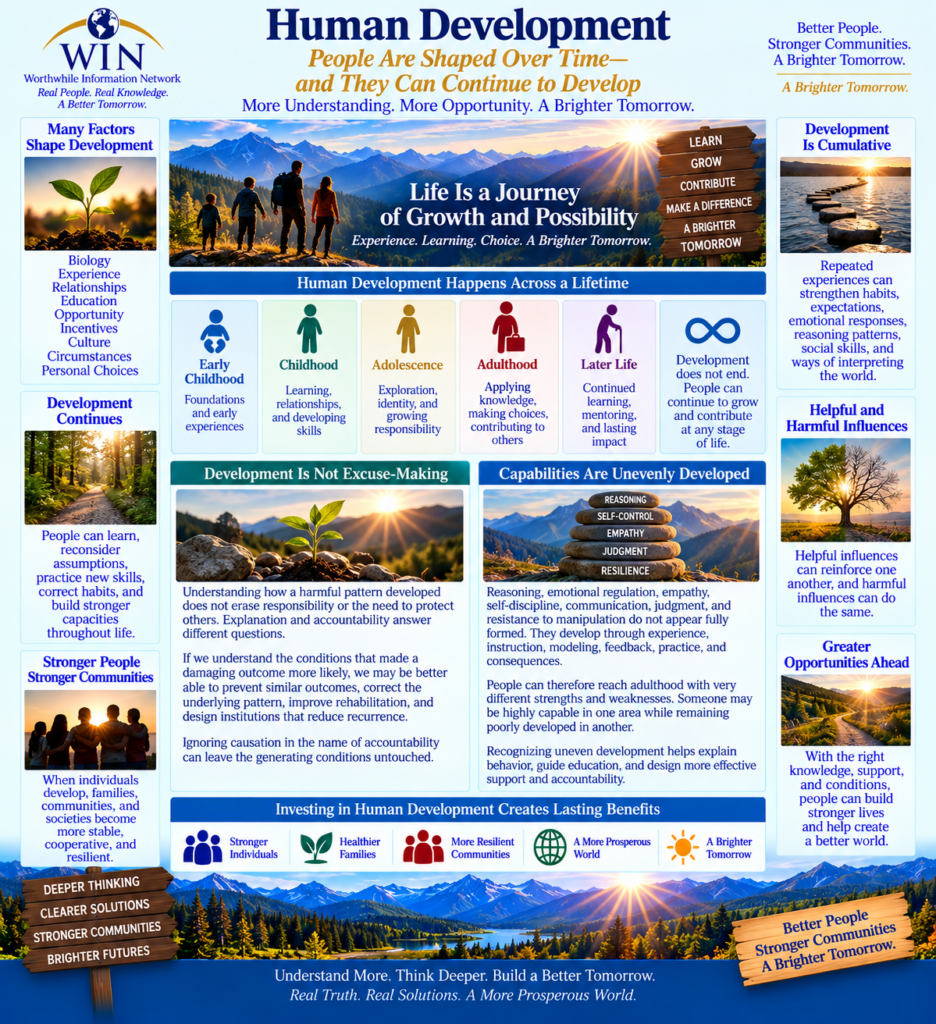
People Are Shaped Over Time—and They Can Continue to Develop
Human behavior reflects an interaction among biology, experience, relationships, education, opportunity, incentives, culture, circumstances, and personal choices.
No single influence explains every person. Development is cumulative: repeated experiences can strengthen habits, expectations, emotional responses, reasoning patterns, social skills, and ways of interpreting the world. Helpful influences can reinforce one another, and harmful influences can do the same.
This means that understanding a person requires more than looking at one decision in isolation. It also means development is not necessarily finished with childhood. People can learn, reconsider assumptions, practice new skills, correct habits, and build stronger capabilities throughout life.
Development Is Not Predestination
Early experiences matter, but they do not write an unchangeable script for the future.
Two people can experience similar conditions and develop differently. The same person can also respond differently to similar circumstances at different stages of life because knowledge, relationships, opportunities, responsibilities, skills, and surrounding conditions have changed.
Development therefore affects probability rather than guaranteeing destiny.
Understanding developmental influences helps identify conditions that make particular outcomes more or less likely. It should not be used to declare that a person’s future is predetermined.
Development Is Not Excuse-Making
Understanding how a harmful pattern developed does not erase responsibility or the need to protect others.
Explanation and accountability answer different questions.
Accountability asks: What happened? Who was responsible? What harm occurred? What protection, restitution, correction, or other response is appropriate?
Developmental analysis asks: What conditions contributed to this outcome? Why did the pattern develop? What might reduce the probability that it happens again?
A complete response can require both.
If we understand the conditions that made a damaging outcome more likely, we may be better able to prevent similar outcomes, correct the underlying pattern, improve rehabilitation, and design environments that reduce recurrence.
Ignoring causation in the name of accountability can leave the generating conditions untouched. Ignoring accountability in the name of causation can leave harmful behavior insufficiently addressed.
Capabilities Are Unevenly Developed
Human capabilities do not develop uniformly.
Reasoning, emotional regulation, communication, empathy, self-discipline, judgment, patience, resilience, cooperation, conflict resolution, and the ability to evaluate information can develop at different rates and to different degrees.
A person may be exceptionally capable in one area while having serious weaknesses in another. Academic achievement, intelligence, professional success, wealth, age, or social status does not guarantee mature judgment in every domain.
This matters because information alone does not always change behavior. Knowing what is better and having the practiced capability to do it under pressure are different things.
Education that seeks meaningful human development must therefore address more than information transfer.
Knowledge and Capability Are Different
Knowing what to do is not the same as being able to do it consistently.
A person may understand that anger can impair judgment yet still lack the practiced ability to regulate anger during conflict. Someone may know how to evaluate evidence but abandon those standards when a conclusion threatens a strongly held belief. A person may understand responsible financial behavior but repeatedly make impulsive decisions.
This distinction helps explain why information campaigns alone often produce disappointing results.
Knowledge matters. But knowledge becomes more useful when it is combined with practice, feedback, reflection, correction, and opportunities to apply it under realistic conditions.
The developmental question is therefore not only What does a person know? It is also What can the person reliably do with that knowledge?
Development Happens Through Repeated Experience
Many developmental changes occur gradually rather than through a single dramatic event.
Consider two children who make similar mistakes.
One receives a calm explanation of what went wrong, is shown a better approach, practices it, receives useful feedback, and gets another opportunity to succeed.
The other is ridiculed, receives inconsistent punishment, is given no useful explanation, or repeatedly sees adults model the same behavior for which the child is being punished.
One incident is unlikely to determine either child’s future. But if those patterns repeat hundreds of times, they can contribute to different expectations, habits, coping strategies, and responses to mistakes.
The important developmental unit is often not the isolated event. It is the repeated pattern.
Early Conditions Can Compound
Small developmental differences can accumulate.
A child who develops confidence in reading may read more often. More reading can improve vocabulary and comprehension. Greater competence can make reading more enjoyable, which encourages additional practice.
The opposite pattern can also occur. Early difficulty may create frustration. Frustration may lead to avoidance. Less practice can increase the difficulty, which creates still more avoidance.
Similar compounding patterns can occur with communication, emotional regulation, social interaction, problem-solving, health habits, responsibility, and many other capabilities.
Early intervention can therefore matter not because childhood permanently determines adulthood, but because changing a pattern earlier may prevent years of accumulated consequences.
Environment and Agency Interact
People are influenced by their conditions but are not merely products of them.
Environments can expand or restrict opportunity, normalize certain behaviors, reward particular choices, expose people to different information, and shape what seems possible or expected.
At the same time, people can examine influences, anticipate consequences, seek better information, change environments, practice different responses, and accept responsibility for their decisions.
Agency itself can also be strengthened.
A person who learns how to evaluate information, regulate impulses, communicate effectively, recognize manipulation, solve problems, and recover from failure may become increasingly capable of directing his or her own development.
Effective education should therefore strengthen agency rather than teach helplessness.
Relationships Influence Development
Human development does not occur in isolation.
Parents, relatives, teachers, peers, mentors, coworkers, community members, leaders, and other people can influence what behaviors are modeled, rewarded, discouraged, challenged, or considered normal.
A trustworthy mentor may expose someone to possibilities that were previously invisible. A destructive peer group may normalize behaviors that would otherwise have appeared unacceptable. A stable relationship may provide the feedback and encouragement necessary for a person to persist through difficulty.
Relationships are not automatically beneficial or harmful. Their developmental effect depends on what they repeatedly teach, model, reward, tolerate, and make possible.
Culture and Institutions Also Educate
Development occurs within larger systems.
Schools, workplaces, governments, businesses, media, technology platforms, families, community organizations, and other institutions establish incentives and expectations. Their structures can teach lessons even when no formal instruction is occurring.
An institution that rewards honesty teaches something different from one in which dishonesty repeatedly succeeds. A workplace that encourages employees to identify mistakes without retaliation creates different learning conditions from one that pressures people to conceal problems.
Human development therefore cannot be understood entirely at the individual level. The environments surrounding individuals can reinforce or undermine the capabilities society says it values.
Developmental Loops
Development often occurs through loops rather than isolated events.
An experience influences a belief; the belief influences a choice; the choice produces a consequence; the consequence reinforces or challenges the original belief. Repeated cycles can gradually become habits, expectations, identities, or social norms.
These loops can operate within individuals, families, schools, workplaces, communities, and institutions.
A system that repeatedly rewards a behavior can strengthen it even when official rules discourage it. A system that provides useful feedback and opportunities for correction can strengthen better judgment over time.
Studying these loops helps WIN look beyond a single moment and ask how patterns are created, maintained, interrupted, and improved.
Harmful Patterns Can Be Interrupted
A developmental pattern may be powerful without being permanent.
Change can begin when one or more parts of the pattern change: information, incentives, relationships, expectations, skills, opportunities, consequences, environment, or repeated behavior.
Suppose someone has learned to respond to disagreement with hostility. Simply telling that person to “behave better” may accomplish little. A more complete approach examines what triggers the response, what the person believes disagreement means, what behavior has been modeled, what consequences reinforce the pattern, and which skills are missing.
That does not guarantee change. It provides more places where change can become possible.
The more accurately the pattern is understood, the more intelligently interventions can be designed and tested.
Failure Can Become Developmental Information
Mistakes and failures can either strengthen development or damage it depending partly on what happens afterward.
A person who fails and learns to examine what happened, identify the cause, correct the approach, and try again may develop resilience and better judgment.
A person who learns that failure produces humiliation, concealment, or permanent labeling may instead become skilled at avoiding difficult challenges or hiding mistakes.
This is one reason WIN treats failure analysis as part of learning.
The objective is not to celebrate failure. It is to extract useful information from it so that the next attempt can be better.
Development Requires Feedback
Improvement is difficult without information about results.
People need some way to compare what they intended with what actually happened.
Good feedback can reveal mistaken assumptions, ineffective habits, unintended consequences, missing knowledge, and areas where additional practice is needed.
But feedback itself must be evaluated. Inaccurate, manipulative, delayed, inconsistent, or poorly designed feedback can teach the wrong lesson.
Development improves when people can receive credible information about outcomes and use that information to adjust future behavior.
Opportunity Matters
Capability cannot develop entirely without opportunity to practice it.
Someone may have the potential to become an excellent scientist but never encounter adequate education. Another person may have leadership potential but never receive responsibility or constructive feedback. Someone raised in a destructive environment may not encounter healthier alternatives until much later.
This does not mean opportunity alone determines success. Effort, decisions, persistence, ability, circumstances, and many other variables matter.
It means that human potential can remain invisible when the conditions needed to discover and develop it never appear.
Creating better developmental opportunities can therefore benefit both individuals and society.
Different People May Need Different Developmental Support
Equal human worth does not mean identical developmental needs.
One person may need more practice. Another may need clearer information. Another may need stronger boundaries, different incentives, specialized instruction, greater responsibility, a safer environment, or an opportunity that has never previously been available.
Treating everyone identically can sometimes preserve inequality of capability because people do not begin from identical developmental histories.
The relevant question is not simply whether everyone received the same experience. It is whether the developmental process actually helped people build the capabilities being sought.
Lifelong Development
Development does not end with formal schooling.
Adults continue learning, adapting, correcting habits, encountering new evidence, and shaping the environments of children, coworkers, organizations, and communities.
This creates an important multiplier effect. As people improve their own reasoning, communication, emotional regulation, responsibility, and ability to evaluate information, they also change the developmental environment experienced by others.
A healthier society therefore has reason to treat education as lifelong infrastructure rather than merely as a temporary stage of childhood.
The long-term objective is not perfection. It is continuous development: increasing the capacity of people and institutions to learn, correct errors, and make better decisions.
Human Development Is Cumulative but Correctable
Past development matters because it helps create the starting conditions for what happens next.
But a starting condition is not necessarily an ending condition.
People can encounter new information, new relationships, different incentives, better environments, meaningful responsibilities, corrective experiences, and opportunities to practice capabilities they previously lacked.
Some developmental damage may be difficult or impossible to reverse completely. Other patterns may change substantially. The responsible position is neither to assume that everyone can easily change nor to assume that meaningful change is impossible.
The question must remain empirical:
Under what conditions can this person or pattern improve, and what evidence would show that improvement is actually occurring?
Why This Matters to WIN
WIN’s long-term educational work is concerned not only with what people know at one moment, but with the processes through which knowledge, judgment, habits, capability, and responsibility develop.
Developmental analysis also connects directly with systems thinking and Real Root Cause analysis. Persistent outcomes often continue because the conditions producing them are repeatedly recreated. Understanding the developmental process helps reveal where those conditions originate and what evidence would show that they have actually changed.
This changes the central question from:
“What is wrong with this person?”
to a more useful set of questions:
What happened? What has this person learned? What capabilities are strong? What capabilities remain weak? What conditions are reinforcing the present pattern? What responsibility does the person bear? What could realistically improve? And how would we know whether improvement actually occurred?
Those questions preserve accountability while creating more opportunities for understanding, prevention, repair, and measurable development.
The Practical Goal
The purpose of studying human development is not merely to explain people.
It is to improve our ability to create conditions in which more people can develop the knowledge, judgment, responsibility, resilience, cooperation, and other capabilities needed to build worthwhile lives and healthier communities.
That requires realistic expectations. Human beings are complex. Development is influenced by many interacting variables. No educational program or social intervention can guarantee a particular human outcome.
But complexity is not a reason to stop learning.
It is a reason to observe more carefully, test assumptions, measure outcomes, learn from failure, identify stronger developmental conditions, and continually improve what we do.
Better understanding should ultimately produce better opportunities for people to become more capable than they were before.
Continue Exploring
Human development connects directly to WIN’s educational model and to the pathway for people who want to continue developing their knowledge, judgment, responsibility, and ability to contribute constructively.