Policies and Public Documents
Public Information, Organized for Accountability
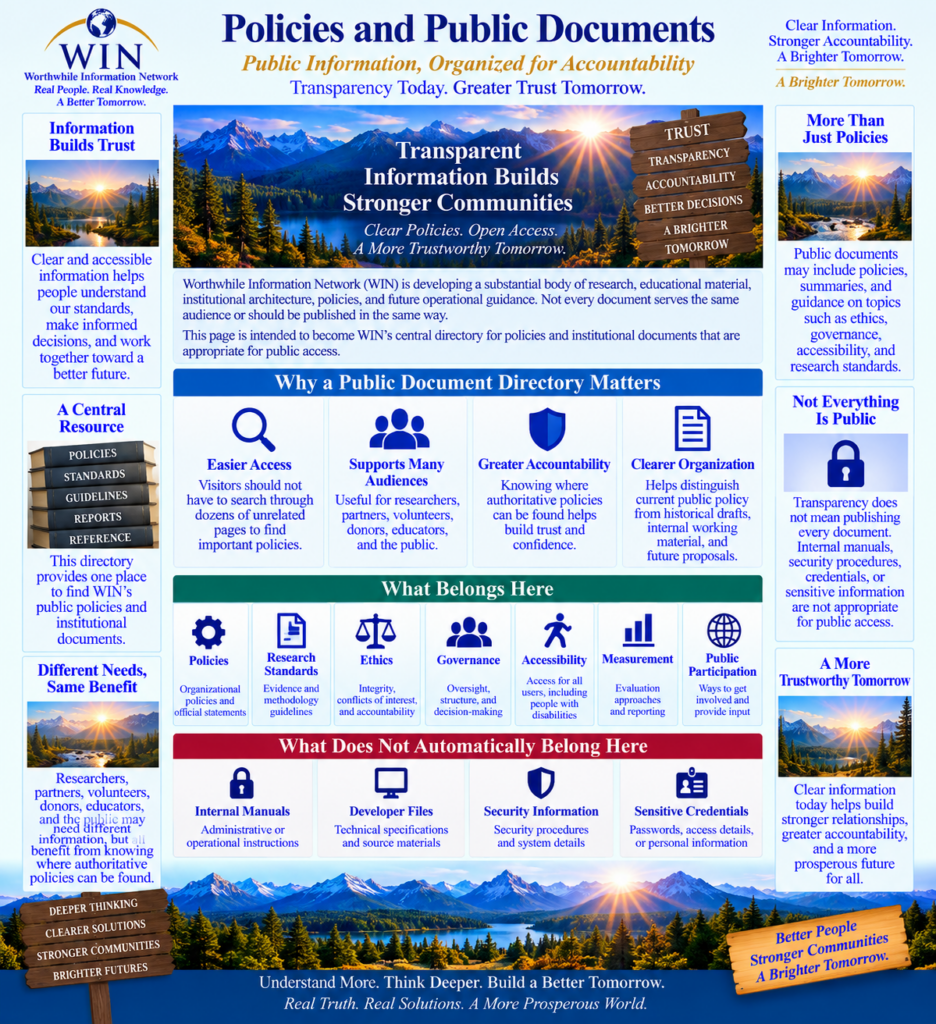
Worthwhile Information Network (WIN) is developing a substantial body of research, educational material, institutional architecture, policies, and future operational guidance. Different documents serve different audiences and purposes, and not all organizational material is appropriate for public distribution.
This page serves as WIN’s central directory for policies and institutional documents that are appropriate for public access.
Why a Public Document Directory Matters
Visitors should not have to search through dozens of unrelated pages to understand WIN’s public standards. Researchers, prospective partners, volunteers, donors, educators, and members of the public may need different information, but all benefit from knowing where authoritative public policies can be found.
A central directory also helps distinguish current public policy from historical drafts, internal working material, and future proposals.
What Belongs Here
WIN’s public documents include policies and summaries concerning privacy, accessibility, website terms, research and evidence standards, ethics, accountability, governance, conflicts of interest, measurement, public participation, and other matters where public understanding improves transparency and trust.
As WIN develops formal reports or externally reviewed materials, appropriate documents will be added to this directory.
What Does Not Automatically Belong Here
Transparency does not require WIN to publish every document it possesses.
Internal administrative manuals, developer instructions, security procedures, credentials, sensitive technical configurations, personal information, confidential correspondence, privileged legal material, unpublished research records, incident-response details, and other information that could create privacy, security, legal, or operational risks may require restricted access.
Decisions to withhold sensitive material must have a legitimate purpose. Confidentiality must not be used merely to conceal inconvenient evidence or avoid appropriate accountability.
Current Public Policy Pages
The following public pages are part of WIN’s developing policy and accountability structure:
Privacy Policy
Accessibility Statement
Terms of Use Overview
Measuring Progress
Additional public documents will be added as they are completed, reviewed, and approved for publication.
Research and Evidence Standards
WIN’s public research materials distinguish, where important, among evidence, interpretation, hypotheses, frameworks, proposals, and established organizational facts.
WIN’s research standards require examination of competing explanations, uncertainty, failure modes, contradictory evidence, and conditions that would require a conclusion to be revised.
Public-facing research standards should continue to evolve as WIN gains experience, receives appropriate academic or professional review, and encounters evidence that existing standards should be improved.
Corrections and Revisions
Publication does not make a WIN document immune from correction merely because it has been labeled official.
When substantive errors are discovered, WIN should correct them and, where appropriate, preserve sufficient revision information to explain significant changes. The prominence of a correction and the degree of version documentation should remain proportionate to the significance of the document, the error, and the consequences of leaving the error uncorrected.
Current Policy Versus Future Proposal
WIN’s architecture includes many future capabilities. A proposal for a future system is not automatically a current policy.
WIN identifies the status of public documents clearly enough for readers to distinguish existing organizational rules from concepts under development, future plans, educational frameworks, and historical material.
Public Summaries and Full Internal Documents
Some subjects require both a public summary and a more detailed internal document. For example, the public may need to understand the principles governing security or governance without receiving technical information that could undermine those safeguards.
Public summaries accurately represent the underlying policy without concealing material facts behind vague language.
Privacy
WIN’s public privacy information explains, in understandable terms, how personal information associated with its public website is handled and how privacy practices may evolve as new systems are introduced.
A future educational platform could involve substantially different data practices from the current informational website. WIN should update applicable privacy information before introducing materially different forms of personal-data collection or use.
Accessibility
Accessibility is part of responsible public communication. WIN’s Accessibility Statement explains the organization’s public commitment and provides a pathway for accessibility concerns to be addressed.
As WIN develops more advanced educational systems, accessibility requirements will be incorporated into design and review rather than added only after systems are complete.
Website Terms
Public website terms explain the nature and limitations of information presented on the site, appropriate use, and other relevant conditions.
As WIN’s technology and services change, its terms will receive additional professional or legal review when appropriate. A simple informational website and a future account-based learning platform do not necessarily require identical terms.
Governance and Ethics
Public governance information helps visitors understand how organizational authority, accountability, conflicts of interest, donor independence, and institutional responsibilities are intended to be managed.
Detailed internal governance architecture may contain material intended primarily for future administrators. Public transparency focuses on the principles, authorities, safeguards, and accountability mechanisms that materially affect outside stakeholders.
Donor and Partnership Independence
Financial or organizational support does not purchase control over WIN’s research conclusions, suppress legitimate criticism, or automatically provide governance authority.
WIN’s public partnership materials describe these boundaries so donors, businesses, academics, volunteers, and visitors can distinguish between supporting WIN’s work and controlling its conclusions.
Measurement and Accountability
WIN’s Measuring Progress page explains a core accountability principle: activity is not the same as outcome.
As programs and pilots develop, appropriate public reporting will distinguish what was attempted, what was measured, what happened, what remains uncertain, and what changes follow from the evidence.
Future Reports and Evaluations
As WIN develops greater operational capacity, this directory may eventually include appropriate annual summaries, pilot evaluations, independent reviews, research reports, financial or organizational disclosures, educational evaluation reports, and other materials suitable for public access.
Publication will expand in proportion to WIN’s actual organizational capacity rather than promising reports before the systems necessary to produce them responsibly exist.
Document Status Matters
WIN uses status labels or other conventions when necessary to distinguish documents such as:
Current — presently applicable public information or policy.
Under Review — material being reconsidered or professionally reviewed.
Proposed — a future policy or architecture not yet adopted.
Archived — retained for historical reference but no longer current.
Superseded — replaced by a newer authoritative version.
Consistent status information helps prevent outdated documents from being mistaken for current policy.
Authority and Approval
As WIN’s governance matures, consequential public policies will identify the appropriate approval authority and effective status. Publishing a working draft on a website does not automatically transform it into binding organizational policy.
WIN’s governance processes should define who may approve, revise, supersede, or retire important policy documents.
Preserving Institutional Memory
Document management is part of WIN’s long-term durability. WIN preserves sufficient institutional records so future administrators can determine what policies existed, when they changed, why they changed, and which documents are authoritative.
Good preservation reduces dependence on individual memory and helps prevent institutional knowledge from disappearing during leadership or technology transitions.
Accuracy Before Volume
WIN does not need to publish a large number of policy documents merely to appear established. A smaller set of accurate, current, understandable, and maintainable policies is more useful than an impressive-looking library of outdated or contradictory material.
WIN adds public documents as it develops the capacity to keep them accurate.
Questions About a Public Policy
If a visitor believes a public policy is unclear, outdated, internally inconsistent, inaccessible, or factually incorrect, WIN should provide a clear way for that concern to be received and reviewed.
Use Contact WIN for general questions or to identify a public document that may require attention.
A Developing Public Repository
This directory will grow as WIN’s public policies, professional reviews, reports, and institutional capabilities mature. Its purpose is not to publish everything. Its purpose is to make the information that should be public easier to find, understand, evaluate, and keep current.
Continue Exploring
Privacy Policy
Accessibility Statement
Terms of Use Overview
Measuring Progress
Contact WIN