Understanding the Human (UTH)
Human Behavior Develops Through Interacting Influences
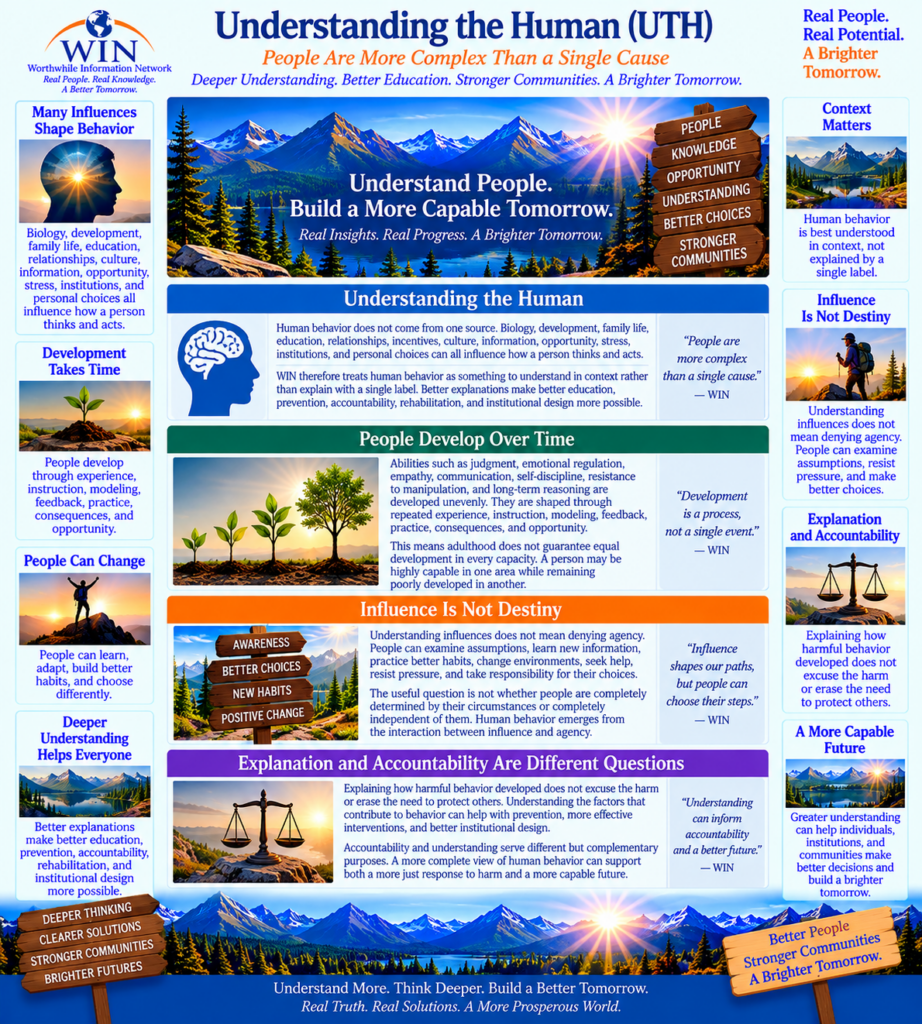
Human behavior does not come from one source. Biology, development, family life, education, relationships, incentives, culture, information, opportunity, stress, institutions, and personal choices can all influence how a person thinks and acts.
WIN therefore treats human behavior as something to understand in context rather than explain with a single label. Better explanations make better education, prevention, accountability, rehabilitation, and institutional design more possible.
People Develop Over Time
Abilities such as judgment, emotional regulation, empathy, communication, self-discipline, resistance to manipulation, and long-term reasoning are part of Human Development and develop unevenly. They are shaped through repeated experience, instruction, modeling, feedback, practice, consequences, and opportunity.
This means adulthood does not guarantee equal development in every capacity. A person may be highly capable in one area while remaining poorly developed in another.
Influence Is Not Destiny
Understanding influences does not mean denying agency. People can examine assumptions, learn new information, practice better habits, change environments, seek help, resist pressure, and take responsibility for their choices.
The useful question is not whether people are completely determined by their circumstances or completely independent of them. Human behavior emerges from the interaction between influence and agency.
Explanation and Accountability Are Different Questions
Explaining how harmful behavior developed does not excuse the harm or erase the need to protect others. Explanation asks what produced or reinforced the behavior. Accountability asks what responsibility exists and what response is appropriate.
Confusing those questions creates two opposite errors: ignoring causation in the name of accountability, or ignoring accountability in the name of causation. A stronger approach examines both.
Human Needs and Pressures Matter
People respond to needs for safety, belonging, competence, dignity, purpose, stability, recognition, and opportunity. They also respond to fear, scarcity, stress, humiliation, uncertainty, isolation, and social pressure.
Systems that repeatedly frustrate important needs or reward destructive coping strategies can unintentionally increase harmful behavior.
Incentives Shape Choices
Formal rules are only part of the environment people respond to. Social approval, financial rewards, convenience, status, risk, punishment, opportunity, and expected consequences all affect behavior.
When stated values conflict with actual incentives, behavior often follows the incentives. Understanding people therefore also requires understanding the systems surrounding them.
Information Quality Changes Human Behavior
People make decisions using the information available to them, but information can be incomplete, misleading, emotionally charged, manipulated, or difficult to evaluate. Repetition can create familiarity without creating truth. Social identity and group pressure can influence which claims people accept or reject.
For that reason, human development includes learning how to distinguish evidence from assertion, recognize uncertainty, compare explanations, detect manipulation, and revise beliefs when better information appears.
Habits and Developmental Loops
Behavior can become self-reinforcing. A choice produces a consequence; that consequence changes expectations, opportunities, relationships, identity, or future choices; and the cycle repeats.
Helpful loops can strengthen competence and responsibility. Harmful loops can strengthen avoidance, dependency, aggression, dishonesty, hopelessness, or other destructive patterns. WIN examines these recurring patterns more fully in Developmental Loops.
People Can Change
Human beings remain capable of learning and adaptation throughout life. Change is not guaranteed, and some patterns become difficult to alter, but development does not simply stop when formal schooling ends.
Education, practice, accountability, supportive relationships, improved incentives, treatment when appropriate, and better environments can all affect future behavior.
Better Systems Support Better Human Outcomes
If institutions assume that people will always act perfectly, those institutions will be fragile. If they assume people can never improve, they may become unnecessarily coercive or defeatist.
Durable systems should account for ordinary human limitations while creating conditions that make better judgment, responsibility, cooperation, correction, and development more likely. Understanding how those conditions interact is part of WIN’s broader Systems Thinking approach.
The Practical Standard
Understanding the human is useful when it improves decisions. A strong explanation should help identify what conditions are shaping behavior, what could realistically change, what safeguards are needed, what responsibility remains, and how improvement can be measured over time.
WIN’s objective is not to reduce people to a theory. It is to build a more accurate, correctable, and humane understanding of human behavior so that education, institutions, and individual development can improve together.
Continue Exploring
Understanding the human connects directly to human development, developmental loops, systems thinking, and the broader educational pathway.