Why Problems Keep Returning
Why Problems Keep Returning
Why Do Serious Problems Return After We “Solve” Them?
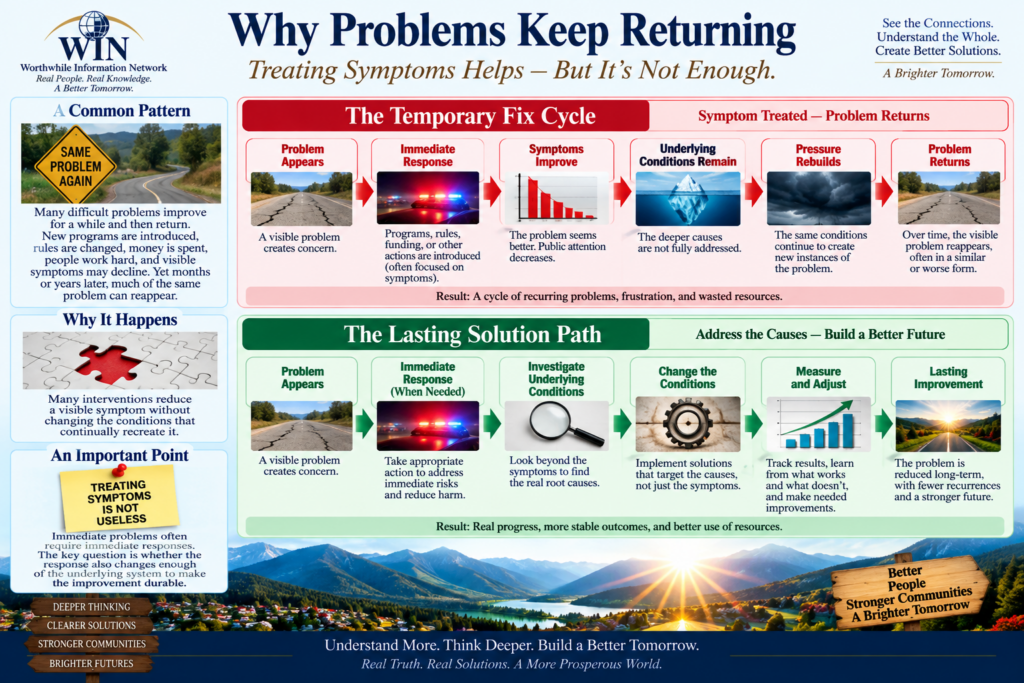
Many difficult problems improve for a while and then return.
New programs are introduced.
Rules are changed.
Money is spent.
People work hard.
Visible symptoms decline.
For a time, the intervention appears successful.
Then months or years later, much of the same problem reappears.
Why?
One possibility is that the intervention reduced the visible symptom without changing enough of the conditions that continually recreate it.
But that is not the only possibility.
The original explanation may have been incomplete.
The intervention may have been poorly implemented.
The system may have adapted.
Important incentives may have remained unchanged.
A successful intervention may have been discontinued too early.
New conditions may have emerged.
Or the improvement may never have been as large as the original measurements suggested.
Understanding recurrence therefore requires more than saying:
“The solution didn’t work.”
The more useful question is:
What changed, what did not change, and what allowed the problem to return?
Symptoms Are Real, but They Are Not the Whole System
A visible outcome is often the final stage of a longer process.
By the time a problem becomes obvious, many earlier influences may already have been operating:
information;
habits;
incentives;
relationships;
opportunities;
institutional practices;
expectations;
consequences;
developmental conditions;
and repeated experiences.
Responding only to the final event can therefore leave much of the process untouched.
The symptom may disappear temporarily while the conditions capable of producing it remain in place.
This is why WIN’s Looking Beyond Symptoms approach asks what happened before the visible problem appeared and what continues happening after the immediate response ends.
Immediate Response and Durable Improvement Are Different Objectives
Sometimes a symptom must be addressed immediately.
A leaking pipe must be stopped.
A dangerous situation may require immediate protection.
A failing system may need emergency stabilization.
An organization losing money through fraud may need to stop the loss before completing a lengthy causal investigation.
There is nothing inherently wrong with symptom treatment.
The mistake occurs when emergency response is mistaken for permanent correction.
Stopping today’s harm answers:
What must we do now?
Durable improvement asks:
What would have to change so that we are less likely to face the same situation again?
A serious problem-solving system should be capable of answering both.
Suppression Is Not Necessarily Resolution
A problem can become less visible without becoming less likely.
A new rule may temporarily suppress behavior.
Additional supervision may reduce errors while the supervisor is present.
Temporary funding may increase resources.
Unusual attention may improve compliance.
A publicity campaign may briefly change behavior.
But what happens when the additional attention, money, supervision, novelty, or pressure disappears?
If the original conditions return and the problem returns with them, the intervention may have suppressed the outcome rather than changed the system producing it.
This distinction is critical.
Temporary improvement is evidence. It is not automatically proof of durable correction.
Multiple Causes Interact
Complex human problems rarely have one isolated cause.
Several influences can interact over time, reinforce one another, and produce different results under different conditions.
That is why WIN uses the idea of the Real Root Cause: not a search for one convenient explanation, but causal understanding deep enough to identify conditions and mechanisms that actually generate or regenerate an outcome.
The useful question is not only:
What happened?
It is also:
What repeatedly made this outcome possible, likely, or difficult to prevent?
Sometimes the answer is not one root.
It is a causal structure.
The Original Cause May No Longer Be the Main Cause
A recurring problem can change over time.
Suppose an initial problem develops because people lack information.
Later, poor decisions based on that missing information create distrust.
Distrust reduces communication.
Reduced communication produces even poorer information.
At that point, simply supplying the original information may no longer be sufficient.
The problem has developed additional mechanisms that help sustain it.
This is important because:
what originally created a problem may not be identical to what currently keeps it alive.
Effective correction may therefore require understanding both origination and maintenance.
Systems Can Recreate the Same Outcome
Even when individual people change, a poorly designed system can continue producing familiar failures.
Incentives can reward the wrong behavior.
Information can arrive too late.
Responsibility can remain unclear.
Institutions can repeat practices that have already failed.
Short-term pressures can overwhelm long-term interests.
People can be replaced while the same structure remains.
The names change.
The outcome does not.
When that happens, blaming each new person may fail to explain why different people keep encountering the same pattern.
Systems thinking asks:
What is it about the surrounding structure that keeps making this outcome possible?
This is one reason recurring problems should also be examined through Systems Thinking.
Feedback Loops Can Rebuild the Problem
An outcome can change the conditions surrounding the next outcome.
For example:
Poor performance
↓
greater criticism
↓
lower confidence
↓
less willingness to attempt difficult work
↓
slower skill development
↓
still poorer performance
The initial poor performance did not simply produce one consequence.
It helped create conditions that increased the probability of additional poor performance.
These processes are examined more fully in WIN’s Developmental Loops framework.
When a reinforcing loop is operating, changing only one event may not be enough.
The loop may continue rebuilding the pattern.
Incentives Can Defeat Good Intentions
People can sincerely support an objective while operating within incentives that repeatedly pull behavior in another direction.
An organization may say:
“Quality comes first.”
But promotions depend almost entirely on speed.
A government program may say:
“Solve the underlying problem.”
But funding depends on the number of cases processed.
A company may say:
“Report problems immediately.”
But employees who report problems are treated as troublemakers.
The written objective and the experienced incentive point in different directions.
Over time, repeated incentives can overpower stated intentions.
If the incentive structure remains unchanged, the old behavior may return even after a successful intervention.
People Adapt to Interventions
Interventions change behavior partly because people respond to them.
That response can be constructive.
People can learn better procedures, develop skills, and adjust to new expectations.
But adaptation can also weaken an intervention.
People may discover loopholes.
They may shift behavior toward what is measured.
They may hide behavior that is penalized.
They may find substitutes.
They may learn how to satisfy the formal requirement without accomplishing the underlying objective.
This means a program that works during its first months may behave differently after people understand how the new system operates.
Evaluation should therefore ask:
What happens after people have had time to adapt?
Measurements Can Improve While the Problem Remains
A recurring problem may appear solved because the measurement changed rather than the underlying condition.
Suppose an organization measures complaints.
Complaints decline.
That seems encouraging.
But perhaps customers stopped complaining because the complaint process became more difficult.
The measured number improved.
The underlying experience did not.
Other examples include:
changing definitions;
reclassifying cases;
measuring only easily observed outcomes;
ignoring people who leave the system;
moving costs into another category;
or improving one target while worsening an unmeasured outcome.
This does not mean measurements are unreliable by nature.
It means measurement design is part of causal analysis.
Local Improvement Can Move the Problem Somewhere Else
An intervention can succeed within one boundary while transferring the problem outside that boundary.
A department reduces its expenses by shifting work to another department.
A community changes enforcement practices and undesirable activity moves somewhere nearby.
A company reduces visible waste while increasing waste somewhere in its supply chain.
A program improves one outcome while creating another cost that is not being measured.
The original symptom declines.
But the total problem may remain similar—or become worse.
This is why WIN asks not merely:
Did the number improve here?
but:
What happened to the larger system?
Short-Term Success Can Conceal Long-Term Failure
Time changes evaluation.
An intervention may produce immediate benefits and delayed costs.
Another may impose an immediate cost while producing later benefits.
Suppose an organization reduces training.
Expenses decline immediately.
Financial performance improves.
Months later, errors increase.
Experienced employees spend more time correcting mistakes.
Customers become dissatisfied.
Turnover rises.
The original cost reduction may eventually create costs larger than the money saved.
If evaluation ended during the first quarter, the decision might have been called successful.
This is why recurrence analysis should include Long-Horizon Thinking.
Removing a Successful Intervention Can Recreate the Problem
Sometimes a problem returns because the intervention actually worked.
This sounds contradictory, but it is important.
Suppose additional maintenance reduces equipment failures.
Failures become rare.
Decision-makers conclude that the maintenance program is no longer necessary.
Maintenance is reduced.
Failures gradually return.
The recurrence does not prove that maintenance failed.
It may demonstrate that maintenance was one of the conditions preventing the problem.
The same logic can apply to:
training;
inspection;
prevention;
monitoring;
education;
support systems;
and institutional safeguards.
A successful prevention system can make its own value difficult to see because the outcome it prevents becomes less visible.
Do Not Confuse Recurrence With Proof That Nothing Works
If a problem returns, it can be tempting to conclude:
“Nothing works.”
That conclusion may be just as mistaken as declaring permanent victory after an early improvement.
Recurrence can mean many things:
the intervention was ineffective;
the intervention was effective but incomplete;
implementation weakened;
the intervention was discontinued;
conditions changed;
people adapted;
the wrong outcome was measured;
the original causal theory was incomplete;
or a different cause became more important.
Recurrence is therefore not merely failure.
It is evidence requiring explanation.
Distinguish Theory Failure From Implementation Failure
Suppose a program produces disappointing results.
At least two broad explanations are possible.
The theory was wrong.
The intervention was implemented as intended, but the expected causal mechanism did not produce the predicted outcome.
Or:
The implementation failed.
The underlying idea may have been reasonable, but the program was not delivered as intended.
These possibilities should not be confused.
If implementation was weak, declaring the theory disproven may be premature.
But the reverse error also matters.
Organizations sometimes protect failed ideas indefinitely by claiming that every disappointing result was merely poor implementation.
A serious evaluation asks:
Was the intervention actually implemented as designed?
Did the predicted intermediate changes occur?
Did the expected final outcome occur?
What evidence would distinguish implementation failure from theory failure?
Pilot Conditions May Not Survive Expansion
A program can succeed during a pilot and weaken when expanded.
Why?
The pilot may have unusually motivated participants.
Its leaders may be exceptionally capable.
Staff may receive more training.
Resources may be more abundant.
The group may be small enough for close supervision.
Participants may know they are being observed.
Expansion changes those conditions.
The relevant question is therefore not merely:
Did the pilot work?
It is:
Which conditions made the pilot work, and can those conditions survive expansion?
A solution that depends on conditions that cannot realistically be maintained at scale may not produce the same outcome when expanded.
Leadership Can Temporarily Compensate for Weak Systems
An unusually capable leader can sometimes make a weak system perform well.
The leader notices problems quickly.
Communicates clearly.
Resolves conflicts.
Remembers critical details.
Motivates people.
And personally corrects failures before they become serious.
Performance improves.
Then the leader leaves.
The organization deteriorates.
The improvement may have been real.
But the capability existed primarily in the person rather than in the institution.
Durable improvement asks:
Can the system continue functioning when unusually capable individuals are no longer present?
Resources Can Conceal Structural Weakness
Additional money, personnel, technology, or attention can sometimes overpower a weak system temporarily.
That may be appropriate during an emergency or experiment.
But if improvement depends on resources that cannot realistically be sustained, recurrence becomes likely when those resources disappear.
This does not mean resources are unimportant.
It means evaluation should distinguish:
Did the intervention improve the underlying system?
from:
Did additional resources temporarily compensate for its weaknesses?
Both can produce better short-term outcomes.
They imply very different long-term expectations.
Institutional Memory Can Fail
Organizations sometimes solve a problem and later forget why the solution was necessary.
People leave.
Records disappear.
Procedures remain but their reasoning is lost.
New leaders see a safeguard as unnecessary bureaucracy.
The safeguard is removed.
The original failure returns.
This creates a recurring pattern:
Problem
↓
correction
↓
success
↓
loss of institutional memory
↓
removal of correction
↓
problem returns
A durable solution therefore preserves not only what was changed, but enough evidence and reasoning for future people to understand why it was changed.
Old Solutions Can Also Become Obsolete
Preserving institutional memory does not mean preserving every solution forever.
Conditions change.
Technology changes.
Knowledge improves.
Populations change.
New risks appear.
An intervention that once worked may become unnecessary, ineffective, or harmful.
The purpose of institutional memory is not to prevent revision.
It is to prevent uninformed revision.
Future people should be able to determine:
what problem existed;
what intervention was attempted;
why it was selected;
what happened afterward;
and what evidence would justify changing it.
Prevention Creates a Measurement Problem
Successful prevention creates an unusual difficulty:
How do we measure something that did not happen?
If a safety system prevents accidents, there may be fewer accidents to demonstrate its value.
If education prevents poor decisions, the avoided decisions are difficult to count.
If maintenance prevents breakdowns, the breakdowns never occur.
This can cause effective preventive systems to appear unnecessary.
Good evaluation therefore looks for intermediate evidence:
risk factors;
near misses;
process reliability;
knowledge;
behavior;
compliance;
system condition;
and comparisons across different levels of exposure.
The absence of a problem can be encouraging.
But by itself, it does not always explain why the problem is absent.
Durable Improvement Requires Learning
No explanation should be protected from evidence.
When an intervention succeeds, the important questions include:
Why did it succeed?
Which conditions were necessary?
Did the improvement last?
Did costs appear elsewhere?
When it fails:
What actually happened?
Which expectation was wrong?
Which assumption failed?
Was implementation faithful?
What should change next time?
This requires documenting results, testing explanations, measuring effects, watching for unintended consequences, comparing competing interpretations, and updating the model when evidence changes.
This is why WIN treats Learning From Failure as part of improvement rather than merely as a record of mistakes.
Repeated Failure Should Change the Response
If the same intervention repeatedly produces the same disappointing result, continuing it unchanged requires increasingly strong justification.
Failure should create information.
Information should change understanding.
Changed understanding should influence the next intervention.
If none of those things happens, the organization may not actually be learning.
A learning system asks:
What do we know now that we did not know before this failed?
If the answer is “nothing,” an important opportunity may have been lost.
Success Should Also Change Understanding
Learning should not occur only when something fails.
Success contains causal information too.
When an intervention works, ask:
Which part mattered?
Under what conditions?
For whom?
For how long?
What else changed?
Could the improvement survive without unusual support?
Can the result be reproduced?
Without those questions, organizations can repeat a successful intervention in a different environment and be surprised when the outcome does not repeat.
Some Problems Are Managed Rather Than Permanently Eliminated
Not every recurring problem can be permanently removed.
Some risks arise from conditions that cannot be eliminated completely.
Machines require maintenance.
Organizations require governance.
Knowledge requires updating.
People require continuing education.
Security requires continued attention.
Institutions require succession.
In such cases, recurrence does not necessarily indicate failure.
The appropriate objective may be continuous management, prevention, detection, correction, and learning.
A realistic framework distinguishes problems that can reasonably be eliminated from problems that require continuing stewardship.
Do Not Promise Permanent Solutions Without Evidence
Claims such as:
“This will permanently solve the problem.”
should require unusually strong evidence.
Human systems change.
People adapt.
Conditions evolve.
Unexpected consequences emerge.
New generations inherit institutions they did not design.
A more disciplined standard is:
What evidence indicates that the improvement is durable, under what conditions, and for how long has it been observed?
Durability should be demonstrated rather than assumed.
Recurrence Can Reveal the Missing Variable
When a problem returns, compare the periods when it was better with the periods when it was worse.
Ask:
What changed?
What stayed the same?
What disappeared before recurrence?
What new condition appeared?
What protective factor weakened?
What incentive changed?
What behavior adapted?
Patterns across recurrence can reveal causal information that was difficult to see during the original event.
In that sense, recurrence is not merely frustrating.
It can expose variables the original explanation missed.
The Recurring-Problem Test
When a problem returns after an attempted solution, ask:
What exactly improved?
How was improvement measured?
How long did it last?
What remained unchanged?
Did the original generating conditions change?
Was the intervention implemented as intended?
Did people adapt to it?
Did incentives remain unchanged?
Was the problem displaced somewhere else?
Were important costs excluded from measurement?
Did temporary resources create the improvement?
Did unusual leadership compensate for weak systems?
Was a successful preventive measure removed because the problem became less visible?
Did conditions change after the intervention?
Was the pilot environment different from the expanded environment?
What feedback loops continued operating?
What evidence distinguishes theory failure from implementation failure?
What did we learn from the recurrence?
What should be different the next time?
The purpose is not to make every problem infinitely complicated.
It is to prevent recurrence from being treated as an inexplicable surprise when the system contains discoverable reasons for it.
The Larger Principle
Persistent problems should not merely produce repeated reactions.
They should produce better understanding.
A mature problem-solving process moves from:
Something went wrong.
to:
Why did it happen?
then:
Why did it happen again?
then:
What remained unchanged?
and finally:
What evidence would show that the improvement is actually durable?
That progression converts recurrence from a cycle of frustration into an opportunity for cumulative learning.
The objective is not to claim that every problem can be permanently eliminated.
The objective is more defensible and more useful:
understand enough of the causal structure to reduce preventable recurrence, manage unavoidable recurrence intelligently, and keep improving the explanation as reality provides new evidence.
Continue Exploring
Understanding recurring problems connects WIN’s causal, systems, developmental, measurement, and learning frameworks.