Future Educational Opportunities
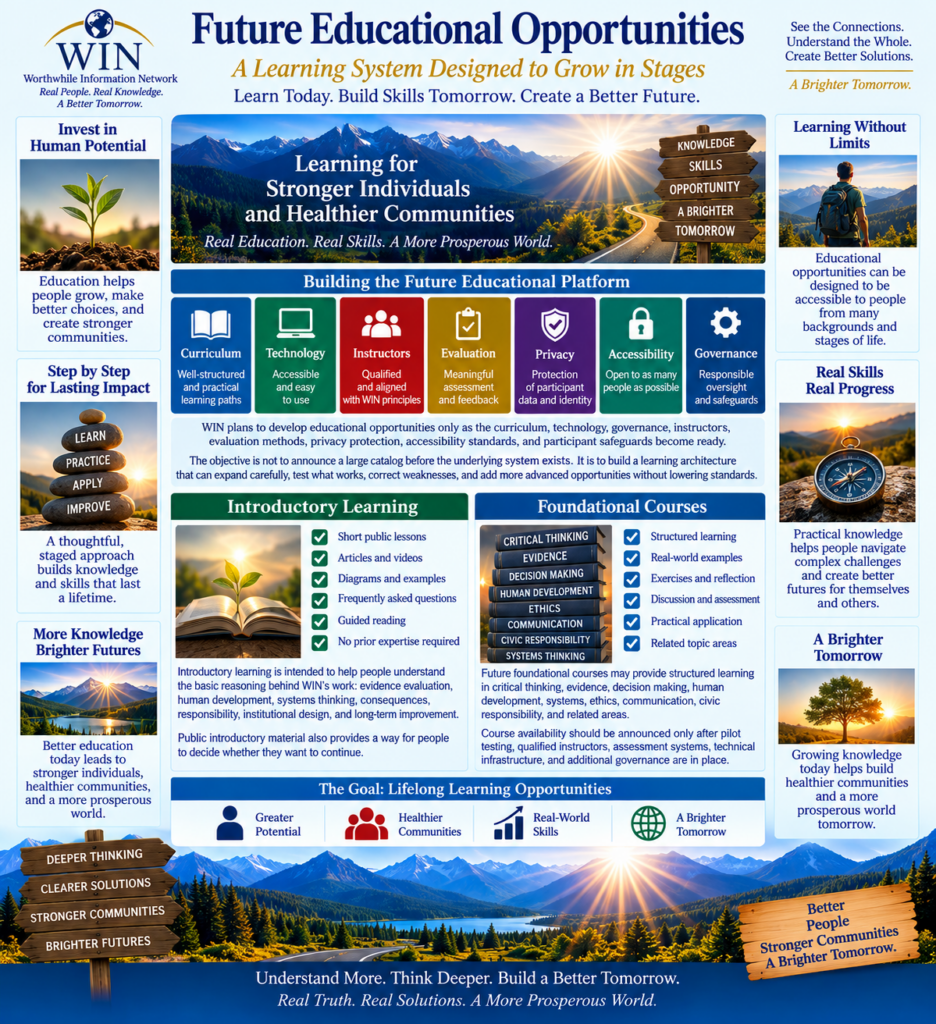
A Learning System Designed to Grow in Stages
Worthwhile Information Network (WIN) intends to develop educational opportunities progressively rather than attempting to launch a large educational system before the necessary foundations exist.
Those foundations can include:
- curriculum;
- evidence review;
- learning objectives;
- qualified instructors or reviewers;
- assessment methods;
- technology;
- accessibility;
- privacy and security;
- participant safeguards;
- governance;
- administrative capability;
- and methods for evaluating whether the education actually works.
The objective is not to announce an impressive catalog before the underlying system exists.
It is to build a learning architecture that can:
begin with sound foundations;
test what works;
identify weaknesses;
correct mistakes;
and
expand responsibly as capability grows.
Some educational resources can be public and comparatively simple.
Other forms of learning may require pilot testing, qualified instruction, assessment systems, technical infrastructure, participant records, supervision, or additional governance before they should be offered.
What Exists Today
WIN’s current WordPress website is primarily a public informational and introductory educational resource.
Visitors can already explore material concerning:
- human development;
- evidence;
- decision-making;
- systems thinking;
- developmental loops;
- causal reasoning;
- institutional design;
- long-term thinking;
- responsibility;
- and other concepts underlying WIN’s work.
That public material is educational.
But it should not be confused with a completed course system.
WIN does not currently present this website as though it already contains a mature catalog of structured courses, comprehensive assessments, learner records, advanced certifications, or a fully operational Active Citizen educational pathway.
WIN’s broader educational philosophy is explained in the Education Overview.
Why Educational Development Should Occur in Stages
Educational systems become more consequential as they become more complex.
A public article requires comparatively little infrastructure.
A structured course requires more.
An assessment intended to demonstrate competence requires stronger design.
A qualification connected to organizational responsibility requires stronger standards still.
As consequences increase, WIN should require correspondingly stronger evidence, review, testing, safeguards, supervision, documentation, governance, and accountability.
This creates a simple development principle:
Greater educational consequence should require greater institutional readiness.
WIN’s future educational progression can therefore be understood through five broad stages.
Stage 1 — Public Introductory Learning
The first stage is already beginning through WIN’s public website.
Introductory learning can include:
- articles;
- short lessons;
- diagrams;
- infographics;
- frequently asked questions;
- examples;
- videos;
- guided reading;
- and explanations of important concepts.
This material should generally be understandable without specialized prior knowledge.
Its purpose is to introduce concepts and allow people to examine WIN’s reasoning before deciding whether they want deeper involvement.
Public introductory education also creates an opportunity for criticism and correction before material becomes embedded in more formal instruction.
What Introductory Learning Should Accomplish
Introductory education should help learners begin answering questions such as:
- What is WIN trying to accomplish?
- How does WIN approach evidence?
- What does WIN mean by human development?
- Why does WIN examine systems and developmental loops?
- What is Real Root Cause?
- Why does WIN emphasize responsibility and consequences?
- Why must education remain open to correction?
- What is the relationship between learning and the future Active Citizen pathway?
At this stage, the objective is not mastery.
It is orientation sufficient for deeper learning.
Stage 2 — Foundational Structured Education
Future foundational courses may organize important concepts into structured learning sequences.
Potential subjects could include:
- critical thinking;
- evidence evaluation;
- responsible decision-making;
- human development;
- systems thinking;
- causal reasoning;
- communication;
- ethics;
- responsibility;
- institutional design;
- learning from failure;
- and long-term analysis.
These courses should go beyond simply presenting information.
Depending upon the subject, they may eventually include examples, questions, scenarios, exercises, reflection, discussion, case analysis, practice, feedback, and assessment.
Course availability should be announced only when the material, delivery system, review process, and participant protections are genuinely ready.
Courses Should Have Explicit Learning Objectives
A course should not exist merely because WIN has information to present.
Before a structured course is developed, it should be reasonably clear what learners are expected to understand or become able to do.
A learning objective might ask whether a learner can:
- distinguish evidence from assumption;
- identify a causal claim;
- recognize uncertainty;
- compare competing explanations;
- identify important incentives;
- anticipate possible unintended consequences;
- apply a framework to an unfamiliar example;
- or explain why a conclusion is—or is not—supported by available evidence.
Clear objectives make it possible to evaluate whether the education is accomplishing its intended purpose.
Stage 3 — Applied Learning and Demonstrated Capability
Understanding becomes more meaningful when learners can apply it under conditions that are not identical to the examples they studied.
Future applied learning may therefore include:
- case analysis;
- problem mapping;
- structured dialogue;
- scenario evaluation;
- community observation;
- institutional analysis;
- research exercises;
- decision exercises;
- and supervised projects.
The purpose is not to turn learners into authorities after a short course.
It is to help participants practice:
- careful judgment;
- working with incomplete information;
- recognizing limits;
- comparing explanations;
- documenting reasoning;
- applying concepts;
- communicating conclusions;
- and learning from outcomes.
Where meaningful competence matters, the relevant question becomes:
Can the learner demonstrate the intended capability?
Applied Learning Requires Appropriate Boundaries
Not every educational exercise carries the same level of risk.
Analyzing a hypothetical case is different from working with real people, sensitive information, vulnerable populations, organizational records, legal issues, or consequential real-world decisions.
Applied activities should therefore have boundaries appropriate to their subject.
Higher-risk activities may require stronger eligibility requirements, qualified supervision, privacy safeguards, ethical review, restricted information access, clear documentation, and more extensive oversight.
Educational value does not justify ignoring appropriate boundaries.
Completion Is Not the Same as Competence
A learner can watch every video, open every page, complete every module, and receive a perfect attendance record without necessarily demonstrating meaningful understanding.
WIN should therefore avoid confusing activity with learning.
Depending upon the educational objective, assessments might eventually include questions, scenario analysis, written explanations, case evaluation, projects, demonstrations, structured discussion, or supervised application.
A multiple-choice test may be appropriate for some knowledge.
It may be inadequate for evaluating complex judgment.
The assessment method should match the capability being evaluated.
This principle becomes increasingly important when a future qualification could be associated with greater responsibility.
Feedback Is Part of Education
Assessment should not merely sort learners into pass and fail categories.
Useful feedback can help identify:
- what the learner understands;
- what remains unclear;
- where reasoning failed;
- which assumptions were incorrect;
- what needs additional practice;
- and what the learner should do next.
A wrong answer can contain educational information.
WIN’s broader approach to using mistakes as information for improvement is explained in Learning From Failure.
Stage 4 — Advanced Pathways
Future specialization may eventually include areas such as:
- curriculum development;
- research review;
- educational facilitation;
- organizational integrity;
- technical systems;
- institutional analysis;
- leadership development;
- and Active Citizen development.
Advanced pathways should require more than interest.
Depending upon the responsibility involved, they may eventually require:
- prerequisites;
- demonstrated competence;
- ethical standards;
- supervised practice;
- documented performance;
- continuing education;
- periodic reassessment;
- and accountability.
The more consequential the responsibility, the stronger the qualification process should become.
Learning Does Not Automatically Create Authority
This distinction is essential.
Completing educational material does not automatically make someone:
- a WIN representative;
- an employee;
- a certified expert;
- an investigator;
- a law-enforcement officer;
- an organizational decision-maker;
- or an Active Citizen with advanced responsibilities.
Education develops capability.
Organizational authority, where any such authority exists, requires separate organizational processes.
This prevents a dangerous mistake:
confusing learning with authorization.
The Future Active Citizen Educational Pathway
One potential advanced application of WIN’s educational architecture is the Active Citizen Pathway.
The pathway is intended to begin with learning.
Early development can emphasize:
- evidence;
- judgment;
- responsibility;
- conduct;
- critical thinking;
- appropriate boundaries;
- continuing education;
- and constructive participation.
More advanced participation should require more than course completion.
Greater responsibility should correspond with stronger evidence of competence, reliability, ethical conduct, sound judgment, and willingness to accept accountability and review.
Active Citizen education does not create police powers, detention authority, enforcement authority, or other special legal powers over people.
The objective is not to create a new class of authorities.
It is to develop people increasingly capable of informed, responsible, constructive participation.
Stage 5 — Continuing Education and Review
Certification or qualification should not imply permanent mastery.
Knowledge changes.
Evidence changes.
Technology changes.
Institutions change.
Standards evolve.
People can forget material.
People can become overconfident.
Habits can drift away from original training.
Significant future roles may therefore require updated instruction, continuing education, periodic review, reassessment, or demonstrated adherence to current standards.
Continuing education makes learning part of an ongoing responsibility rather than a one-time credential.
Qualifications Should Remain Connected to Capability
A responsible qualification system should be able to respond when circumstances change.
A qualification may require review if:
- standards materially change;
- important knowledge becomes outdated;
- serious misconduct occurs;
- required competence is no longer demonstrated;
- or responsibilities associated with the qualification change.
This does not mean qualifications should be unstable or arbitrary.
It means a credential should not become permanently detached from the capability and standards it was intended to represent.
Learning Should Remain Open to Challenge
Educational material should not become immune to criticism merely because it has been placed into a course.
Moving a claim from a webpage into a lesson does not increase the quality of the evidence supporting it.
Future WIN education should continue distinguishing, where relevant, among:
- established evidence;
- interpretation;
- working frameworks;
- hypotheses;
- proposals;
- and unresolved questions.
Learners should be able to ask:
What evidence supports this?
What assumptions are involved?
What competing explanations exist?
What remains uncertain?
What evidence would cause this material to change?
That standard should apply to WIN’s own educational material.
Independent Review Can Strengthen the Education
WIN’s educational ambitions cross multiple fields.
No single person is likely to possess expert-level knowledge across all of them.
Qualified educators, researchers, scholars, experienced practitioners, accessibility specialists, technical professionals, and subject-matter experts can therefore play an important role in reviewing appropriate portions of future curriculum.
Review may help identify unsupported claims, weak evidence, misused terminology, missing literature, poor assessments, unintended bias, accessibility problems, ethical concerns, and better educational methods.
The objective is not to obtain prestigious endorsements.
It is to improve the quality of the education.
WIN’s approach to qualified outside review is explained further on the Academic Collaboration page.
Instructors and Reviewers Need Standards Too
A strong curriculum does not guarantee strong instruction.
Future instructors, facilitators, mentors, evaluators, or reviewers may need standards appropriate to their responsibilities.
Depending upon the role, those standards could include subject competence, instructional ability, appropriate conduct, respect for learner boundaries, evidence-based reasoning, documentation, privacy, conflict-of-interest management, and willingness to accept review.
A learning system should evaluate not only learners but also the systems and people responsible for educating them.
Accessibility, Privacy, and Safeguards
Future educational opportunities should be designed with accessibility and appropriate participant protections from the beginning.
Accessibility may include attention to readable structure, clear navigation, alternative text, captioning, keyboard accessibility, device compatibility, visual accessibility, reasonable accommodation, and other barriers relevant to the learning environment.
Accessibility does not mean reducing intellectual standards.
It means avoiding barriers unrelated to the capability being taught or evaluated.
Similarly, more advanced learning systems may eventually involve learner accounts, assessment records, qualification histories, progress information, instructor notes, or other educational records.
As the sensitivity and consequence of the information increase, appropriate privacy, security, access, accuracy, and governance safeguards should increase with them.
The future educational environment and its safeguards are explained in greater detail on the Future Learning Platform page.
Technology Should Follow Educational Requirements
WIN should not begin by choosing sophisticated technology and then designing education around whatever that technology happens to do.
The order should be reversed.
First determine:
- What should learners understand?
- What capabilities should they develop?
- How should those capabilities be assessed?
- What feedback do learners need?
- What records are legitimately necessary?
- What requires human judgment?
- What privacy and security protections are required?
Then determine which technology best supports those requirements.
Education should determine the requirements. Technology should support them.
Pilot Before Broad Expansion
New educational components should not automatically move from design directly to large-scale deployment.
Controlled pilots can help determine:
- whether instructions are understandable;
- whether assessments measure what they are intended to measure;
- whether learners can apply the material;
- where confusion occurs;
- what technical problems appear;
- what safeguards are missing;
- and what unintended effects emerge.
Pilot results should be allowed to change the program.
If testing reveals important weaknesses, correction should come before expansion.
Expansion Should Follow Demonstrated Capability
Successful development should not be measured only by the number of people enrolled.
Rapid growth can exceed an organization’s ability to teach, review, support, protect, measure, correct, and govern.
A smaller program operating responsibly may provide more useful information than a larger program expanded prematurely.
Expansion should follow demonstrated organizational and educational capability.
Measure the Education, Not Merely Participation
Enrollment numbers can show interest.
Completion numbers can show activity.
Neither automatically demonstrates learning.
Future evaluation should ask questions such as:
- Did learners understand the material?
- Can they apply it?
- Do relevant capabilities improve?
- Do improvements persist?
- Which instructional methods worked?
- Where did learners struggle?
- Were there unintended consequences?
- Did some participants encounter unnecessary barriers?
- Did the curriculum itself need correction?
WIN’s broader framework for distinguishing meaningful outcomes from convenient activity measures is explained in Measurable Outcomes.
Education Should Improve Through Evidence
Future courses should not become fixed merely because substantial work went into creating them.
Learner performance may reveal confusing instruction.
Instructors may identify weak examples.
Researchers may identify better evidence.
Accessibility testing may reveal barriers.
New knowledge may make old material obsolete.
Assessment results may reveal that a course does not develop the capability it was intended to develop.
A mature educational system should be capable of changing when the evidence says it should.
Interest Registration
Visitors may currently register for WIN updates, including future educational developments and pilot announcements as appropriate.
Registration expresses interest only.
It does not:
- guarantee admission to a future program;
- create a certification;
- establish an Active Citizen designation;
- make someone a WIN member or representative;
- or confer any other WIN status.
People interested in following these developments can use Stay Informed.
Opportunities to Help Build the Education
Some visitors may be more interested in helping develop or review the educational system than in becoming learners.
Potential contributions could eventually include:
- curriculum review;
- research review;
- learning-objective development;
- assessment design;
- case-study development;
- accessibility review;
- instructional technology;
- software development;
- privacy and security;
- usability testing;
- and professional subject-matter review.
Qualified academic and professional participation can be especially valuable because WIN’s educational material should be challenged before weak claims become embedded in curriculum.
People interested in helping can explore Academic Collaboration.
What WIN Should Not Promise Yet
WIN should not announce:
- courses that have not been developed;
- certifications that do not yet exist;
- qualification systems that have not been validated;
- technology that has not been built;
- pilot dates that cannot yet be supported;
- or advanced responsibilities for which appropriate safeguards do not exist.
Future possibilities should be described as future possibilities.
Current capabilities should be described as current capabilities.
That distinction protects both WIN’s credibility and the people who may eventually participate.
A Learning System That Can Outlast Its Founders
WIN’s educational mission is intended to extend beyond current leadership.
Future administrators should therefore be able to understand:
- why courses were created;
- what evidence supports them;
- how learning objectives were selected;
- how assessments were evaluated;
- what changed;
- what failed;
- what remains uncertain;
- and why important safeguards exist.
Documentation, appropriate revision history, institutional memory, succession planning, and maintainable technology are therefore part of educational continuity.
The objective is not merely to build courses.
It is to build an educational system that future people can understand, evaluate, maintain, correct, and improve.
The Educational Progression
WIN’s future educational architecture can be summarized as:
Stage 1 — Public Introductory Learning
↓
Stage 2 — Foundational Structured Education
↓
Stage 3 — Applied Learning and Demonstrated Capability
↓
Stage 4 — Advanced Pathways Where Appropriate
↓
Stage 5 — Continuing Education and Review
This sequence does not mean every learner must reach the same destination.
Some people may simply use the public educational material.
Others may eventually complete structured courses.
Some may contribute professionally.
A smaller number may eventually pursue more advanced pathways.
The purpose is to create appropriate opportunities for different levels of interest, capability, and responsibility.
The Larger Principle
The objective is not to build the largest educational system WIN can imagine.
It is to build the most responsible educational system WIN can actually support.
That means developing opportunities only when WIN can reasonably provide the content, evidence, instruction, technology, assessment, accessibility, privacy, security, governance, and accountability those opportunities require.
Growth should follow readiness.
Responsibility should grow with demonstrated capability.
And the educational system itself should remain capable of learning.
Continue Exploring
These pages explain the educational foundation, future learning environment, participation pathways, measurement, and ways to follow or contribute to WIN’s educational development.