Academic Collaboration
Help Strengthen the Intellectual and Educational Foundation
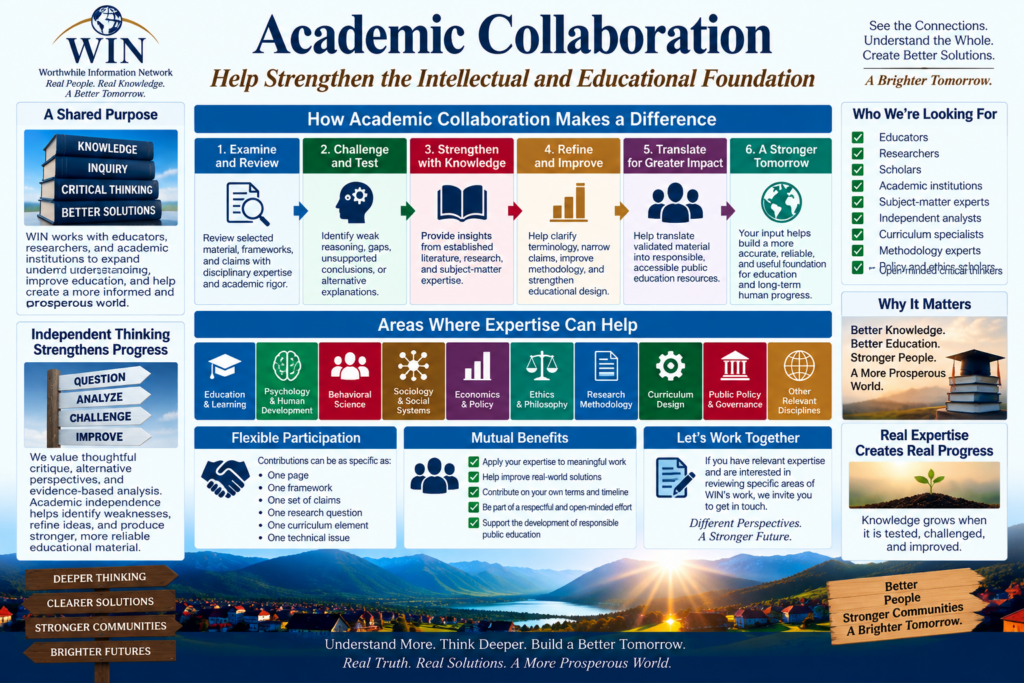
Worthwhile Information Network (WIN) invites qualified educators, researchers, scholars, subject-matter experts, and academic institutions to examine, challenge, refine, and help translate selected portions of its work into responsible public education.
The objective is not institutional endorsement. It is disciplined scrutiny.
WIN has developed ideas across many subject areas over a long period of time. That breadth creates both opportunity and risk.
Ideas that cross disciplinary boundaries can reveal important relationships, but they can also misuse terminology, overlook established literature, confuse correlation with causation, apply findings beyond the populations or conditions in which they were established, or extend conclusions beyond the available evidence.
Qualified academic participation can help identify those weaknesses before they become embedded in educational material.
Academic Collaboration Should Increase Reliability, Not Prestige
Association with a university, professor, researcher, or professional organization does not automatically make an idea correct.
Academic expertise is valuable because qualified people may possess specialized knowledge, methodological training, familiarity with established literature, experience interpreting evidence, knowledge of disciplinary limitations, and the ability to identify mistakes that nonspecialists may overlook.
Academic participation should strengthen examination—not create immunity from examination.
Credentials can help identify relevant expertise. They do not replace evidence.
What WIN Is Asking For
WIN is not asking professors or researchers to endorse the entire organization, adopt WIN terminology, approve every WIN conclusion, or attach their professional reputations to claims they have not examined.
A useful collaboration may be narrow.
A qualified person might:
- review one concept;
- check a set of sources;
- evaluate a proposed lesson;
- examine a causal claim;
- identify an unsupported inference;
- review a measurement method;
- examine terminology;
- identify relevant scholarship;
- evaluate competing explanations;
- or recommend a better analytical approach.
A bounded review can be valuable without becoming an endorsement of WIN as a whole.
No Reviewer Is Expected to Evaluate Everything
WIN’s work crosses multiple disciplines. No individual expert should be expected to evaluate material outside that person’s genuine area of competence.
A psychologist may be well qualified to examine a developmental claim without having special expertise in economics, cybersecurity, constitutional law, statistical methodology, or educational technology.
Likewise, expertise in one branch of a discipline does not automatically establish expertise across the entire field.
Academic collaboration should therefore identify the scope of the reviewer’s relevant expertise and the limits of the assignment.
Cross-Disciplinary Work Requires Special Care
Questions involving human development and complex social systems may draw upon psychology, education, neuroscience, economics, family systems, communication, ethics, technology, public policy, organizational behavior, and other fields.
Cross-disciplinary thinking can reveal relationships that specialization may separate.
But it also creates a significant danger:
Knowledge from one field can be misunderstood when transferred into another.
WIN should therefore seek appropriate disciplinary expertise when consequential claims depend upon specialized knowledge.
Literature Review Can Prevent Reinventing Existing Knowledge
Before WIN treats an idea as new, unusual, or insufficiently studied, relevant scholarship should be examined where practical.
Academic collaborators may help determine whether a question has already been studied, which terminology established disciplines use, what competing theories exist, what systematic reviews or meta-analyses are available, which findings have replicated, what important limitations have been identified, and where genuine research gaps remain.
Discovering that existing scholarship already explains something well is progress, not a setback.
WIN does not need to reinvent knowledge that already exists.
Terminology Should Serve Understanding
WIN uses some terminology developed for its own explanatory purposes.
Academic collaborators can help determine when WIN terminology clarifies an idea, duplicates an established concept, creates unnecessary ambiguity, conflicts with accepted technical usage, or needs a clearer definition.
The objective should not be to preserve terminology merely because WIN has historically used it.
The objective should be to communicate as accurately as possible.
Reviewers Must Be Free to Disagree
Academic independence is essential.
Reviewers must remain free to disagree with WIN.
Criticism should not be edited into endorsement. Material objections should not be concealed. Institutional affiliation should never be implied without permission.
Where credible experts reach different conclusions, WIN should examine the disagreement rather than manufacture artificial consensus.
That includes examining competing explanations, supporting evidence, assumptions, methodological differences, and remaining uncertainty.
Evidence Matters More Than Affiliation
A conclusion does not become correct merely because it is associated with a prestigious university, famous researcher, professional association, government institution, donor, or WIN itself.
Evidence and reasoning remain subject to examination regardless of their source.
WIN’s How We Evaluate Evidence framework therefore applies to academic claims as well as WIN’s own claims.
Hypotheses Should Not Quietly Become Conclusions
Exploratory ideas can be useful.
But an attractive explanation should not gradually become treated as established simply because it has been repeated for a long time.
Academic collaborators can help distinguish observation, hypothesis, inference, model, prediction, empirical finding, and well-supported conclusion.
Those distinctions are particularly important when complex research is translated for general audiences.
Correlation, Causation, and Context Require Care
Many questions WIN examines involve complex human systems in which variables interact.
An observed relationship does not automatically establish which variable caused the other, whether both resulted from another cause, whether selection effects are involved, whether measurement created the apparent relationship, or whether the relationship will persist in another population or setting.
A finding observed in one age group, community, culture, institution, historical period, country, educational setting, or experimental condition may not automatically generalize to another.
Qualified reviewers can help WIN determine what level of causal and generalizing language the available evidence actually supports.
Replication, Contrary Evidence, and Negative Findings Matter
A single study can be informative without being conclusive.
Confidence becomes stronger when important findings survive replication, different methods, different samples, independent investigators, and multiple relevant forms of evidence.
Evidence that an expected effect did not appear, a proposed relationship was weak, an intervention failed, or results did not replicate can also be highly informative.
WIN should not treat negative or contrary findings as less worthy merely because they complicate a preferred explanation.
Methodology Should Match the Question
Different questions require different methods.
Depending on the subject, appropriate approaches might include experiments, observational research, longitudinal studies, qualitative research, case studies, historical analysis, surveys, administrative data, systematic reviews, or mixed methods.
No single methodology is automatically superior for every question.
Academic collaborators can help determine whether a method is actually capable of answering the question being asked and whether the evidence supports the conclusion being drawn from it.
From Critique to Better Educational Material
Academic review has value only if WIN can learn from it.
Weak claims should be revised, narrowed, qualified, or removed. Better sources should replace inferior ones. Important unresolved questions should remain identified as unresolved rather than being presented as settled conclusions.
When a substantive claim changes because better evidence appears, an important source is corrected, a methodological weakness is discovered, or a reviewer identifies a significant error, WIN should preserve enough information where appropriate to understand what changed and why.
Correction should improve institutional knowledge rather than disappear into undocumented revision.
Research Questions, Not Predetermined Answers
Some of WIN’s most useful academic collaborations may begin with questions rather than conclusions.
Examples might include:
- Why do certain social or institutional problems recur despite repeated interventions?
- Which conditions appear to improve long-term human development?
- Which incentives unintentionally undermine otherwise sound programs?
- Which outcomes are most meaningful to measure?
- How should educational outcomes be evaluated across longer periods?
- Why might similar interventions produce different results in different settings?
Academic collaborators can help separate these questions into testable components, existing evidence, competing hypotheses, measurable variables, and unresolved research questions.
Students and Educational Collaboration
Faculty members may identify appropriate opportunities for supervised student participation, including capstone projects, service-learning assignments, independent studies, internships, research assistance, literature reviews, usability testing, educational technology projects, or other bounded academic work.
Student participation should have clear learning objectives, appropriate supervision, defined scope, realistic responsibility, and legitimate educational value.
Students should not be used as substitutes for qualified professional review where legal, ethical, statistical, scientific, security, or other high-stakes accuracy is required.
A student project should create educational value for the learner as well as useful work for WIN.
Student-produced work should also be identified appropriately. Supervision does not automatically convert every student conclusion into a faculty or institutional conclusion.
Curriculum and Assessment
Educators may help WIN translate research and conceptual material into responsible instruction.
Useful contributions may include defining learning objectives, sequencing concepts, developing examples, identifying prerequisites, designing exercises, creating assessments, improving accessibility, and evaluating whether instruction actually develops the intended capability.
Knowing a subject and teaching it effectively are related but different abilities.
Likewise, completing a course or performing well on a quiz does not automatically demonstrate reasoning, transfer, judgment, application, or long-term retention.
Educational assessment should measure the capability it claims to measure.
Research Ethics Must Precede Research Activity
Research involving people can create responsibilities involving consent, privacy, risk, confidentiality, vulnerable populations, data handling, and institutional oversight.
WIN should not treat research ethics as paperwork added after a study has already been designed.
Where formal human-subject research is contemplated, applicable ethical requirements and appropriate qualified or institutional review should be identified before the work proceeds.
Research Design and Independent Examination
As WIN eventually develops pilots or educational programs, qualified researchers may help establish appropriate baseline conditions, outcome measures, follow-up periods, comparison methods where appropriate, implementation measures, and procedures for identifying unintended effects and limitations.
Measurement should be designed early enough that important evidence is not lost because no one determined beforehand what needed to be observed.
If WIN eventually develops findings important enough to influence broader education or institutional practice, independent examination should be encouraged where practical.
WIN should prefer knowledge that can survive examination beyond WIN itself.
Publication Should Not Be Controlled to Protect WIN
Where an academic collaboration includes research or evaluation intended for independent publication, agreements should not be structured merely to prevent unfavorable findings from becoming visible.
Legitimate protections may still be necessary for privacy, confidential information, legal obligations, intellectual property, research ethics, and other appropriate responsibilities.
But disagreement or unfavorable results should not automatically be treated as reasons for suppression.
Attribution Must Be Accurate
WIN should not imply that a professor, researcher, department, university, professional association, or other institution endorses WIN merely because someone participated in a limited review or project.
Attribution should reflect the actual scope of participation and any required permissions.
Prestige should never be borrowed through ambiguity.
Larger Academic Partnerships
As WIN’s educational infrastructure develops, collaboration may eventually extend beyond individual reviewers to departments, laboratories, colleges, universities, professional associations, research centers, or other qualified institutions.
Larger collaborations may require defined responsibilities and appropriate provisions concerning research ethics, privacy, data governance, intellectual property, publication, conflicts of interest, attribution, funding, and institutional approval.
The level of documentation should correspond to the complexity and consequences of the collaboration.
Growth should follow demonstrated capability.
WIN should never represent a collaboration as broader or more authoritative than it actually is.
Intellectual Property and Data Responsibilities
Collaborative work may produce research, curriculum, software, datasets, graphics, publications, assessment materials, or other intellectual products.
Before consequential joint work begins, expectations should be clear where appropriate concerning ownership, publication, reuse, licensing, credit, access, data protection, retention, sharing, and what happens when a collaboration ends.
Technical capability to collect data does not itself establish a legitimate reason to collect it.
Collaboration Should Not Create Hidden Authority
Academic expertise can strengthen WIN’s work.
It should not create an undefined class of outside decision-makers.
A reviewer or collaborating institution should have the authority established by the specific collaboration—no more and no less.
Likewise, WIN should not control independent academic judgment merely because it initiated, supported, or funded a project.
Clear roles protect both sides.
Collaboration Should Be Evaluated Too
Academic collaboration should not be assumed useful merely because it occurred.
WIN should eventually ask:
- Did the review identify important errors?
- Did it improve the evidence?
- Did it improve educational material?
- Did it clarify uncertainty?
- Did it expose better explanations?
- Did it improve research design?
- Did both sides understand the scope?
- Did the collaboration produce durable value?
The collaboration itself should remain open to learning and improvement.
The Long-Term Value of Academic Collaboration
The strongest academic contribution may not be agreement with WIN’s current work.
It may be helping WIN discover where its work is incomplete, imprecise, outdated, poorly supported, or wrong.
A durable educational institution must be capable of learning from that information.
WIN’s long-term objective is to develop educational material and research practices that remain open to evidence, correction, replication, criticism, professional review, and improvement across changes in leadership and generations.
The Standard for Academic Collaboration
A useful academic collaboration should ultimately help answer:
What does the available evidence actually support?
What does it not support?
What remains uncertain?
Are important competing explanations missing?
Is the terminology accurate?
Is the methodology appropriate?
Are conclusions being generalized beyond the evidence?
Can another qualified person examine the reasoning?
Did the collaboration improve WIN’s understanding rather than merely its appearance of authority?
If the work strengthens those answers, the collaboration has served its purpose.
Interested in Academic Collaboration?
Professors, researchers, educators, scholars, and subject-matter specialists interested in a bounded review or other potential collaboration can use Contact WIN to introduce themselves.
A useful initial message can briefly identify the person’s relevant field or expertise, the type of review or collaboration of interest, and the approximate level of involvement being considered.
No broad endorsement or long-term commitment is required simply to begin a conversation.