Foundations of Responsible Decision-Making
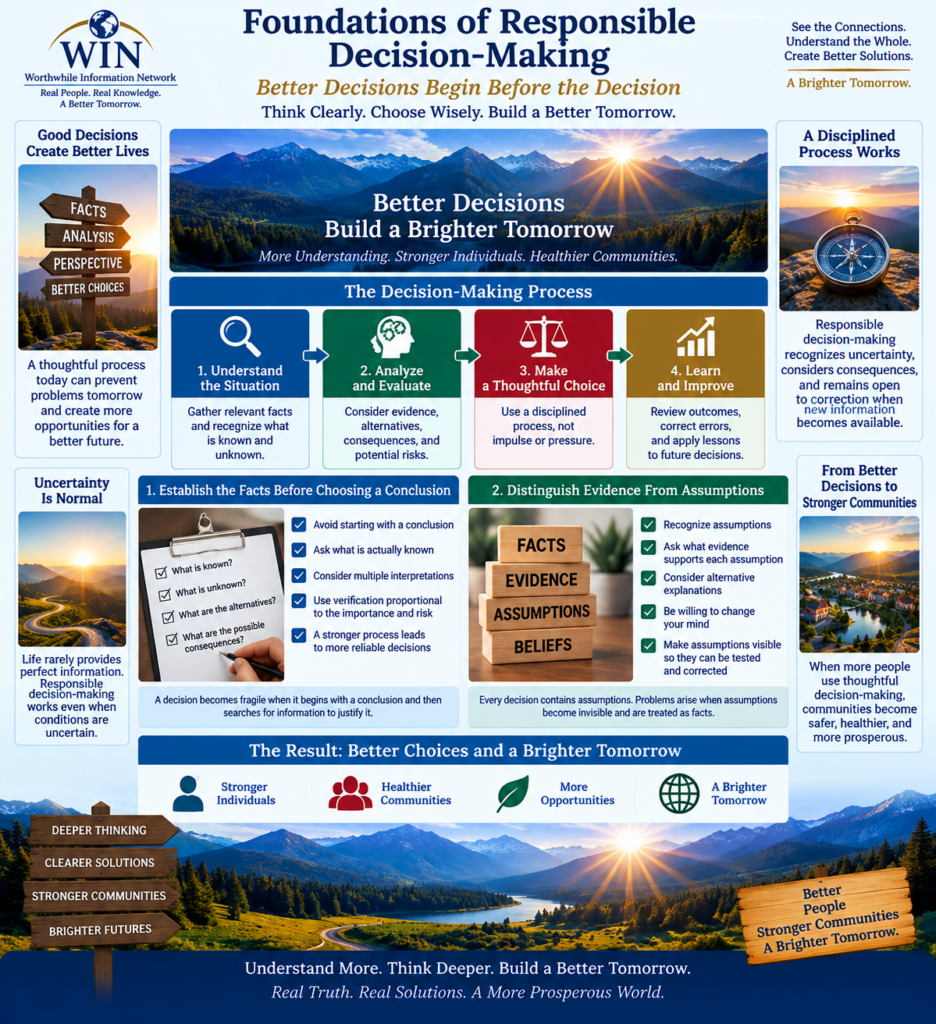
Foundations of Responsible Decision-Making
Better Decisions Begin Before the Decision
Responsible decision-making is not a guarantee that every choice will produce the desired result.
Human beings often make decisions with:
incomplete information;
uncertain outcomes;
competing priorities;
limited time;
limited resources;
emotional pressures;
and circumstances they cannot control.
The objective is therefore not perfection.
It is to use a disciplined process that:
improves the probability of making sound choices;
distinguishes evidence from assumption;
recognizes uncertainty;
considers immediate and long-term consequences;
anticipates failure where reasonably possible;
and
remains open to correction when new information becomes available.
Good decision-making begins before the final choice is made.
1. Establish the Facts Before Choosing a Conclusion
A decision becomes fragile when it begins with a conclusion and then searches for information to justify it.
A stronger process begins by asking:
What is actually known?
How is it known?
How reliable is the information?
What remains uncertain?
Which claims are observations and which are interpretations?
What important information might be missing?
This does not require exhaustive research for every ordinary decision.
The amount of verification should be proportional to the importance, risk, reversibility, uncertainty, and potential consequences of the choice.
For higher-stakes decisions, WIN’s How We Evaluate Evidence principles provide a more detailed framework for evaluating evidence.
2. Distinguish Evidence From Assumptions
Every decision contains assumptions.
Problems arise when assumptions become invisible and are treated as facts.
Useful questions include:
What am I assuming?
What evidence supports that assumption?
How strong is that evidence?
What would change my mind?
Could the same evidence support another explanation?
What happens if this assumption is wrong?
Making assumptions visible makes them easier to test and correct.
An assumption does not become a fact merely because everyone in the room shares it.
3. Recognize What You Do Not Know
Uncertainty is not weakness.
Pretending to know what cannot yet be known creates false confidence.
A responsible decision-maker distinguishes among:
what is known with reasonable confidence;
what appears probable;
what is plausible but uncertain;
what is merely possible;
and
what remains unknown.
This distinction allows plans to include safeguards for uncertainty rather than silently assuming uncertainty away.
Sometimes the most important fact in a decision is:
We do not know yet.
4. Separate Facts From Values and Priorities
Evidence can tell us a great deal about what is.
It cannot, by itself, determine every question about what people ought to value.
Suppose two options have different tradeoffs.
One produces greater short-term benefit but greater long-term risk.
Another is more expensive but protects against a rare catastrophic failure.
Evidence can help estimate those consequences.
But the final choice may also depend on legitimate judgments about:
risk tolerance;
fairness;
responsibility;
rights;
cost;
future generations;
and competing priorities.
Responsible decision-making should therefore distinguish:
What does the evidence indicate?
from:
What values or priorities are being used to choose among the alternatives?
Keeping those questions separate makes disagreement easier to understand.
5. Consider More Than One Explanation or Option
The first plausible explanation is not always the best explanation.
The first available option is not always the best choice.
Comparing alternatives reduces the risk of becoming trapped by an initial assumption.
For important decisions, ask:
What other explanations could fit the facts?
What other courses of action could accomplish the objective?
Is doing nothing temporarily a legitimate option?
Could a smaller intervention accomplish most of the benefit with less risk?
Could the decision be delayed long enough to obtain important missing information?
The purpose is not to generate endless alternatives.
It is to prevent the first idea from becoming the default merely because it appeared first.
6. Define the Actual Objective
People sometimes optimize the wrong outcome because the immediate goal was never distinguished from the larger purpose.
For example:
Ending a disagreement quickly is different from resolving the underlying problem.
Increasing a short-term measurement is different from producing durable improvement.
Reducing reported incidents is different from reducing actual incidents.
Increasing activity is different from increasing useful results.
A clear objective helps prevent a convenient substitute from being mistaken for success.
Before choosing a solution, ask:
What are we actually trying to accomplish?
7. Identify Constraints
A desirable objective does not eliminate real-world constraints.
A decision may be limited by:
law;
ethics;
time;
money;
staffing;
technology;
privacy;
safety;
available knowledge;
organizational capability;
or obligations to other people.
Constraints should be identified before an attractive solution is treated as feasible.
Some constraints can be changed.
Others cannot.
A responsible decision process distinguishes between the two.
8. Examine Immediate and Long-Term Consequences
A decision that works today can create a larger problem tomorrow.
Conversely, a difficult short-term choice can produce significant long-term benefits.
Responsible decision-making considers:
immediate effects;
delayed effects;
cumulative effects;
adaptive effects;
and, when relevant,
intergenerational effects.
This is particularly important when decisions influence habits, incentives, relationships, institutional behavior, finances, education, infrastructure, or future options.
WIN examines this more fully through Long-Horizon Thinking.
9. Look for Unintended Consequences
Actions occur within systems.
Changing one condition can alter behavior elsewhere.
A new rule can create a new incentive.
A benefit can create dependency.
A restriction can shift activity rather than eliminate it.
A measurement can become a target and change the behavior being measured.
An efficiency improvement can reduce resilience.
A solution in one department can create costs in another.
Systems Thinking does not allow us to predict every consequence.
It encourages us to look beyond the most obvious effect.
A useful question is:
And then what?
10. Understand Incentives
People and organizations respond to incentives, although not always in simple or identical ways.
Rewards, penalties, convenience, status, attention, opportunity, social approval, risk, and effort can all influence choices.
When designing a decision that affects others, ask:
What behavior will the resulting system actually make easier?
What becomes harder?
What becomes more rewarding?
What becomes more costly?
What behavior might people adopt that we did not intend?
The important question is not merely what the rule says it wants.
It is what the resulting environment encourages people to do.
11. Consider Probabilities, Not Just Possibilities
Almost anything can be described as possible.
That does not make every possibility equally important.
Responsible decisions should consider:
How likely is the outcome?
How confident are we in that estimate?
How serious would the consequence be?
How much would prevention cost?
Would the risk be reversible?
A low-probability inconvenience may deserve little attention.
A low-probability catastrophic event may deserve substantial protection.
Risk therefore involves both probability and consequence.
12. Consider Base Rates and Relevant Comparisons
A dramatic individual example can influence judgment more strongly than broader evidence.
But one memorable event may not represent what normally happens.
When relevant, ask:
How often does this outcome usually occur?
What happens in comparable situations?
What is the baseline?
How does this option compare with realistic alternatives rather than with perfection?
Without a baseline, improvement and deterioration can be difficult to judge accurately.
13. Recognize Emotional Influence
Emotion is part of human judgment and can provide useful information.
Fear can signal danger.
Empathy can reveal human consequences.
Anger can draw attention to perceived injustice.
Concern can motivate investigation.
But strong emotion can also:
narrow attention;
exaggerate certainty;
accelerate decisions;
increase selective attention;
and make contradictory evidence harder to consider.
Responsible decision-making does not require eliminating emotion.
It requires recognizing when emotion may be influencing the interpretation of facts.
The question is not:
Am I emotional?
A better question is:
How might my current emotional state be affecting what I notice, believe, dismiss, or prioritize?
14. Recognize Social Pressure
People are influenced by:
families;
friends;
organizations;
political groups;
professional communities;
online networks;
authority figures;
and cultural expectations.
Agreement with a group can feel safer than independent evaluation.
A useful question is:
Would I evaluate this evidence differently if the people around me believed the opposite?
The purpose is not automatic distrust of groups.
Collective knowledge can be extremely valuable.
The purpose is to prevent belonging from substituting for reasoning.
15. Recognize Conflicts of Interest
People can be sincere and still have incentives that affect judgment.
A person may benefit financially from one conclusion.
An organization may protect a program it created.
A researcher may have invested years in a theory.
A manager may be evaluated using a particular performance measure.
An institution may fear reputational damage from admitting an error.
A conflict of interest does not automatically prove dishonesty or invalidate a conclusion.
But it is relevant information.
Responsible decision systems should identify important conflicts and, where appropriate, use disclosure, independent review, or other safeguards.
16. Consider Who Bears the Consequences
A decision can benefit one person while shifting costs or risks to someone else.
Responsible analysis therefore asks:
Who receives the benefits?
Who bears the burdens?
Who accepts the risk?
Who has a voice in the decision?
Who may be affected but is not represented?
Are important costs being externalized or ignored?
This is especially important for institutional decisions affecting people who are not present when the decision is made.
It also matters when today’s benefits create costs for future people.
17. Consider Opportunity Costs
Choosing one option often means not choosing another.
Money spent in one place cannot always be spent elsewhere.
Staff assigned to one project may not be available for another.
Attention devoted to one problem can reduce attention available for another.
Time itself is a limited resource.
Responsible decision-making therefore asks:
What are we giving up by choosing this option?
An intervention can produce benefits and still be a poor decision if another feasible use of the same resources would produce substantially greater value.
18. Match the Process to the Stakes
Not every decision requires a committee, research project, or formal analysis.
Over-analysis can itself waste time and resources.
Low-risk, inexpensive, easily reversible choices can often be made quickly.
High-risk, irreversible, expensive, precedent-setting, or widely consequential choices deserve more:
evidence;
independent review;
scenario analysis;
documentation;
testing;
safeguards;
and scrutiny.
The decision process should be proportional to what can go wrong.
19. Ask What Failure Would Look Like
Before implementing an important decision, ask:
How could this go wrong?
How could people misunderstand it?
How could people manipulate it?
Which assumptions might fail?
What unintended incentives might appear?
What early warning signs would tell us something is going wrong?
What would make us stop or change course?
Considering failure in advance makes it possible to build monitoring, safeguards, exit conditions, and corrective mechanisms before they are urgently needed.
20. Distinguish Reversible From Irreversible Decisions
Not all mistakes have the same consequences.
Some decisions can be reversed cheaply.
Others create commitments that are difficult or impossible to undo.
When uncertainty is substantial, irreversible decisions deserve greater scrutiny.
Ask:
If this decision is wrong, can we reverse it?
How quickly?
At what cost?
What damage would remain even after reversal?
The less reversible a decision is, the stronger the justification generally should be.
21. Preserve Reversibility When Possible
When uncertainty is high, reversible steps can allow learning without committing to the full consequences of a large decision.
Pilots;
staged implementation;
limited trials;
prototypes;
temporary policies;
and checkpoints
can provide information before expansion.
This does not mean every decision should move slowly.
Sometimes delay itself creates serious costs.
The principle is:
when uncertainty is important and learning is possible, avoid unnecessary irreversible commitments.
22. Use Pre-Mortems for Important Decisions
Before implementing a major decision, imagine that enough time has passed and the decision has failed badly.
Then ask:
What probably caused the failure?
This exercise can expose risks that are psychologically difficult to notice while everyone is focused on making the plan succeed.
Possible answers may reveal:
unrealistic assumptions;
weak safeguards;
poor incentives;
insufficient resources;
implementation problems;
communication failures;
or conditions that were never considered.
The purpose is not pessimism.
It is failure discovery before failure becomes expensive.
23. Record the Reasoning Behind Major Decisions
Human memory changes.
Organizations change.
People leave.
Later outcomes can make an earlier decision appear obviously wise or obviously foolish even when the information available at the time was much less clear.
For sufficiently important decisions, preserve:
the objective;
important evidence;
major assumptions;
alternatives considered;
known uncertainties;
anticipated risks;
reasons for the choice;
expected outcomes;
and conditions that would justify reconsideration.
This creates a decision record.
It allows future evaluation to distinguish:
What did we know then?
from:
What do we know now?
That distinction is essential for institutional learning.
24. Learn From Outcomes Without Oversimplifying Them
A good decision can produce a bad outcome because of chance or unforeseen circumstances.
A poor decision can occasionally produce a good outcome by luck.
Evaluation should therefore examine both:
the result
and
the reasoning process.
Ask:
What information was available at the time?
Were important risks considered?
Which assumptions were correct?
Which assumptions were wrong?
Did the expected mechanism occur?
Did something unexpected intervene?
What should be done differently next time?
Judging decision quality solely by outcome encourages hindsight bias.
25. Correct Course When the Evidence Changes
Changing one’s position in response to stronger evidence is not inconsistency.
It is a necessary feature of learning.
A decision becomes dangerous when:
personal pride;
institutional reputation;
financial investment;
past effort;
or group identity
makes correction psychologically or organizationally more costly than continuing an error.
Past investment does not automatically justify future investment.
WIN’s emphasis on Real Truth requires conclusions to remain subordinate to reality.
26. Separate Confidence From Certainty
People often need to act before certainty is possible.
A responsible decision can therefore be based on the best available evidence while still acknowledging that the conclusion may be wrong.
Confidence should reflect:
the quality of the evidence;
the completeness of the evidence;
the reliability of the reasoning;
the strength of competing explanations;
and the amount of relevant uncertainty.
It should not reflect merely the intensity with which a belief is expressed.
A person can be extremely confident and wrong.
A careful person can acknowledge uncertainty and still make a well-supported decision.
27. Build Better Decisions Into Systems
Good judgment should not depend entirely on exceptional individuals.
Organizations can improve decision quality through:
documentation;
independent review;
conflict-of-interest rules;
evidence standards;
decision checkpoints;
audits;
feedback;
measurement;
protected mechanisms for reporting problems;
and procedures for correcting errors.
Institutional design can make careful reasoning easier and uncorrected error harder to preserve.
This is especially important because capable people eventually leave.
A mature institution should preserve decision capability, not merely individual decisions.
28. Do Not Confuse Consensus With Proof
Agreement can be informative.
When many independent experts examining strong evidence reach similar conclusions, that convergence can matter.
But consensus is not itself proof.
People can share:
the same assumptions;
the same incentives;
the same information source;
the same blind spots;
or the same error.
The useful questions are:
Why is there agreement?
How independent are the judgments?
What evidence supports the conclusion?
What credible contrary evidence exists?
Consensus deserves appropriate weight.
It should not replace examination of the evidence that produced it.
29. Know When to Seek Expertise
Independent thinking does not mean pretending to possess expertise that one does not have.
Some decisions require specialized knowledge.
Medicine.
Engineering.
Law.
Cybersecurity.
Finance.
Statistics.
Scientific research.
Technical infrastructure.
Responsible decision-making includes recognizing when the decision exceeds one’s competence.
But expertise should also be used intelligently.
Ask:
What is the expert qualified to evaluate?
What evidence supports the recommendation?
Do relevant experts substantially agree?
Where does legitimate professional uncertainty remain?
The goal is neither blind deference nor reflexive distrust.
It is informed use of relevant expertise.
30. Know When Not to Decide Yet
Sometimes the responsible decision is:
not yet.
If critical information will soon become available, delay may improve the decision.
If emotions are unusually intense, time may improve judgment.
If the decision is irreversible but not urgent, further investigation may be justified.
If essential expertise is missing, obtaining it may be necessary.
But delay also has costs.
Failure to decide is itself a decision when circumstances continue changing.
The question is therefore:
Will waiting probably improve the decision enough to justify the cost of waiting?
A Simple Decision Framework
For important choices, a practical sequence is:
Define the problem → Establish the facts → Identify assumptions and uncertainty → Clarify the objective → Identify constraints → Compare alternatives → Examine probabilities → Consider short- and long-term consequences → Examine incentives and unintended effects → Identify who bears the consequences → Consider opportunity costs → Examine failure modes → Determine reversibility → Choose proportionate safeguards → Act → Measure results → Compare results with expectations → Correct when necessary → Preserve what was learned.
This sequence is not a rigid formula.
It is a reminder of questions that are easily skipped when decisions are made under pressure.
The Responsible-Decision Test
Before an important decision, ask:
Do we understand the actual problem?
What do we know, and how do we know it?
What are we assuming?
What remains uncertain?
What values or priorities affect the choice?
What realistic alternatives exist?
What happens if we do nothing?
What are the probabilities and consequences?
What does relevant experience or the base rate suggest?
Who benefits?
Who bears the costs and risks?
What are we giving up?
What incentives will the decision create?
What unintended consequences are plausible?
What would failure look like?
Is the decision reversible?
Can we test it on a smaller scale?
Do we need specialized expertise?
What evidence would make us change course?
How will we know whether it worked?
How will what we learn be preserved?
The purpose is not to turn every decision into a research project.
It is to reduce preventable errors in decisions important enough to justify deeper thought.
Responsible Decision-Making Is a Learnable Skill
People can become better decision-makers through practice.
They can learn to:
ask stronger questions;
recognize bias;
evaluate evidence;
identify assumptions;
compare alternatives;
think probabilistically;
anticipate consequences;
recognize incentives;
seek appropriate expertise;
admit uncertainty;
and correct errors.
This is why responsible decision-making belongs near the center of WIN’s educational architecture.
Better information has limited value if people lack the skills to evaluate and use it responsibly.
The Long-Term Objective
WIN’s goal is not to produce people who simply repeat WIN’s conclusions.
That would contradict the purpose of responsible decision-making.
The objective is to help develop people who can:
examine evidence;
reason independently;
cooperate constructively;
recognize uncertainty;
identify manipulation;
understand consequences;
accept responsibility;
seek better information;
and
revise their conclusions when reality requires it.
WIN itself should be subject to the same standard.
People should be able to question WIN’s reasoning, examine its evidence, identify weak assumptions, propose stronger explanations, and challenge its conclusions.
A society with stronger decision-making capability is better equipped to:
identify problems early;
resist manipulation;
improve institutions;
learn from failure;
adapt to changing conditions;
and transmit better judgment to future generations.
The long-term objective is therefore not agreement.
It is greater human capability for making responsible decisions under real-world conditions of uncertainty.
Continue Exploring
These pages extend responsible decision-making into evidence, frameworks, systems, education, causal analysis, and long-term thinking.