What WIN Needs From Coding and Technology Experts
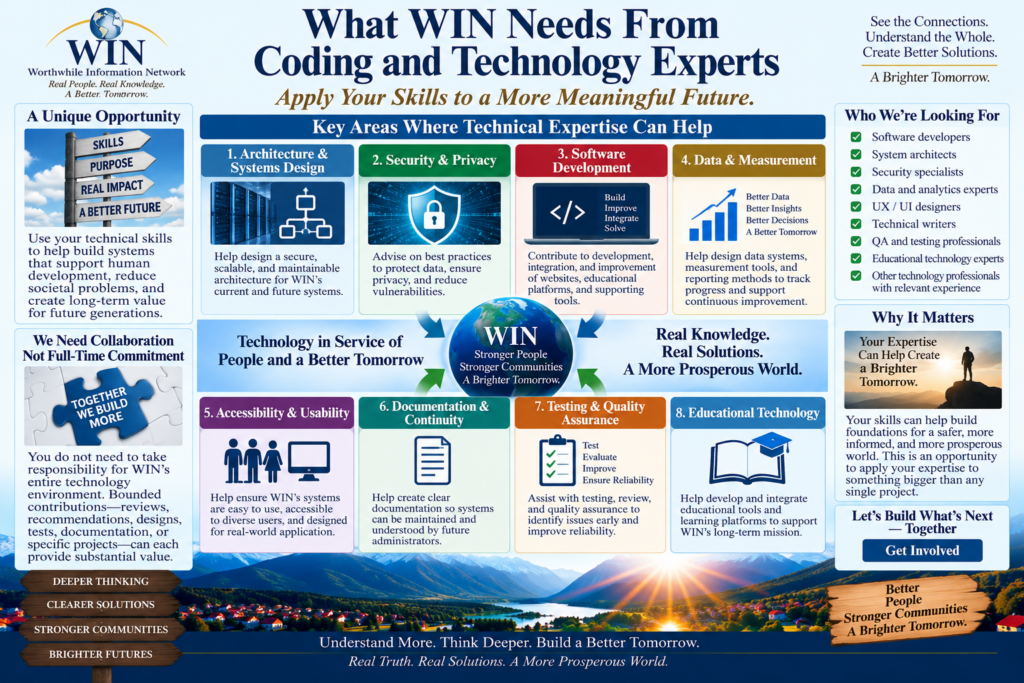
Help WIN Build Technology That Can Outlast Its Builders
WIN’s long-term plans will eventually require technical systems that are secure, accessible, maintainable, documented, recoverable, and understandable to future administrators.
WIN is interested in programmers, developers, engineers, architects, cybersecurity professionals, accessibility specialists, data specialists, technical writers, administrators, and other qualified technology professionals who can help translate organizational and educational requirements into durable systems.
The objective is not technology for its own sake.
WIN needs technology that solves real problems without creating unnecessary complexity, dependence, cost, or risk.
You Do Not Need to Know Everything
WIN does not expect one person to possess every technical skill it may eventually need.
Relevant expertise may include:
- software engineering;
- web development;
- systems architecture;
- cybersecurity;
- privacy engineering;
- cloud and infrastructure administration;
- database and data architecture;
- learning-management systems;
- accessibility;
- user experience;
- quality assurance and testing;
- DevOps;
- interoperability;
- disaster recovery;
- technical documentation;
- artificial intelligence;
- analytics;
- automation;
- information architecture;
- and technology governance.
Different problems require different specialists.
The objective is to match the right expertise to a defined need.
Experts Can Help Before Anything Is Built
Some of the most valuable technical assistance can occur before implementation begins.
An experienced professional may help WIN clarify requirements, identify hidden risks, compare architectural approaches, estimate lifecycle costs, recognize unnecessary complexity, identify security or privacy consequences, evaluate build-versus-buy choices, or determine that a proposed system is not yet necessary.
Preventing a poor technical decision can sometimes create more value than correcting it later.
WIN’s preferred principle is:
Begin with the need, implement the simplest adequate solution, test whether it works, and add complexity only when evidence justifies it.
Current Public-Website Needs
WIN’s WordPress public website is operational and continuing to mature.
Useful expertise may include architecture review, responsive design, accessibility, performance, security, backup and restoration, forms, site-wide search, privacy-conscious analytics, SEO fundamentals, structured content, plugin and dependency review, administrator training, maintainability, and documentation.
These needs can often be handled as separate, bounded projects rather than one massive redevelopment effort.
The objective is not endless customization.
The public site should remain reliable and manageable by future administrators who may not be programmers.
WordPress Should Remain Maintainable
A technically sophisticated change is not automatically a good change.
Technical assistance should consider whether a proposed improvement creates unnecessary theme dependence, excessive plugin dependence, undocumented custom code, security problems, difficult updates, or permanent dependence upon a particular developer.
A technical improvement that solves one problem while creating a larger long-term maintenance problem may not be an improvement overall.
The system should serve WIN. WIN should not become trapped by the system.
Future Educational Technology
WIN may eventually develop or adopt technology for a substantially larger educational system.
Potential requirements could include learning-management capabilities, course authoring, assessments, learner progress, continuing education, identity and access management, instructor tools, reporting, accessibility, privacy, security, data retention, auditability, mobile access, integrations, and long-term maintenance.
Platform selection should follow educational and institutional requirements rather than precede them.
WIN should determine what the educational system needs to accomplish before deciding which technology should accomplish it.
Learn more about WIN’s planned educational technology on the Future Learning Platform page.
Architecture Should Reduce Dependence
Future systems should be designed, where practical, so WIN does not become permanently dependent upon:
- one developer;
- one vendor;
- one platform;
- one undocumented custom system;
- or one person who alone understands how everything works.
Useful architectural guidance may involve modularity, data models, testing, deployment, version control, dependency management, interoperability, migration planning, disaster recovery, documentation, and technical succession.
Architecture should make future change more manageable—not unnecessarily lock WIN into today’s decisions.
Build Versus Buy Requires Judgment
WIN will not necessarily need to build every future system itself.
Existing products, managed services, open-source systems, custom development, and combinations of those approaches may each be appropriate under different circumstances.
Experts can help evaluate functional fit, security, privacy, accessibility, interoperability, customization requirements, data portability, vendor dependence, licensing, lifecycle cost, maintenance, and migration risk.
The question is not simply:
Can WIN build this?
It is also:
Should WIN build this?
Security Should Match Consequence
Cybersecurity expertise may help WIN establish appropriate controls involving account ownership, least-privilege access, multifactor authentication, secure configuration, vulnerability management, logging, backups, incident response, recovery, vendor review, and administrative procedures.
Security requirements should become stronger as systems begin handling information of greater sensitivity or consequence.
WIN needs security professionals capable of distinguishing realistic risk from unnecessary complexity.
The objective is neither careless security nor security theater.
It is protection proportionate to actual risk and consequence.
Privacy Should Begin With Data Minimization
Future systems may involve contact information, donor information, educational records, learner accounts, assessment information, or other personal data.
Technical experts can help WIN establish appropriate data minimization, access controls, retention rules, secure storage, encryption where warranted, deletion and export procedures, vendor review, and privacy-aware architecture.
One of the strongest privacy protections is often architectural:
Do not collect information that WIN does not reasonably need.
Accessibility Is Part of System Quality
WIN wants its public and future educational systems to be usable by people with different abilities, devices, technical experience, and access needs.
Technical assistance may include accessibility review, keyboard navigation, screen-reader compatibility, heading structure, contrast, form labels, understandable error messages, alternative text, captions and transcripts, document accessibility, responsive behavior, and practical usability testing.
Accessibility should not be treated merely as a final inspection after a system has already been designed.
It should be considered throughout development.
Testing Should Look for Failure
A system working once for its developer is not sufficient evidence that it is reliable.
WIN may need repeatable testing appropriate to the system’s importance, including functionality, browsers and devices, accessibility, performance, security, backups and restoration, integrations, updates, migrations, and regression risks.
Testing should become more rigorous as systems become more consequential.
The objective is not to prove that software never fails.
It is to discover important failures before they cause unnecessary harm, cost, or disruption.
Backups Must Be Recoverable
Creating a backup is only part of resilience.
WIN should eventually understand what is being backed up, how frequently, where backups are stored, who controls them, whether they are appropriately isolated, how restoration works, and whether recovery procedures have actually been tested.
A backup that cannot be restored when needed is not adequate protection.
Data Should Remain Understandable
As WIN’s research, educational, participation, and administrative systems develop, information architecture may become increasingly important.
Data specialists may help determine what information actually needs to exist, how it should be defined, how different systems should exchange it, how duplicate or contradictory records are handled, how changes are tracked, how information can be exported, and how future administrators can understand its meaning.
Poor data architecture can outlive the software that originally created it.
WIN should therefore treat understandable, portable data as part of long-term institutional resilience.
Artificial Intelligence Should Remain Accountable
AI may eventually assist WIN with research organization, education, accessibility, analysis, administration, knowledge retrieval, quality control, or other appropriate functions.
Potential uses should be examined for accuracy, evidentiary reliability, bias, privacy, security, explainability, intellectual property, cost, vendor dependence, data retention, and the risk that generated material will be mistaken for verified knowledge.
AI should assist appropriate human judgment and review—not acquire authority simply because its output is fast or persuasive.
As AI becomes more capable, WIN may also need expertise in evaluation, workflow design, testing, data governance, security, documentation, human oversight, failure analysis, and monitoring.
The central question should remain:
What level of AI reliance is justified by the evidence and by the consequence of being wrong?
Automation Should Follow Process Understanding
WIN may eventually automate repetitive administrative or informational work.
Experts can help identify which tasks are sufficiently defined for automation, which contain exceptions, which require human judgment, how errors will be detected, and how unusual cases will be escalated.
Automating an unclear process can preserve its weaknesses while increasing its speed.
Understand the process before automating consequential parts of it.
Search and Knowledge Retrieval Matter
As WIN accumulates more research, educational material, policies, documentation, historical records, and institutional knowledge, finding the right information may become a technical challenge of its own.
Appropriate technology may eventually include website search, document search, metadata, taxonomy, indexing, knowledge retrieval, and internal information-discovery systems.
The objective is not merely storing information.
It is preserving the ability to find and correctly interpret it later.
Documentation Is Part of the System
Technical documentation should not be an afterthought.
WIN may need architecture documentation, configuration records, administrator instructions, recovery procedures, change records, data definitions, dependency inventories, decision records, and system handoffs.
Documentation should be useful to the people who eventually need it—not merely exist because a project required a document.
For consequential decisions, another qualified person should be able to determine:
- what was done;
- why it was done;
- what assumptions were made;
- what dependencies exist;
- and what remains unfinished.
WIN’s broader standards for technical work are explained on the Technical Collaboration page.
Specific Ways a Technical Expert Can Help
A technical professional might:
- conduct an architecture review;
- review WordPress security or maintainability;
- assess accessibility;
- evaluate site-wide search;
- evaluate backup and recovery procedures;
- recommend documentation standards;
- design or review a data model;
- review hosting or dependencies;
- establish version-control practices;
- evaluate learning-platform options;
- conduct a threat assessment;
- define testing standards;
- review an AI use case;
- review an automation workflow;
- create a migration plan;
- train administrators;
- or supervise a clearly bounded technical project.
A useful contribution can sometimes be completed in hours rather than months if the scope is well defined.
Bounded Contributions Are Welcome
WIN does not expect every technical expert who helps to become a permanent volunteer or assume indefinite responsibility for a system.
A contributor might review one architecture, answer one technical question, evaluate several options, test one component, document one system, teach one administrative procedure, or advise on one project.
Clear scope protects both WIN and the contributor.
A review can also be as valuable as an implementation.
Sometimes the most useful technical recommendation is:
Proceed.
Sometimes it is:
Simplify this.
Change this before building.
Use an existing system instead.
Postpone this until the requirements are clearer.
Do not build this.
Each Engagement Should Leave Something Durable
Technical knowledge should not disappear when the expert leaves.
Depending on the assignment, a useful work product might include a written recommendation, architecture diagram, configuration record, documented code repository, checklist, threat model, accessibility report, test report, data model, migration plan, recovery procedure, training session, decision record, or reviewed implementation.
The goal is institutional capability—not knowledge that disappears when the expert leaves.
Independent Technical Judgment Is Valuable
WIN does not need experts merely to approve decisions already made.
A qualified professional who identifies a security weakness, unnecessary complexity, inaccessible design, flawed architecture, excessive vendor dependence, unrealistic requirement, or better alternative may provide more value by disagreeing than by agreeing.
Technical contributors should also distinguish, where important, among technical facts, evidence, assumptions, uncertainties, professional judgment, and personal preference.
Two qualified experts may prefer different technologies while agreeing on the underlying requirements.
Making that distinction visible helps WIN make better decisions.
WIN’s broader correction principle is explained on the Prove Us Wrong page.
Critical Systems Must Remain Under WIN Control
Contributors may receive appropriate access to perform approved work.
But critical domains, hosting, administrative accounts, repositories, backups, and other organizational systems should remain under WIN’s institutional control.
No essential WIN system should depend permanently on a contributor’s personal account or undocumented credentials.
Access should also be limited to what is reasonably necessary for the approved assignment.
Technical expertise does not itself create organizational authority.
Volunteer and Professional Contributions
Some experts may choose to volunteer limited time.
Other technical needs may eventually require paid professional services, formal contracts, or institutional partnerships.
WIN should define the nature and scope of an engagement before work begins and should not assume that professional expertise will always be available without compensation.
A limited professional engagement may sometimes save substantial money if it prevents poor architecture, security failures, inaccessible systems, vendor lock-in, failed migrations, unnecessary custom development, or expensive rebuilding.
Cost should therefore be considered in relation to the risk and consequence of the decision, not merely the number of hours involved.
What WIN Most Needs From Technology Experts
WIN does not merely need people who can make technology work.
WIN needs technical professionals willing to help make good decisions before systems become difficult to change—and willing to leave those systems safer, clearer, better documented, and more maintainable for the people who inherit them.
The best technical contribution may be:
- building something;
- fixing something;
- reviewing something;
- documenting something;
- teaching something;
- challenging an assumption;
- simplifying something;
- or preventing WIN from building something it does not actually need.
Interested in Contributing?
Until WIN establishes and verifies a dedicated technical-interest form, use Contact WIN.
Helpful introductory information may include your professional role, areas of technical expertise, relevant experience, portfolio or repository links where appropriate, the type of contribution that interests you, approximate availability, and whether you are offering volunteer or professional services.
Please do not send passwords, private keys, sensitive credentials, or confidential system information through an ordinary contact message.