Systems Thinking
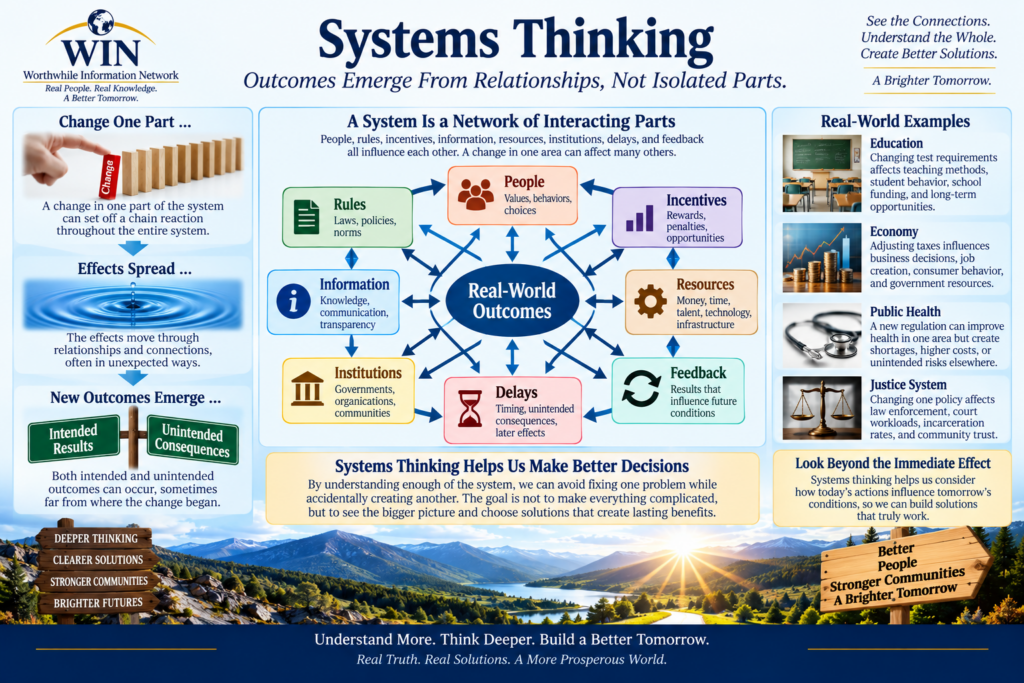
Systems Thinking
Outcomes Emerge From Relationships, Not Isolated Parts
Systems thinking is a way of examining how people, rules, incentives, information, resources, institutions, delays, technologies, decisions, and feedback interact over time.
Instead of asking only what one part of a problem is doing, it asks:
What larger pattern do these parts create together?
This matters because many persistent problems are not produced by one cause acting alone.
They emerge from relationships.
A change that appears helpful in isolation can produce unexpected effects elsewhere.
An intervention that seems ineffective at first may require time before its benefits become visible.
A rule designed to solve one problem may change people’s behavior in ways that create another.
For WIN, systems thinking complements Real Root Cause analysis.
The objective is not to make every question complicated.
It is to understand enough of the system to avoid solving the wrong problem, shifting damage somewhere else, or mistaking temporary improvement for durable progress.
A System Is More Than a Collection of Parts
A system is not merely a list of components.
The relationships among those components matter.
Consider a workplace.
It may contain:
employees;
managers;
rules;
technology;
budgets;
performance measures;
training;
communication channels;
customers;
and organizational goals.
Listing those elements does not yet explain how the organization behaves.
We also need to understand:
who receives what information;
what behavior is rewarded;
where decisions are made;
what happens when someone reports a problem;
how quickly feedback arrives;
what resources are constrained;
what people learn from previous outcomes;
and how one decision changes the conditions surrounding the next.
The behavior of a system often emerges from relationships among its parts rather than from any one part acting alone.
A Simple Real-Life Example
Imagine a company whose customer service department is receiving too many calls.
Management establishes a new objective:
Reduce the average length of each call.
Employees respond rationally.
They end calls more quickly.
The measured result improves.
Average call time falls.
Management appears to have solved the problem.
But customers whose problems were not fully resolved call again.
Repeat calls increase.
Frustrated customers demand supervisors.
Employees spend additional time correcting earlier incomplete solutions.
Customer satisfaction falls.
The original metric improved while the larger system became less efficient.
The mistake was not necessarily measuring call duration.
The mistake was treating one local measurement as though it represented the performance of the entire system.
Systems thinking asks:
What happened elsewhere because this number improved?
The Limits of Isolated Solutions
Improving one part of a system can weaken another.
A policy that increases speed may reduce accuracy.
A rule that prevents one form of abuse may create an incentive to hide information.
A technology that expands access may also create privacy, security, manipulation, or dependency risks.
A cost reduction in one department may create larger costs somewhere else.
The relevant question is therefore not simply:
Did this action accomplish its immediate objective?
We also need to ask:
What else changed because of it?
Who absorbed the costs?
What behavior did it encourage?
What new dependencies did it create?
What happened later?
And can the apparent improvement last?
Cause and Effect Can Form Chains
Systems frequently contain causal chains.
A change in one place affects another condition.
That condition changes behavior.
The changed behavior produces another consequence.
That consequence alters the next decision.
For example:
Poor information reaches management.
↓
Management makes a weak decision.
↓
Employees encounter problems implementing it.
↓
Employees lose confidence in management.
↓
They become less willing to report problems.
↓
Management receives even poorer information.
What initially appears to be an information problem has become part of a larger organizational pattern.
Systems thinking attempts to understand the sequence, not merely the final outcome.
Feedback Changes the System
Actions often alter the conditions that influence future actions.
Success can build confidence, participation, resources, and further success.
Failure can create frustration, withdrawal, declining capability, and additional failure.
These are feedback loops.
Feedback can reinforce a trend or counteract it.
Understanding which kind of loop is operating helps explain why some patterns accelerate, why others resist change, and why the same intervention can produce different results under different conditions.
This connects directly with WIN’s Developmental Loops framework.
Reinforcing Feedback
A reinforcing loop strengthens movement in the direction already occurring.
For example:
Greater skill
↓
better performance
↓
greater confidence
↓
more practice
↓
still greater skill
The same structure can also reinforce destructive outcomes:
Poor communication
↓
more mistakes
↓
greater distrust
↓
less communication
↓
still more mistakes
A reinforcing loop is not inherently good or bad.
It simply means that change in one direction helps produce additional change in that direction.
Balancing Feedback
Other feedback pushes against change.
Suppose inventory falls below a desired level.
A company orders more.
Inventory rises.
As inventory approaches the desired level, additional orders decline.
That is a balancing process.
Balancing feedback can stabilize a useful system.
But it can also resist beneficial change.
An organization attempting reform may encounter procedures, incentives, habits, budgets, authority structures, or cultural expectations that repeatedly pull behavior back toward the previous condition.
This helps explain why announcing a change does not necessarily change a system.
The system may contain mechanisms that restore the old behavior.
Delays Can Distort Judgment
Cause and effect are not always close together in time.
Some actions produce immediate benefits and delayed costs.
Others impose an early cost while creating benefits that become visible only after months or years.
For example, preventive maintenance costs money today.
The avoided breakdown may not occur for years.
Because the prevented failure is invisible, maintenance can appear to be merely an expense.
Reducing maintenance may then make short-term financial measurements look better.
Years later, failures increase.
The delayed consequence can make the original decision difficult to recognize as part of the cause.
When evaluation happens too soon, a harmful strategy can appear successful or a useful strategy can appear to have failed.
Systems thinking therefore asks:
Does the observation period match the time required for the important consequences to emerge?
Stocks and Flows Matter
Some systems contain things that accumulate.
Knowledge accumulates.
Debt accumulates.
Trust can accumulate.
Maintenance needs accumulate.
Skills accumulate.
Institutional experience accumulates.
Environmental damage can accumulate.
These accumulated conditions are sometimes called stocks.
The processes that increase or decrease them are flows.
For example:
Training adds knowledge.
Forgetting, turnover, and outdated information reduce it.
Hiring adds employees.
Departures reduce them.
Revenue adds financial resources.
Expenses reduce them.
Looking only at the current amount can hide the direction of the system.
An organization may still possess substantial institutional knowledge while losing experienced people faster than knowledge is being transferred.
The current stock looks healthy.
The underlying flow indicates future trouble.
A snapshot can therefore conceal a deteriorating trajectory.
Local Success Can Produce System Failure
A department, organization, program, or individual can meet a local target while shifting costs elsewhere.
A department reduces expenses by eliminating training.
Its budget improves.
Another department later absorbs the cost through additional errors.
A program improves one measured outcome while participants deteriorate on another unmeasured outcome.
An institution meets a numerical target by changing how cases are categorized.
The reported metric improves while the underlying condition remains unchanged.
Good evaluation therefore distinguishes local performance from total system performance.
It asks whether the improvement is real, whether costs were displaced, and whether the result remains beneficial when viewed across a wider boundary.
Optimization Can Become a Problem
It is tempting to assume that if every part of a system is optimized individually, the whole system will also improve.
That is not necessarily true.
A production department can maximize output while overwhelming quality control.
A purchasing department can minimize unit cost by buying large quantities that create storage and obsolescence problems.
A hospital unit could maximize rapid patient turnover while shifting unresolved problems elsewhere.
Each component can appear successful according to its own measure.
The overall system can perform worse.
Optimizing the parts does not automatically optimize the whole.
Incentives Shape Behavior
Rules describe what people are expected to do.
Incentives influence what behavior is rewarded, punished, ignored, or made easier.
When formal goals and actual incentives conflict, behavior may follow the incentives rather than the stated purpose.
Suppose an organization says:
“Report problems immediately.”
But employees who report problems are repeatedly criticized, delayed, or blamed.
The formal instruction encourages reporting.
The experienced incentive discourages it.
Over time, the actual system may teach employees to remain quiet.
This does not mean every person responds identically.
It means system design should examine the pressures operating repeatedly across many decisions.
A system that depends on people continually acting against its strongest incentives may be fragile even when its written rules are admirable.
People Adapt to Systems
People are not passive components.
They observe rules.
They discover shortcuts.
They learn what is rewarded.
They respond to measurements.
They find ways around restrictions.
They change behavior when conditions change.
This means an intervention can alter the system partly because people adapt to the intervention itself.
A new measurement can change what people prioritize.
A new rule can create new avoidance behavior.
A new benefit can create new demand.
A new penalty can cause behavior to become less visible rather than disappear.
Systems thinking therefore asks:
How are people likely to respond once they understand the new system?
Measures Can Change the Behavior Being Measured
Measurement is necessary for serious evaluation.
But measurements can influence systems.
Once a metric becomes important, people may begin optimizing the metric rather than the underlying objective.
If employees are rewarded only for quantity, quality may decline.
If schools are judged only by one test, instruction may increasingly focus on the test.
If an organization measures only completed cases, difficult cases may receive less attention.
This does not mean measurement is undesirable.
It means:
the measure must not be confused with the objective.
A useful system of measurement examines whether improved numbers correspond to improved real-world outcomes.
Boundaries Change What We See
Every analysis draws a boundary around what it considers.
If the boundary is too narrow, important causes and consequences disappear from view.
If it is too broad, analysis can become unmanageable.
Suppose a company evaluates a new technology only by asking whether it reduces labor hours.
That boundary may exclude:
training costs;
security risks;
maintenance;
vendor dependency;
loss of internal expertise;
employee adaptation;
customer effects;
and recovery procedures if the technology fails.
Expanding the boundary can change the conclusion.
The practical task is to choose a boundary wide enough to include the major relationships that could materially change the decision.
Boundaries Should Be Questioned
Because boundaries influence conclusions, analysts should ask:
What have we excluded?
Who is affected but not represented in the analysis?
What costs occur outside our organization?
What consequences occur after our measurement period ends?
What assumptions are we treating as fixed even though the intervention might change them?
This does not mean everything in the universe belongs in every analysis.
It means important exclusions should be deliberate rather than invisible.
Unintended Consequences Are Information
When an intervention produces an unexpected result, the surprise is not merely an inconvenience.
It is evidence that the original model of the system was incomplete.
Ask:
What relationship was missed?
What assumption failed?
Did people adapt to the intervention?
Was a cost transferred elsewhere?
Did a delay conceal the effect during the original evaluation?
Did another feedback loop become important?
Was the system boundary too narrow?
Unexpected results should improve the model.
A framework that repeatedly explains surprises only after they happen but never becomes more predictive or useful should be questioned.
Second-Order Effects Matter
The immediate consequence of a decision is a first-order effect.
What happens because of that consequence is a second-order effect.
There may then be third-order effects and beyond.
For example:
A company automates a process.
First-order effect: fewer employee hours are required.
Employees stop practicing the manual process.
Second-order effect: internal knowledge gradually declines.
Years later the automated system fails.
Later effect: few people know how to operate without it.
The original efficiency gain may still have been worthwhile.
But a better decision would have recognized the dependency and preserved appropriate recovery capability.
Systems thinking asks:
And then what?
The Same Intervention Can Produce Different Results
An intervention that works in one environment may fail in another.
Why?
Because the intervention is only one part of the system.
Different environments may contain different:
incentives;
resources;
skills;
leadership;
cultures;
constraints;
technologies;
histories;
expectations;
or feedback loops.
This is why copying a successful program does not guarantee copying its outcome.
The relevant question is not merely:
Did it work somewhere?
It is:
What conditions helped make it work there, and do those conditions exist here?
Look for Leverage Points
Not every part of a system has equal influence.
A small change in one place may produce little effect.
A small change somewhere else may alter several relationships at once.
A leverage point is a place where a relatively focused change can produce a disproportionately important effect on system behavior.
Possible leverage points can include:
information flow;
incentives;
feedback timing;
decision authority;
defaults;
training;
access to resources;
measurement;
or the assumptions guiding decisions.
The most obvious part of a system is not necessarily the highest-leverage place to intervene.
But Leverage Must Be Demonstrated
Calling something a leverage point does not make it one.
A proposed intervention should produce observable expectations.
If changing a particular incentive is supposed to alter behavior:
What behavior should change?
How quickly?
Through what mechanism?
What else might change?
What evidence would indicate that the proposed leverage point was not as important as expected?
This keeps systems thinking connected to evidence rather than turning it into an attractive diagram with an untested story.
Systems Thinking and Real Root Causes
A visible symptom may have several interacting causes.
The same cause may contribute to several symptoms.
For that reason, searching for a Real Root Cause does not always mean searching for one hidden event or one person to blame.
It means developing a causal explanation deep enough to account for why a pattern is repeatedly produced.
In some cases, the most useful explanation may involve a combination of:
incentives;
information failures;
developmental conditions;
institutional structures;
feedback loops;
resource constraints;
adaptation;
and delayed consequences.
Systems thinking helps show how those causes interact.
Real Root Cause analysis asks what is generating or regenerating the outcome.
Together, they provide a stronger causal picture.
Systems Thinking and Looking Beyond Symptoms
A symptom is often one visible point in a larger system.
A recurring failure may be maintained by relationships that are not obvious at the moment the failure occurs.
This is why systems thinking connects closely with WIN’s Looking Beyond Symptoms approach.
Looking beyond the visible outcome helps identify candidate causes.
Systems thinking then helps examine how those causes interact, reinforce one another, change over time, and respond to intervention.
Avoid Systems-Thinking Theater
Complex diagrams can create the appearance of deep understanding without actually improving it.
A diagram containing dozens of arrows is not automatically a useful model.
Neither is specialized terminology.
The standard should remain practical:
Does the model help explain important observations?
Does it identify relationships that matter?
Does it generate expectations that can be tested?
Does it reveal risks or consequences that simpler analysis missed?
Does it improve decisions?
If not, additional complexity may be decorative rather than useful.
Systems Are Not Excuses
Systems thinking can also be misused to imply that individuals have no responsibility because “the system caused it.”
That conclusion does not follow.
Systems influence behavior.
Individuals also make decisions.
Organizations create conditions.
People respond to those conditions in different ways.
Responsibility and causal explanation answer different questions.
A serious analysis can examine both without pretending either one explains everything.
Systems Change Over Time
A system examined today may not behave the same way five years from now.
People learn.
Technology changes.
Resources change.
Rules change.
Participants enter and leave.
Incentives drift.
New dependencies develop.
Earlier interventions alter the environment.
A model should therefore not be treated as a permanent description of reality.
Systems thinking requires models that can be revised as the system itself changes.
Resilience Matters
A system should not be judged only by how efficiently it operates under normal conditions.
It can also be examined by asking:
What happens when something fails?
Can the system recover?
Does one failure disable everything else?
Are important capabilities concentrated in one person, technology, supplier, or institution?
Are alternatives available?
Can critical knowledge be recovered?
Efficiency and resilience are related but not identical.
A system with no redundancy may be efficient during ordinary conditions and extremely fragile during disruption.
Time Changes the Evaluation
Some system effects become visible only after repeated cycles.
A new policy may work while unusual attention is focused on it.
A pilot may succeed under unusually capable leadership.
A technology may appear inexpensive before maintenance and replacement costs emerge.
An incentive may initially improve performance before people learn how to manipulate the measure.
Systems thinking therefore connects naturally with Long-Horizon Thinking.
The relevant question is not only:
What happened?
but:
What continues happening after the system has had time to adapt?
Systems Thinking Should Improve Measurement
A useful system model helps determine what should be measured.
If a proposed intervention is supposed to work through several stages, measurement can examine those stages.
Suppose the theory is:
Better training
↓
greater employee understanding
↓
fewer errors
↓
less rework
↓
faster completion
If training increases but understanding does not, the problem may be in the training.
If understanding increases but errors do not decline, the causal model may be incomplete.
If errors decline but completion time does not improve, another bottleneck may exist.
Measuring intermediate mechanisms helps distinguish whether the intervention worked as expected from merely observing whether the final number changed.
The Systems-Thinking Test
When examining an important problem or intervention, ask:
What system are we actually examining?
What are its important components?
How do those components affect one another?
What information moves through the system?
What resources accumulate or decline?
What incentives influence repeated behavior?
What feedback loops reinforce or counteract change?
What delays separate actions from consequences?
Where might costs be transferred?
Who or what lies outside our current boundary?
How might people adapt to the intervention?
Could improving one metric damage another important outcome?
What second-order effects could follow?
Where might useful leverage exist?
What assumptions does our model depend upon?
What evidence would show that our model is wrong or incomplete?
What happens after enough time has passed for the system to adapt?
The objective is not to answer every question for every decision.
It is to prevent important relationships from remaining invisible merely because they fall outside the most obvious explanation.
The Practical Benefit
Systems thinking does not require endless analysis before action.
It requires enough breadth to reduce predictable mistakes:
ignoring incentives;
overlooking feedback;
misreading delays;
optimizing the wrong measure;
treating symptoms as causes;
ignoring adaptation;
moving costs elsewhere;
overlooking dependencies;
and assuming that a change will remain isolated.
The practical standard is:
Build the best explanation available.
Identify important uncertainties.
Consider plausible side effects.
Measure what actually happens.
Compare results with expectations.
Revise the model when reality does not behave as expected.
Systems thinking is useful not because reality can be perfectly modeled.
It is useful because better models can expose mistakes that narrower thinking leaves hidden.
Continue Exploring
Systems thinking becomes more useful when combined with developmental loops, long-horizon evaluation, and analysis that looks beyond visible symptoms.