Governance and Accountability
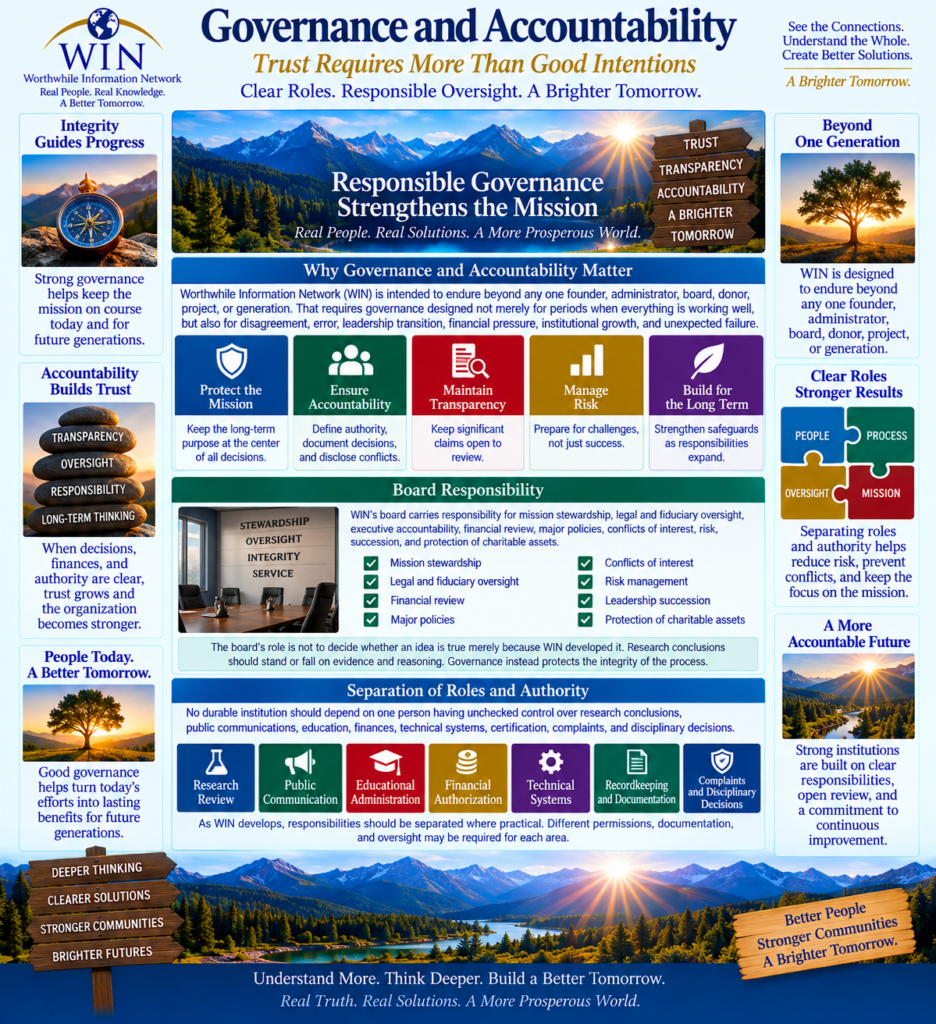
Trust Requires More Than Good Intentions
Worthwhile Information Network (WIN) is intended to endure beyond any one founder, administrator, board, donor, project, or generation. That requires governance designed not merely for periods when everything is working well, but also for disagreement, error, leadership transition, financial pressure, institutional growth, and unexpected failure.
Accountability is therefore part of WIN’s organizational architecture. Authority is defined, important decisions are documented, conflicts are disclosed, significant claims remain open to review, and safeguards become stronger as WIN’s responsibilities expand.
Board Responsibility
WIN’s board carries responsibility for mission stewardship, legal and fiduciary oversight, executive accountability, financial review, major policies, conflicts of interest, risk, succession, and protection of charitable assets.
The board’s role is not to decide whether an idea is true merely because WIN developed it. Research conclusions stand or fall on evidence and reasoning. Governance instead protects the integrity of the process by establishing authority, controlling resources, reviewing decisions, addressing misconduct, and keeping the organization accountable to its mission.
Separation of Roles and Authority
WIN’s long-term governance structure is designed to prevent any one person from having unchecked control over research conclusions, public communications, education, finances, technical systems, certification, complaints, and disciplinary decisions.
As WIN develops, responsibilities will be separated where practical. Financial authorization, recordkeeping, technical administration, research review, public communication, educational administration, and case-related decisions may require different permissions, documentation, or independent review. The level of separation will increase with the size and risk of the activity.
Documented Decisions and Institutional Memory
Important WIN decisions leave an understandable record. Policies, approvals, revisions, exceptions, financial decisions, research changes, governance actions, and major operational judgments are documented sufficiently for later review to determine what happened and why.
This protects WIN from personality dependence and institutional amnesia. Future administrators should not have to reconstruct critical decisions from memory, informal conversations, or inaccessible personal files.
Conflict of Interest
Board members, administrators, reviewers, volunteers, donors, partners, and contractors may sometimes have financial, professional, personal, or organizational interests that could affect—or appear to affect—their judgment.
Relevant conflicts are disclosed and handled according to written policy. Disclosure does not automatically require exclusion from every discussion, but undisclosed conflicts undermine trust and can distort decisions. When a conflict is substantial, recusal or independent review is used as appropriate.
Financial Accountability
WIN uses its charitable resources for its mission and protects them through appropriate budgeting, authorization, recordkeeping, review, and reporting. Financial controls remain proportionate to WIN’s size and complexity and become stronger as funding, staffing, programs, or contractual obligations increase.
Financial support does not give a donor control over WIN’s research conclusions. Funding relationships do not prevent WIN from correcting an error, reporting an inconvenient finding, or examining competing explanations.
Research and Publication Accountability
WIN’s research framework requires claims to remain open to evidence, criticism, correction, and refinement. Organizational authority does not make a conclusion true, and longevity does not make an explanation immune from revision.
WIN’s public materials distinguish, where important, among established information, interpretation, working frameworks, uncertainty, and future proposals. When credible evidence shows that published material is materially incomplete or wrong, WIN makes significant corrections.
Correction, Complaints, and Appeals
Accountability includes processes for identifying and correcting mistakes. As WIN develops, it maintains procedures appropriate to its stage of development for correcting published material, reporting suspected misconduct, reviewing significant administrative decisions, and addressing credible complaints.
Future educational, certification, or disciplinary systems will include notice of significant adverse decisions, documented reasons, appropriate review procedures, and safeguards against retaliation for good-faith reporting.
Privacy, Security, and Responsible Access
Governance also includes stewardship of information. WIN limits access to personal, financial, administrative, research, and technical records according to legitimate responsibilities. Sensitive systems do not depend on shared credentials or undocumented access.
As WIN develops more advanced educational and technical capabilities, privacy, cybersecurity, data retention, access control, incident response, and recovery requirements should mature with them.
Succession and Continuity
WIN’s mission is intentionally longer than the working life of any individual. Critical knowledge, credentials, contracts, policies, source files, research records, decision rationales, technical documentation, and institutional responsibilities therefore need organization-controlled continuity.
Leadership succession preserves WIN’s mission without freezing the institution in time. Future leaders must be able to understand why important structures exist while retaining the ability to correct them when evidence, law, technology, or circumstances change.
Independent Review
An organization cannot credibly evaluate every aspect of itself entirely from the inside. As WIN grows, it will use qualified external legal, financial, academic, technical, accessibility, security, and program-evaluation review where the stakes justify independent examination.
Independent review is especially valuable where internal incentives could make weaknesses difficult to see. The purpose is not to surrender responsibility to outside authorities, but to expose assumptions, detect blind spots, and strengthen decisions through competent scrutiny.
Growth Should Not Outrun Governance
WIN’s future plans may eventually include structured education, learning pathways, evaluation, certification, collaborative research, and other institutional capabilities. These functions will expand only as the governance, staffing, technology, financial controls, privacy protections, security, and review systems necessary to support them become ready.
Capability without accountability creates institutional risk. WIN’s objective is controlled development in which safeguards mature with authority and responsibility.
Accountability Applies to WIN Too
WIN’s principles are not standards only for other institutions. If WIN advocates evidence, transparency, learning from failure, correction of harmful patterns, and long-term responsibility, those same expectations must be applied internally.
No governance structure can guarantee perfect decisions. A stronger standard is whether the institution can detect error, expose conflicts, preserve records, correct failures, learn from experience, and improve without abandoning its mission.
Continue Exploring
Governance is one part of a larger accountability structure. Continue with WIN’s transparency and policy materials to see how public responsibility, organizational standards, and future safeguards fit together.