Real Truth
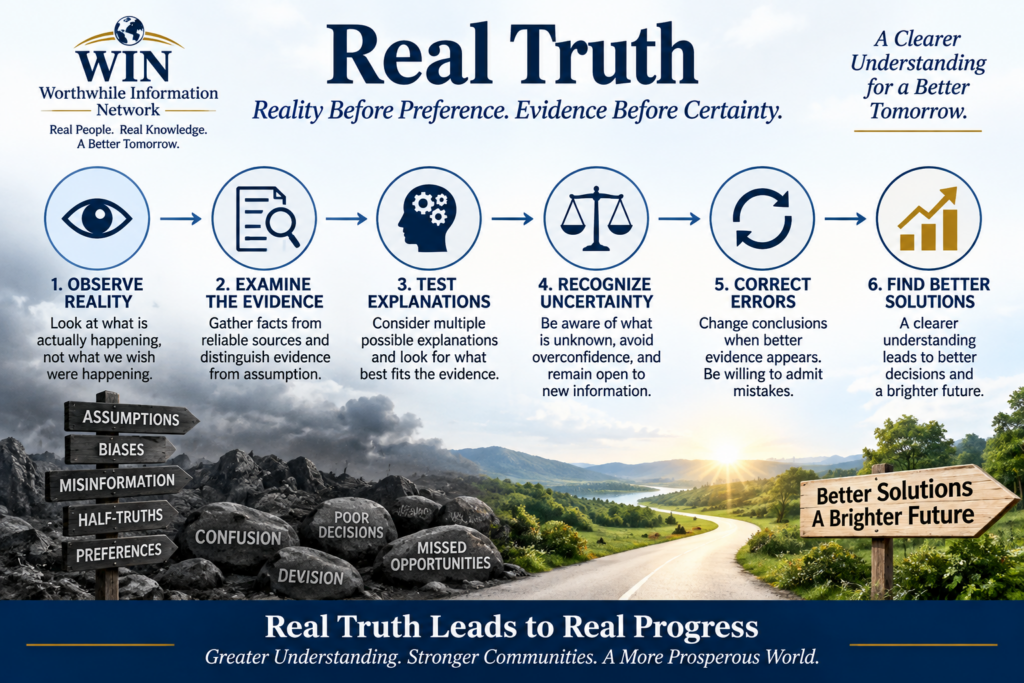
We Face Reality. We Find Real Solutions.
WIN uses the phrase Real Truth to describe a disciplined commitment to understanding reality as accurately as available evidence and sound reasoning permit—even when the evidence is inconvenient, incomplete, uncertain, or different from what we expected.
Real Truth is not a claim that WIN possesses perfect knowledge.
It is not a declaration that WIN’s conclusions are automatically correct.
It is not a label WIN can attach to an idea to place that idea beyond criticism.
Real Truth is a standard for how knowledge should be pursued: examine reality, gather relevant evidence, distinguish observation from assumption, compare explanations, recognize uncertainty, expose conclusions to criticism, and change them when better evidence requires it.
The purpose is practical. Better solutions depend on better explanations of what is actually happening and why.
Reality Exists Independently of Our Preferences
People naturally develop beliefs, loyalties, hopes, fears, expectations, identities, and prior assumptions.
Those influences can affect what evidence we notice, which explanations we prefer, and how quickly we dismiss information that challenges us.
Reality does not change merely because a conclusion is comforting, popular, traditional, profitable, politically convenient, institutionally useful, or strongly believed.
A Real Truth standard therefore asks a harder question:
What does the best available evidence support, regardless of what we would prefer to be true?
This does not require people to abandon values. It requires separating questions about what is happening from questions about what we want to happen whenever that distinction matters.
Real Truth Is a Direction, Not a Claim of Perfection
Human knowledge is incomplete.
Evidence can be missing. Measurements can be imperfect. Memories can fail. Sources can be wrong. Definitions can be unclear. Researchers can overlook variables. Institutions can preserve mistaken assumptions. New evidence can change what once appeared well established.
For that reason, Real Truth is better understood as a direction of inquiry than as a certificate of certainty.
The objective is to move our understanding closer to reality while remaining capable of recognizing when we have moved in the wrong direction.
Evidence Before Certainty
Confidence should follow evidence rather than precede it.
Strong conclusions require stronger support than tentative hypotheses, and important claims should survive serious attempts to challenge them.
Evidence quality also matters. Repetition alone does not establish truth. A claim repeated by many people can still be wrong, while a single observation can sometimes reveal that an existing explanation is incomplete.
WIN therefore seeks confidence proportionate to the quality, relevance, independence, consistency, and limitations of the available evidence.
Where evidence remains mixed or incomplete, the responsible conclusion may be uncertainty rather than false precision.
Separate Observation From Interpretation
What happened and what we think it means are not necessarily the same thing.
WIN distinguishes, where important, among:
Observation — What was directly observed or measured?
Report — What did another source say occurred?
Interpretation — What meaning are we assigning to the information?
Inference — What conclusion are we drawing beyond direct observation?
Hypothesis — What possible explanation are we considering?
Prediction — What should occur if the explanation is substantially correct?
Value judgment — What do we believe ought to happen?
Unknown — What important information do we still lack?
Keeping these categories distinct does not weaken an argument. It makes the reasoning easier to examine and makes errors easier to find.
Facts and Explanations Are Not the Same Thing
People can agree on an observed fact while disagreeing about what caused it.
A measured outcome may be real while the explanation for that outcome remains uncertain.
WIN therefore distinguishes evidence that something occurred from evidence explaining why it occurred.
Strong causal explanations must account for relevant facts, plausible alternatives, timing, mechanisms, contradictory cases, and other evidence appropriate to the question.
Competing Explanations Matter
A conclusion becomes more credible when it performs better than serious alternatives—not merely when supporting examples can be found.
For important questions, WIN considers contradictory evidence, competing explanations, alternative causal models, unusual cases, and conditions under which an explanation may fail.
The purpose is not to manufacture artificial disagreement where evidence strongly favors one explanation.
It is to reduce the danger of accepting the first plausible explanation simply because it fits what we already believe.
Correlation Is Not Automatically Causation
Two things occurring together does not establish that one caused the other.
They may share another cause. One may influence the other. Influence may operate in both directions. The relationship may depend on additional conditions. Selection or measurement effects may be involved. Sometimes the apparent relationship may be coincidental.
WIN therefore keeps causal claims proportionate to the evidence supporting them.
Look Beyond the Visible Symptom
A visible problem may be the final step in a much longer process.
Crime, corruption, educational failure, destructive behavior, institutional breakdown, recurring conflict, or repeated policy failure may arise from interacting developmental, social, economic, informational, organizational, technological, or institutional conditions.
Real Truth therefore requires more than accurately describing the symptom.
It requires asking what combination of conditions generated, sustained, or repeatedly recreated the outcome.
That deeper causal inquiry is what WIN refers to as searching for the Real Root Cause—not necessarily one hidden cause, but causal understanding deep enough to explain why the important pattern keeps returning.
A Root Cause Must Earn the Name
Calling something a Real Root Cause does not make it one.
A proposed root cause should explain important observations, remain consistent with credible evidence, outperform plausible competing explanations where possible, generate useful expectations, and remain open to revision.
A deeper-sounding explanation is not necessarily a better explanation.
The objective is not to find the most dramatic or philosophically satisfying cause. It is to identify the causal structure that best explains the evidence.
Real Facts Must Survive Examination
WIN sometimes uses the phrase Real Facts to emphasize facts that have been sufficiently checked to justify relying upon them.
A Real Fact is not created by organizational declaration.
The relevant question is whether the information can survive appropriate verification: source examination, context, corroboration where needed, competing evidence, measurement limitations, and correction when new information appears.
The stronger the consequence attached to a factual claim, the stronger the verification expected before relying upon it.
Sources Are Evidence, Not Authority by Default
Expertise matters. Credible institutions matter. Professional research matters. Primary records matter.
But the identity of a source does not make every claim from that source automatically correct.
WIN evaluates sources in relation to the question being examined: expertise, methodology, access to relevant information, independence, transparency, corroboration, conflicts of interest, track record, and other appropriate considerations.
The objective is neither blind trust nor automatic distrust.
It is evidence-based evaluation.
Expertise Matters Without Becoming Infallible
Complex subjects often require specialized knowledge.
WIN therefore values qualified academic, scientific, technical, legal, educational, financial, statistical, security, accessibility, and other professional expertise where relevant.
Expertise should increase the quality of examination, not end examination.
Experts can disagree. Experts can make mistakes. Fields can change as evidence improves.
Respect for expertise and willingness to examine expert conclusions are compatible.
Consensus Is Evidence, Not Proof by Itself
Broad expert agreement can be important evidence, particularly when it emerges from substantial research, independent replication, professional scrutiny, and converging lines of evidence.
Consensus is not automatically infallible.
Its significance depends on why the agreement exists, the quality of the underlying evidence, the degree of genuine independence, the maturity of the field, and whether credible contradictory evidence has been adequately examined.
WIN neither dismisses consensus merely because it is consensus nor treats consensus as a substitute for evidence.
Popularity Does Not Determine Reality
A belief does not become true because many people accept it.
Nor does a belief become false merely because it is unpopular.
Public opinion can be useful evidence about what people believe, value, fear, prefer, or experience. It does not by itself establish the factual accuracy of the underlying claim.
Reality is not decided by vote.
Repetition Does Not Transform a Claim Into Evidence
A statement can be repeated across websites, news reports, social media, organizations, classrooms, or conversations while still originating from one unsupported or misunderstood source.
WIN therefore distinguishes multiple repetitions of the same claim from genuinely independent evidence.
Ten sources repeating one unsupported assertion are not necessarily ten independent confirmations.
Personal Experience Matters—Within Its Limits
Personal experience can reveal important information.
It can expose a problem, identify a possibility, reveal an unexpected consequence, challenge an assumption, or suggest a hypothesis that deserves investigation.
Personal experience also has limits. One person’s experience does not automatically establish how common something is, what caused it, or whether the same explanation applies to other people or situations.
WIN therefore respects experience without asking it to prove more than it can establish.
Historical Evidence Requires Context
History can provide evidence about recurring patterns, institutional behavior, incentives, consequences, human decisions, and long-term outcomes.
Historical analogy can also mislead when important conditions differ.
WIN therefore examines both similarities and differences before assuming that a past event explains or predicts a present one.
Definitions Matter
Disagreements sometimes persist because people are using the same word to mean different things.
Important terms should therefore be defined clearly enough that people can understand what is being claimed and determine whether the evidence actually supports it.
Changing a definition after evidence becomes inconvenient can make a claim impossible to test.
WIN seeks definitions that clarify examination rather than protect conclusions from examination.
Uncertainty Is Information
Saying “we do not know” can be a scientifically and intellectually responsible conclusion.
Uncertainty may result from insufficient evidence, conflicting evidence, poor measurement, unknown variables, limited expertise, changing conditions, or multiple explanations that remain plausible.
WIN does not treat uncertainty as failure.
Clearly identifying uncertainty tells us what still needs to be learned.
Confidence Should Have Degrees
Knowledge is rarely divided cleanly into absolute certainty and total ignorance.
Conclusions may be well established, strongly supported, provisionally supported, plausible but uncertain, speculative, contradicted, or unresolved.
WIN seeks language that reflects those differences.
Confidence should increase when independent evidence converges and decrease when predictions fail, assumptions collapse, important contradictory evidence appears, or stronger explanations emerge.
Ask What Would Prove Us Wrong
A serious claim should expose itself to possible correction.
WIN therefore asks:
What evidence would reduce our confidence in this conclusion?
What observation would contradict the explanation?
What prediction should fail if the explanation is wrong?
What competing explanation could account for the evidence better?
A claim structured so that every possible result is treated as confirmation becomes difficult to evaluate and therefore less useful.
Criticism Is Part of the Search for Truth
Criticism can expose missing evidence, weak assumptions, ambiguous definitions, measurement problems, contradictions, alternative explanations, or unintended consequences.
For that reason, criticism is not inherently opposition to WIN’s mission.
Serious criticism can advance the mission when it helps move understanding closer to reality.
The important distinction is not between people who agree with WIN and people who disagree.
It is between claims that can withstand meaningful examination and claims that cannot.
Truth Must Be Correctable
A system devoted to truth must contain a mechanism for admitting error.
If conclusions cannot be revised without threatening the identity, status, reputation, or authority of the people who produced them, errors can become institutionalized.
WIN therefore treats revision as part of the research process.
New evidence, better measurements, stronger reasoning, failed predictions, unintended consequences, or successful criticism can justify changing a conclusion.
The objective is not to preserve every historical statement.
It is to preserve what remains useful, document consequential changes where appropriate, and improve the accuracy of the knowledge upon which future decisions depend.
Correction Is a Strength
Discovering that an earlier conclusion was wrong is not desirable in itself—but correcting it is.
An organization that never acknowledges error is not demonstrating perfection. It may simply be demonstrating an inability to detect or admit mistakes.
WIN therefore treats well-supported correction as evidence that the learning process is functioning.
Transparency Builds Trust
Important public claims should be documented sufficiently for other people to examine relevant evidence, definitions, assumptions, reasoning, uncertainties, and revisions.
Transparency does not guarantee correctness.
It makes unsupported claims, hidden assumptions, conflicts of interest, contradictions, and mistakes easier to detect.
It also gives future reviewers enough information to understand why a conclusion was reached and whether it still deserves confidence.
Real Truth Applies to WIN Too
WIN cannot credibly ask others to examine their assumptions while protecting its own assumptions from examination.
The same standards WIN applies to outside claims must apply to WIN’s research, educational material, organizational decisions, public statements, and future programs.
If evidence shows that an important WIN conclusion is wrong, the appropriate response is not to defend it because it is a WIN conclusion.
The appropriate response is to correct it.
Real Truth Does Not Require Agreement
People examining the same evidence can sometimes reach different conclusions in good faith.
They may assign different weight to uncertain evidence, use different but defensible assumptions, possess different relevant information, or disagree about how evidence should be interpreted.
Real Truth therefore does not require forced consensus.
It requires making the disagreement clear enough that the evidence, assumptions, definitions, and reasoning can continue to be examined.
From Real Truth to Real Solutions
Real Truth is not intended to end with description.
Accurate understanding should improve the quality of the next decision.
When an explanation identifies conditions that actually generate an outcome, better questions become possible:
What would need to change?
What intervention should produce a measurable difference?
What unintended effects might follow?
How long should improvement take?
What evidence would show that the intervention worked?
What evidence would show that our explanation or solution is failing?
That is the connection between Real Truth and Real Solutions.
Reality is the constraint.
A solution that works only in theory, depends on incorrect assumptions, produces unacceptable unintended consequences, or repeatedly fails under real conditions must be improved rather than defended.
The Standard
Real Truth does not mean:
“WIN says this is true.”
It means:
“This is our best current understanding of reality based on the evidence and reasoning available to us, stated with appropriate confidence, exposed to serious challenge, and subject to correction when better evidence appears.”
That standard is more demanding than certainty by declaration.
It also gives WIN something more valuable than the appearance of always being right:
the ability to keep learning.
Continue Exploring
Explore how WIN evaluates evidence and how deeper causal analysis helps distinguish visible symptoms from the conditions that repeatedly produce them.
How We Evaluate Evidence
Looking Beyond Symptoms
Research Overview