Core Principles
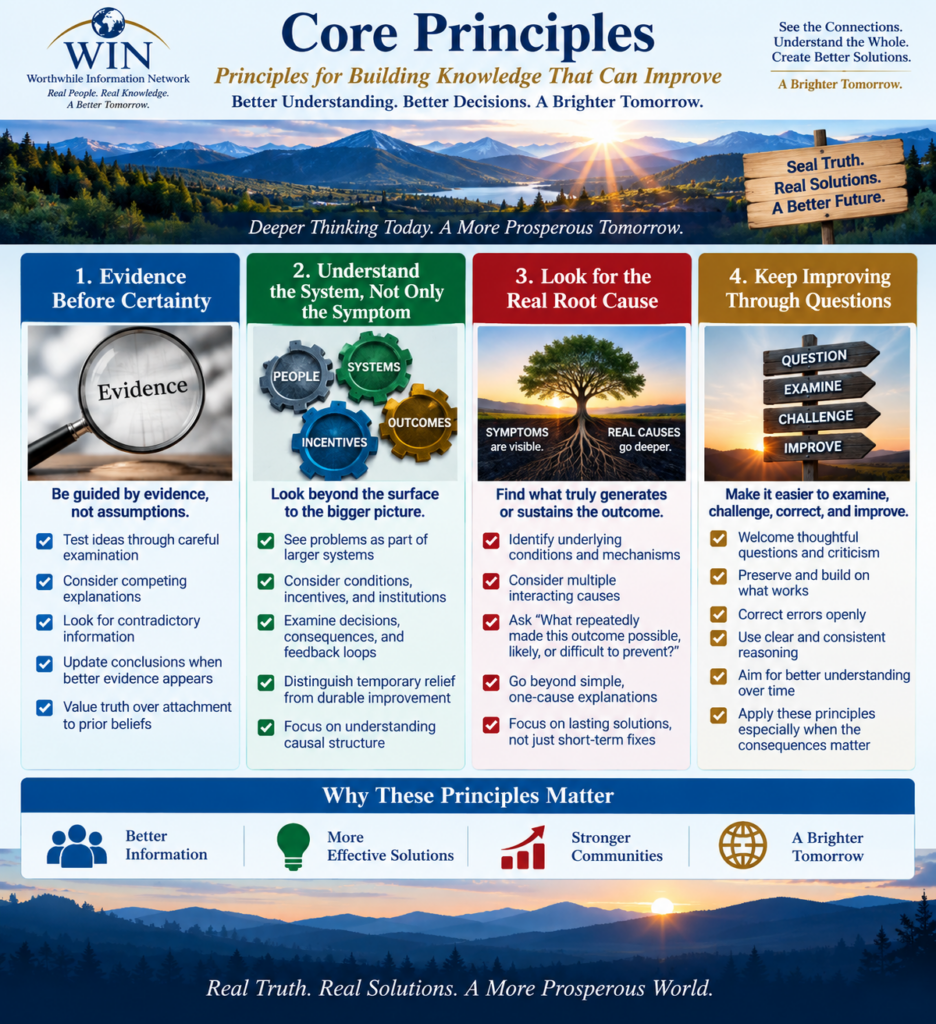
Principles for Building Knowledge That Can Improve
WIN’s work is guided by a set of principles intended to make ideas easier to examine, challenge, correct, preserve, and improve. These principles are not claims that WIN has every answer. They are standards for how questions should be approached when the consequences matter.
Evidence Before Certainty
Confidence should follow evidence rather than precede it. Claims become more credible when they survive careful examination, competing explanations, contradictory information, and repeated testing.
When better evidence changes the picture, conclusions should change with it. Preserving a belief should never become more important than improving an explanation.
Understand the System, Not Only the Symptom
A visible problem may be only the final expression of a much larger process. WIN therefore looks beyond immediate symptoms to the conditions, incentives, developmental influences, institutions, decisions, consequences, and feedback loops that repeatedly help produce an outcome.
The objective is not complexity for its own sake. It is to understand enough of the causal structure to distinguish temporary relief from durable improvement.
Look for the Real Root Cause
WIN uses the term Real Root Cause for causal understanding deep enough to identify the conditions and mechanisms that actually generate or regenerate an outcome.
For complex human problems, this may involve several interacting causes rather than one simple explanation. The useful question is not merely “What happened?” but “What repeatedly made this outcome possible, likely, or difficult to prevent?”
Human Development Matters
People do not develop independently of their surroundings. Families, schools, peers, information, incentives, opportunities, institutions, consequences, examples, and repeated experiences can influence judgment, habits, expectations, character, and behavior.
Understanding those influences can improve the design of education, prevention, institutions, and environments intended to support better human outcomes.
Education Before Coercion
Where responsible education, better information, improved incentives, prevention, or correction can reduce a problem, those approaches deserve serious consideration before unnecessary coercion or punishment.
This does not eliminate accountability. It distinguishes accountability from the assumption that punishment by itself repairs the conditions that produced harmful behavior.
Incentives and Consequences Shape Behavior
Rules alone do not determine outcomes. People and institutions also respond to incentives, opportunities, risks, rewards, social expectations, and consequences.
A system can unintentionally reward the very behavior it is trying to prevent. Durable design therefore requires examining what the system actually encourages—not merely what its policies say it encourages.
Transparency Makes Correction Possible
Important reasoning should be visible enough to examine. Definitions, assumptions, evidence, uncertainties, methods, and major conclusions should be documented so that other people can understand how an idea was reached and where it may need improvement.
Transparency does not guarantee correctness. It makes error, weakness, and manipulation easier to detect and correction easier to perform.
Failure Is Information
When a policy, institution, educational method, or intervention fails, the failure should produce learning. What assumption was wrong? What condition was overlooked? What unintended consequence appeared? What changed when the improvement lasted—and what remained unchanged when the problem returned?
A system that cannot learn from failure is likely to repeat it.
Long-Term Consequences Matter
An intervention can look successful in the short term while creating larger problems later. WIN therefore examines immediate effects together with second-order consequences, recurring patterns, institutional durability, and long-horizon outcomes.
The question is not only whether something works today, but whether the reasoning and structures behind it remain beneficial, understandable, correctable, and sustainable over time.
No Idea Is Above Examination
WIN does not ask people to believe an idea simply because WIN presents it. Competing explanations matter. Criticism matters. Contradictory evidence matters.
A worthwhile body of knowledge should become stronger through examination rather than depending on protection from it.
The Standard Is Improvement
The purpose of these principles is practical: better understanding should support better decisions, stronger development, healthier institutions, more responsible behavior, earlier correction of harmful patterns, and systems that become progressively better at learning from experience.
WIN’s work remains open to revision because the standard is not whether an idea has been defended successfully. The standard is whether it can be made more accurate, useful, durable, and beneficial.